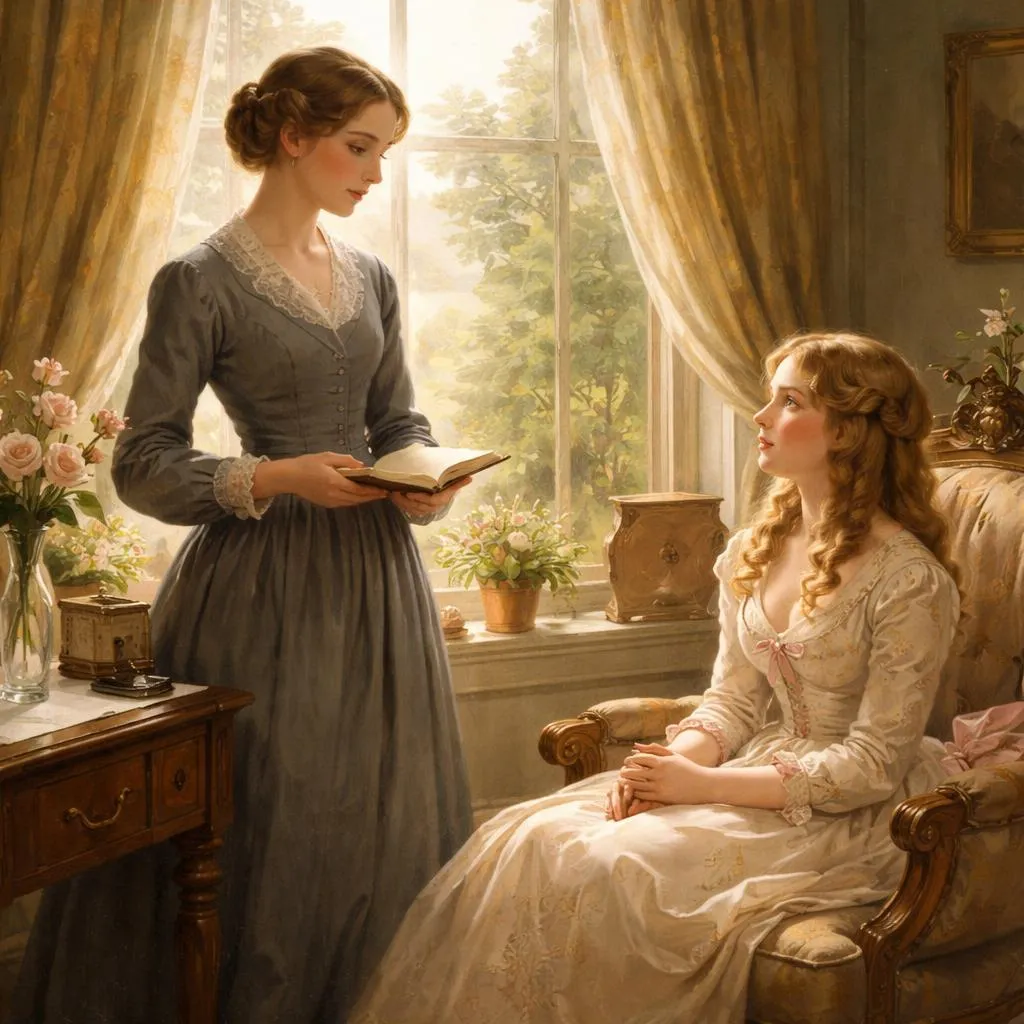

Next Sunday was one of the gloomiest of April days—a day of thick, dark clouds, and heavy showers. None of the Murrays were disposed to attend church in the afternoon, excepting Rosalie: she was bent upon going as usual; so she ordered the carriage, and I went with her: nothing loth, of course, for at church I might look without fear of scorn or censure upon a form and face more pleasing to me than the most beautiful of God’s creations; I might listen without disturbance to a voice more charming than the sweetest music to my ears; I might seem to hold communion with that soul in which I felt so deeply interested, and imbibe its purest thoughts and holiest aspirations, with no alloy to such felicity except the secret reproaches of my conscience, which would too often whisper that I was deceiving my own self, and mocking God with the service of a heart more bent upon the creature than the Creator.
Sometimes, such thoughts would give me trouble enough; but sometimes I could quiet them with thinking—it is not the man, it is his goodness that I love. ‘Whatsoever things are pure, whatsoever things are lovely, whatsoever things are honest and of good report, think on these things.’ We do well to worship God in His works; and I know none of them in which so many of His attributes—so much of His own spirit shines, as in this His faithful servant; whom to know and not to appreciate, were obtuse insensibility in me, who have so little else to occupy my heart.
Almost immediately after the conclusion of the service, Miss Murray left the church. We had to stand in the porch, for it was raining, and the carriage was not yet come. I wondered at her coming forth so hastily, for neither young Meltham nor Squire Green was there; but I soon found it was to secure an interview with Mr. Weston as he came out, which he presently did. Having saluted us both, he would have passed on, but she detained him; first with observations upon the disagreeable weather, and then with asking if he would be so kind as to come some time to–morrow to see the granddaughter of the old woman who kept the porter’s lodge, for the girl was ill of a fever, and wished to see him. He promised to do so.
‘And at what time will you be most likely to come, Mr. Weston? The old woman will like to know when to expect you—you know such people think more about having their cottages in order when decent people come to see them than we are apt to suppose.’
Here was a wonderful instance of consideration from the thoughtless Miss Murray. Mr. Weston named an hour in the morning at which he would endeavour, to be there. By this time the carriage was ready, and the footman was waiting, with an open umbrella, to escort Miss Murray through the churchyard. I was about to follow; but Mr. Weston had an umbrella too, and offered me the benefit of its shelter, for it was raining heavily.
‘No, thank you, I don’t mind the rain,’ I said. I always lacked common sense when taken by surprise.
‘But you don’t LIKE it, I suppose?—an umbrella will do you no harm at any rate,’ he replied, with a smile that showed he was not offended; as a man of worse temper or less penetration would have been at such a refusal of his aid. I could not deny the truth of his assertion, and so went with him to the carriage; he even offered me his hand on getting in: an unnecessary piece of civility, but I accepted that too, for fear of giving offence. One glance he gave, one little smile at parting—it was but for a moment; but therein I read, or thought I read, a meaning that kindled in my heart a brighter flame of hope than had ever yet arisen.
‘I would have sent the footman back for you, Miss Grey, if you’d waited a moment—you needn’t have taken Mr. Weston’s umbrella,’ observed Rosalie, with a very unamiable cloud upon her pretty face.
‘I would have come without an umbrella, but Mr. Weston offered me the benefit of his, and I could not have refused it more than I did without offending him,’ replied I, smiling placidly; for my inward happiness made that amusing, which would have wounded me at another time.
The carriage was now in motion. Miss Murray bent forwards, and looked out of the window as we were passing Mr. Weston. He was pacing homewards along the causeway, and did not turn his head.
‘Stupid ass!’ cried she, throwing herself back again in the seat. ‘You don’t know what you’ve lost by not looking this way!’
‘What has he lost?’
‘A bow from me, that would have raised him to the seventh heaven!’
I made no answer. I saw she was out of humour, and I derived a secret gratification from the fact, not that she was vexed, but that she thought she had reason to be so. It made me think my hopes were not entirely the offspring of my wishes and imagination.
‘I mean to take up Mr. Weston instead of Mr. Hatfield,’ said my companion, after a short pause, resuming something of her usual cheerfulness. ‘The ball at Ashby Park takes place on Tuesday, you know; and mamma thinks it very likely that Sir Thomas will propose to me then: such things are often done in the privacy of the ball–room, when gentlemen are most easily ensnared, and ladies most enchanting. But if I am to be married so soon, I must make the best of the present time: I am determined Hatfield shall not be the only man who shall lay his heart at my feet, and implore me to accept the worthless gift in vain.’
‘If you mean Mr. Weston to be one of your victims,’ said I, with affected indifference, ‘you will have to make such overtures yourself that you will find it difficult to draw back when he asks you to fulfil the expectations you have raised.’
‘I don’t suppose he will ask me to marry him, nor should I desire it: that would be rather too much presumption! but I intend him to feel my power. He has felt it already, indeed: but he shall ACKNOWLEDGE it too; and what visionary hopes he may have, he must keep to himself, and only amuse me with the result of them—for a time.’
‘Oh! that some kind spirit would whisper those words in his ear,’ I inwardly exclaimed. I was far too indignant to hazard a reply to her observation aloud; and nothing more was said about Mr. Weston that day, by me or in my hearing. But next morning, soon after breakfast, Miss Murray came into the schoolroom, where her sister was employed at her studies, or rather her lessons, for studies they were not, and said, ‘Matilda, I want you to take a walk with me about eleven o’clock.’
‘Oh, I can’t, Rosalie! I have to give orders about my new bridle and saddle–cloth, and speak to the rat–catcher about his dogs: Miss Grey must go with you.’
‘No, I want you,’ said Rosalie; and calling her sister to the window, she whispered an explanation in her ear; upon which the latter consented to go.
I remembered that eleven was the hour at which Mr. Weston proposed to come to the porter’s lodge; and remembering that, I beheld the whole contrivance. Accordingly, at dinner, I was entertained with a long account of how Mr. Weston had overtaken them as they were walking along the road; and how they had had a long walk and talk with him, and really found him quite an agreeable companion; and how he must have been, and evidently was, delighted with them and their amazing condescension, &c. &c.
Background and Author Introduction
This passage is from a classic 19th-century novel, reflecting the social manners, relationships, and inner thoughts of its characters during that era. The story is set in a time when social status, courtship, and appearances played a significant role in daily life, especially among the gentry. The author, whose identity is not explicitly mentioned here, is likely a writer who explores themes of love, morality, and social expectations, often focusing on the internal conflicts of young women navigating society.
Detailed Interpretation and Significance
The scene describes a rainy Sunday afternoon where Rosalie, a determined character, insists on attending church despite the gloomy weather. The narrator, who is deeply moved by the presence and voice of Mr. Weston, experiences a mixture of admiration and internal conflict. She struggles with feelings of affection and guilt, torn between spiritual devotion and earthly desires.
Miss Murray’s behavior contrasts sharply with the narrator’s sincerity. Rosalie is portrayed as somewhat vain and manipulative, aiming to attract Mr. Weston’s attention for her own social advantage. This tension between genuine feeling and superficial ambition is a central theme, illustrating different ways people approach relationships and self-worth.
The story also highlights social customs of the time, such as the importance of appearances, the role of church as a social gathering, and the subtle power plays in courtship. The narrator’s reflections on goodness and purity suggest a moral lesson about valuing inner qualities over outward charm.
Lessons and Insights for Students
-
Understanding Inner Conflict: The narrator’s struggle teaches students about the complexity of human emotions, especially when balancing personal desires with ethical or spiritual beliefs. Recognizing such conflicts helps develop emotional intelligence.
-
Observing Social Dynamics: The contrast between characters shows how social status and personal ambitions influence behavior. Students can learn to identify motivations behind actions and understand the impact of societal expectations.
-
Appreciating Genuine Qualities: The narrator’s admiration for Mr. Weston’s goodness over his appearance encourages valuing character and kindness in others, a timeless lesson for building meaningful relationships.
-
Critical Thinking about Appearances: Rosalie’s manipulative tactics serve as a cautionary example about the dangers of superficiality and deceit. Students can reflect on the importance of authenticity in friendships and social interactions.
Applying These Lessons in Life and Learning
-
In School: Students can practice empathy by considering others’ feelings and motivations before judging them. They can also reflect on their own values and strive to act with integrity.
-
In Social Settings: Understanding that people may have hidden reasons for their behavior helps in managing friendships and conflicts more wisely. Recognizing genuine kindness versus superficial charm can guide better choices in relationships.
-
In Personal Growth: The narrator’s introspection encourages self-awareness. Students can learn to listen to their conscience and balance their emotions with reason and ethics.
Cultivating Positive Traits from the Story
-
Honesty and Sincerity: Emulate the narrator’s honest reflections and genuine feelings rather than adopting manipulative behaviors.
-
Respect for Others: Like the narrator’s respect for Mr. Weston’s goodness, students should appreciate others’ inner qualities beyond appearances.
-
Self-Reflection: Regularly think about one’s own motives and feelings to grow emotionally and morally.
-
Kindness and Consideration: Notice how Miss Murray’s moment of thoughtfulness about the old woman’s cottage shows that even seemingly thoughtless people can learn to be considerate. Small acts of kindness matter.
Conclusion
This passage offers rich material for young readers to explore themes of love, morality, social expectations, and self-awareness. By analyzing characters’ actions and inner thoughts, students can gain valuable insights into human nature and develop skills that help them navigate their own social worlds with empathy, integrity, and wisdom.
