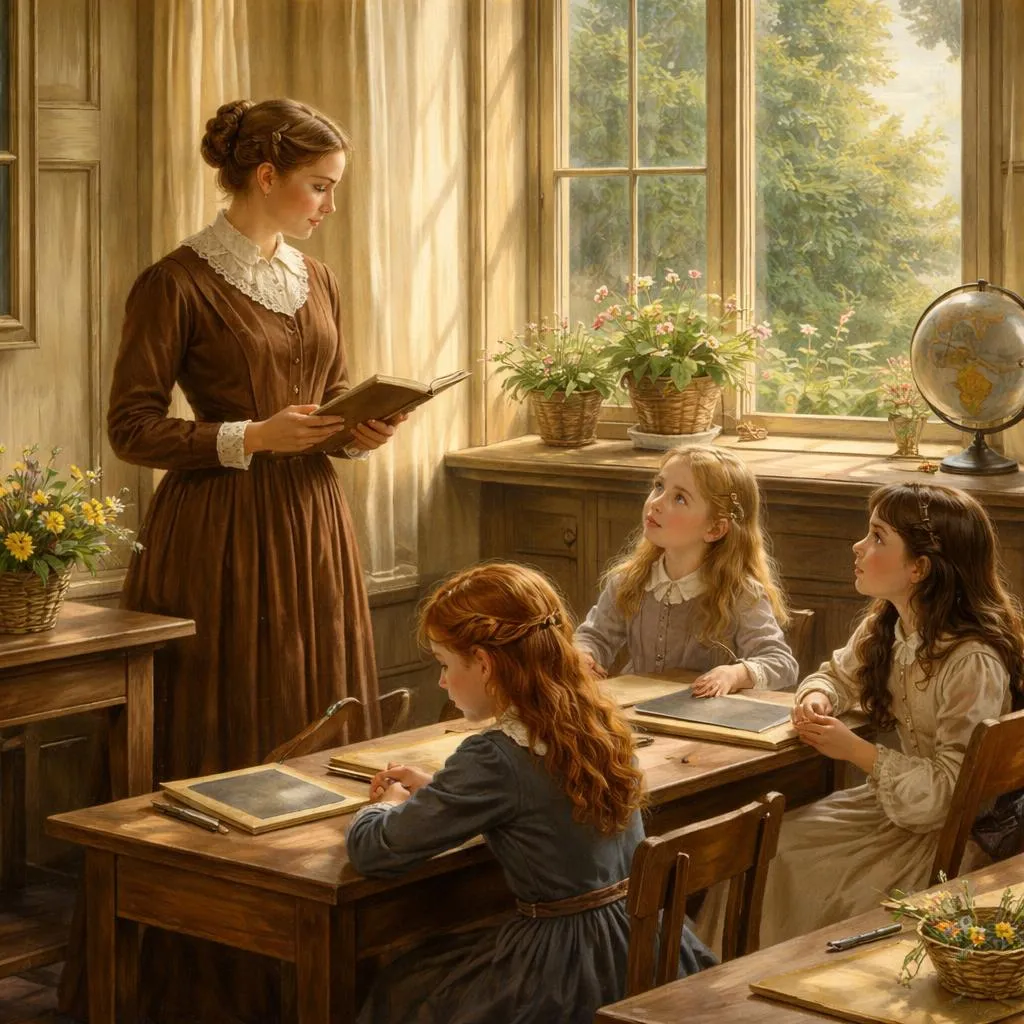

I left Horton Lodge, and went to join my mother in our new abode at A–. I found her well in health, resigned in spirit, and even cheerful, though subdued and sober, in her general demeanour. We had only three boarders and half a dozen day–pupils to commence with; but by due care and diligence we hoped ere long to increase the number of both.
I set myself with befitting energy to discharge the duties of this new mode of life. I call it NEW, for there was, indeed, a considerable difference between working with my mother in a school of our own, and working as a hireling among strangers, despised and trampled upon by old and young; and for the first few weeks I was by no means unhappy. ‘It is possible we may meet again,’ and ‘will it be of any consequence to you whether we do or not?’—Those words still rang in my ear and rested on my heart: they were my secret solace and support. ‘I shall see him again.—He will come; or he will write.’ No promise, in fact, was too bright or too extravagant for Hope to whisper in my ear. I did not believe half of what she told me: I pretended to laugh at it all; but I was far more credulous than I myself supposed; otherwise, why did my heart leap up when a knock was heard at the front door, and the maid, who opened it, came to tell my mother a gentleman wished to see her? and why was I out of humour for the rest of the day, because it proved to be a music–master come to offer his services to our school? and what stopped my breath for a moment, when the postman having brought a couple of letters, my mother said, ‘Here, Agnes, this is for you,’ and threw one of them to me? and what made the hot blood rush into my face when I saw it was directed in a gentleman’s hand? and why—oh! why did that cold, sickening sense of disappointment fall upon me, when I had torn open the cover and found it was ONLY a letter from Mary, which, for some reason or other, her husband had directed for her?
Was it then come to this—that I should be DISAPPOINTED to receive a letter from my only sister: and because it was not written by a comparative stranger? Dear Mary! and she had written it so kindly—and thinking I should be so pleased to have it!—I was not worthy to read it! And I believe, in my indignation against myself, I should have put it aside till I had schooled myself into a better frame of mind, and was become more deserving of the honour and privilege of its perusal: but there was my mother looking on, and wishful to know what news it contained; so I read it and delivered it to her, and then went into the schoolroom to attend to the pupils: but amidst the cares of copies and sums—in the intervals of correcting errors here, and reproving derelictions of duty there, I was inwardly taking myself to task with far sterner severity. ‘What a fool you must be,’ said my head to my heart, or my sterner to my softer self;—’how could you ever dream that he would write to you? What grounds have you for such a hope—or that he will see you, or give himself any trouble about you—or even think of you again?’ ‘What grounds?’—and then Hope set before me that last, short interview, and repeated the words I had so faithfully treasured in my memory. ‘Well, and what was there in that?—Who ever hung his hopes upon so frail a twig? What was there in those words that any common acquaintance might not say to another? Of course, it was possible you might meet again: he might have said so if you had been going to New Zealand; but that did not imply any INTENTION of seeing you—and then, as to the question that followed, anyone might ask that: and how did you answer?—Merely with a stupid, commonplace reply, such as you would have given to Master Murray, or anyone else you had been on tolerably civil terms with.’ ‘But, then,’ persisted Hope, ‘the tone and manner in which he spoke.’ ‘Oh, that is nonsense! he always speaks impressively; and at that moment there were the Greens and Miss Matilda Murray just before, and other people passing by, and he was obliged to stand close beside you, and to speak very low, unless he wished everybody to hear what he said, which—though it was nothing at all particular—of course, he would rather not.’ But then, above all, that emphatic, yet gentle pressure of the hand, which seemed to say, ‘TRUST me;’ and many other things besides—too delightful, almost too flattering, to be repeated even to one’s self. ‘Egregious folly—too absurd to require contradiction—mere inventions of the imagination, which you ought to be ashamed of. If you would but consider your own unattractive exterior, your unamiable reserve, your foolish diffidence—which must make you appear cold, dull, awkward, and perhaps ill–tempered too;—if you had but rightly considered these from the beginning, you would never have harboured such presumptuous thoughts: and now that you have been so foolish, pray repent and amend, and let us have no more of it!’
I cannot say that I implicitly obeyed my own injunctions: but such reasoning as this became more and more effective as time wore on, and nothing was seen or heard of Mr. Weston; until, at last, I gave up hoping, for even my heart acknowledged it was all in vain. But still, I would think of him: I would cherish his image in my mind; and treasure every word, look, and gesture that my memory could retain; and brood over his excellences and his peculiarities, and, in fact, all I had seen, heard, or imagined respecting him.
‘Agnes, this sea air and change of scene do you no good, I think: I never saw you look so wretched. It must be that you sit too much, and allow the cares of the schoolroom to worry you. You must learn to take things easy, and to be more active and cheerful; you must take exercise whenever you can get it, and leave the most tiresome duties to me: they will only serve to exercise my patience, and, perhaps, try my temper a little.’
So said my mother, as we sat at work one morning during the Easter holidays. I assured her that my employments were not at all oppressive; that I was well; or, if there was anything amiss, it would be gone as soon as the trying months of spring were over: when summer came I should be as strong and hearty as she could wish to see me: but inwardly her observation startled me. I knew my strength was declining, my appetite had failed, and I was grown listless and desponding;—and if, indeed, he could never care for me, and I could never see him more—if I was forbidden to minister to his happiness—forbidden, for ever, to taste the joys of love, to bless, and to be blessed—then, life must be a burden, and if my heavenly Father would call me away, I should be glad to rest. But it would not do to die and leave my mother. Selfish, unworthy daughter, to forget her for a moment! Was not her happiness committed in a great measure to my charge?—and the welfare of our young pupils too? Should I shrink from the work that God had set before me, because it was not fitted to my taste? Did not He know best what I should do, and where I ought to labour?—and should I long to quit His service before I had finished my task, and expect to enter into His rest without having laboured to earn it? ‘No; by His help I will arise and address myself diligently to my appointed duty. If happiness in this world is not for me, I will endeavour to promote the welfare of those around me, and my reward shall be hereafter.’ So said I in my heart; and from that hour I only permitted my thoughts to wander to Edward Weston—or at least to dwell upon him now and then—as a treat for rare occasions: and, whether it was really the approach of summer or the effect of these good resolutions, or the lapse of time, or all together, tranquillity of mind was soon restored; and bodily health and vigour began likewise, slowly, but surely, to return.
Early in June, I received a letter from Lady Ashby, late Miss Murray. She had written to me twice or thrice before, from the different stages of her bridal tour, always in good spirits, and professing to be very happy. I wondered every time that she had not forgotten me, in the midst of so much gaiety and variety of scene. At length, however, there was a pause; and it seemed she had forgotten me, for upwards of seven months passed away and no letter. Of course, I did not break my heart about THAT, though I often wondered how she was getting on; and when this last epistle so unexpectedly arrived, I was glad enough to receive it. It was dated from Ashby Park, where she was come to settle down at last, having previously divided her time between the continent and the metropolis. She made many apologies for having neglected me so long, assured me she had not forgotten me, and had often intended to write, &c. &c., but had always been prevented by something. She acknowledged that she had been leading a very dissipated life, and I should think her very wicked and very thoughtless; but, notwithstanding that, she thought a great deal, and, among other things, that she should vastly like to see me. ‘We have been several days here already,’ wrote she. ‘We have not a single friend with us, and are likely to be very dull. You know I never had a fancy for living with my husband like two turtles in a nest, were he the most delightful creature that ever wore a coat; so do take pity upon me and come. I suppose your Midsummer holidays commence in June, the same as other people’s; therefore you cannot plead want of time; and you must and shall come—in fact, I shall die if you don’t. I want you to visit me as a friend, and stay a long time. There is nobody with me, as I told you before, but Sir Thomas and old Lady Ashby: but you needn’t mind them—they’ll trouble us but little with their company. And you shall have a room to yourself, whenever you like to retire to it, and plenty of books to read when my company is not sufficiently amusing. I forget whether you like babies; if you do, you may have the pleasure of seeing mine—the most charming child in the world, no doubt; and all the more so, that I am not troubled with nursing it—I was determined I wouldn’t be bothered with that. Unfortunately, it is a girl, and Sir Thomas has never forgiven me: but, however, if you will only come, I promise you shall be its governess as soon as it can speak; and you shall bring it up in the way it should go, and make a better woman of it than its mamma. And you shall see my poodle, too: a splendid little charmer imported from Paris: and two fine Italian paintings of great value—I forget the artist. Doubtless you will be able to discover prodigious beauties in them, which you must point out to me, as I only admire by hearsay; and many elegant curiosities besides, which I purchased at Rome and elsewhere; and, finally, you shall see my new home—the splendid house and grounds I used to covet so greatly. Alas! how far the promise of anticipation exceeds the pleasure of possession! There’s a fine sentiment! I assure you I am become quite a grave old matron: pray come, if it be only to witness the wonderful change. Write by return of post, and tell me when your vacation commences, and say that you will come the day after, and stay till the day before it closes—in mercy to
‘Yours affectionately,
‘ROSALIE ASHBY.’
I showed this strange epistle to my mother, and consulted her on what I ought to do. She advised me to go; and I went—willing enough to see Lady Ashby, and her baby, too, and to do anything I could to benefit her, by consolation or advice; for I imagined she must be unhappy, or she would not have applied to me thus—but feeling, as may readily be conceived, that, in accepting the invitation, I made a great sacrifice for her, and did violence to my feelings in many ways, instead of being delighted with the honourable distinction of being entreated by the baronet’s lady to visit her as a friend. However, I determined my visit should be only for a few days at most; and I will not deny that I derived some consolation from the idea that, as Ashby Park was not very far from Horton, I might possibly see Mr. Weston, or, at least, hear something about him.
Background and Author Introduction
This passage is from a classic 19th-century novel, reflecting the life and inner thoughts of a young woman navigating personal hopes and societal expectations. The author, writing during a time when women’s roles were often confined to domestic and educational spheres, explores themes of love, disappointment, duty, and personal growth. The narrative style is introspective, allowing readers to delve deeply into the protagonist’s emotional world, her struggles with hope and reality, and her efforts to find meaning and purpose despite setbacks.
Detailed Interpretation and Significance
The story vividly portrays the protagonist’s transition from a life of dependence to one of responsibility, as she moves with her mother to a new home and takes on the challenge of managing a small school. The emotional tension between hope and disappointment is central: she clings to the possibility of reconnecting with Edward Weston, whose brief, ambiguous interaction fuels her dreams, yet reality repeatedly confronts her with silence and absence.
The passage also highlights the protagonist’s internal conflict—between allowing herself to hope and the harsh self-reproach that follows each dashed expectation. This tension reflects a universal human experience, especially poignant for young readers learning to balance dreams with reality. The mother’s practical advice and concern serve as a grounding force, encouraging resilience and self-care.
The invitation from Lady Ashby introduces a new social dynamic and potential for change, symbolizing the protagonist’s tentative steps into a broader world beyond her immediate struggles. It also contrasts different life choices and attitudes, offering readers a glimpse into themes of friendship, social status, and personal transformation.
Lessons and Insights for Students
-
Hope and Resilience: The protagonist’s journey teaches students about the importance of hope as a source of comfort and motivation, but also about the need for resilience when hopes are not immediately fulfilled. Learning to manage expectations and maintain inner strength is a valuable life skill.
-
Self-Reflection and Growth: The narrative encourages self-awareness, showing how the protagonist critically examines her own feelings and behaviors. Students can learn the value of honest self-reflection in personal development.
-
Balancing Emotions and Duties: The story illustrates the challenge of balancing emotional desires with responsibilities. This is relevant for students facing academic pressures, family expectations, or social challenges, reminding them to find equilibrium between personal feelings and obligations.
-
Empathy and Understanding Others: Through the protagonist’s concern for her mother and her willingness to support Lady Ashby despite personal sacrifice, readers learn about empathy, kindness, and the importance of helping others even when it is difficult.
Application in Daily Life
-
In Learning: Students can apply the protagonist’s diligence and perseverance in their studies, recognizing that setbacks are part of growth and that maintaining hope can motivate continued effort.
-
In Social Interactions: The story encourages patience and understanding in relationships, showing that people’s actions often have deeper reasons, and that kindness can be a powerful response to others’ struggles.
-
In Personal Development: By reflecting on their own hopes and disappointments, students can develop emotional intelligence, learning to cope with challenges constructively and to support those around them.
Cultivating Positive Qualities from the Story
-
Patience: Like the protagonist, students can practice patience with themselves and others, understanding that not all desires are fulfilled immediately.
-
Courage: Facing emotional pain and continuing to fulfill duties requires bravery, a quality students can nurture by stepping out of comfort zones and facing challenges head-on.
-
Hopefulness: Maintaining hope, even when circumstances are difficult, can inspire students to keep striving toward their goals.
-
Compassion: The protagonist’s empathy toward her mother and Lady Ashby models compassion, encouraging students to be considerate and supportive friends and family members.
Conclusion
This excerpt offers a rich exploration of human emotions and social realities that remain relevant to young readers today. By engaging with the protagonist’s experiences, students can gain insights into managing their own feelings, building resilience, and acting with kindness and responsibility. The story serves not only as a literary work but also as a guide for personal growth and social understanding, making it a valuable resource for education and self-development.
