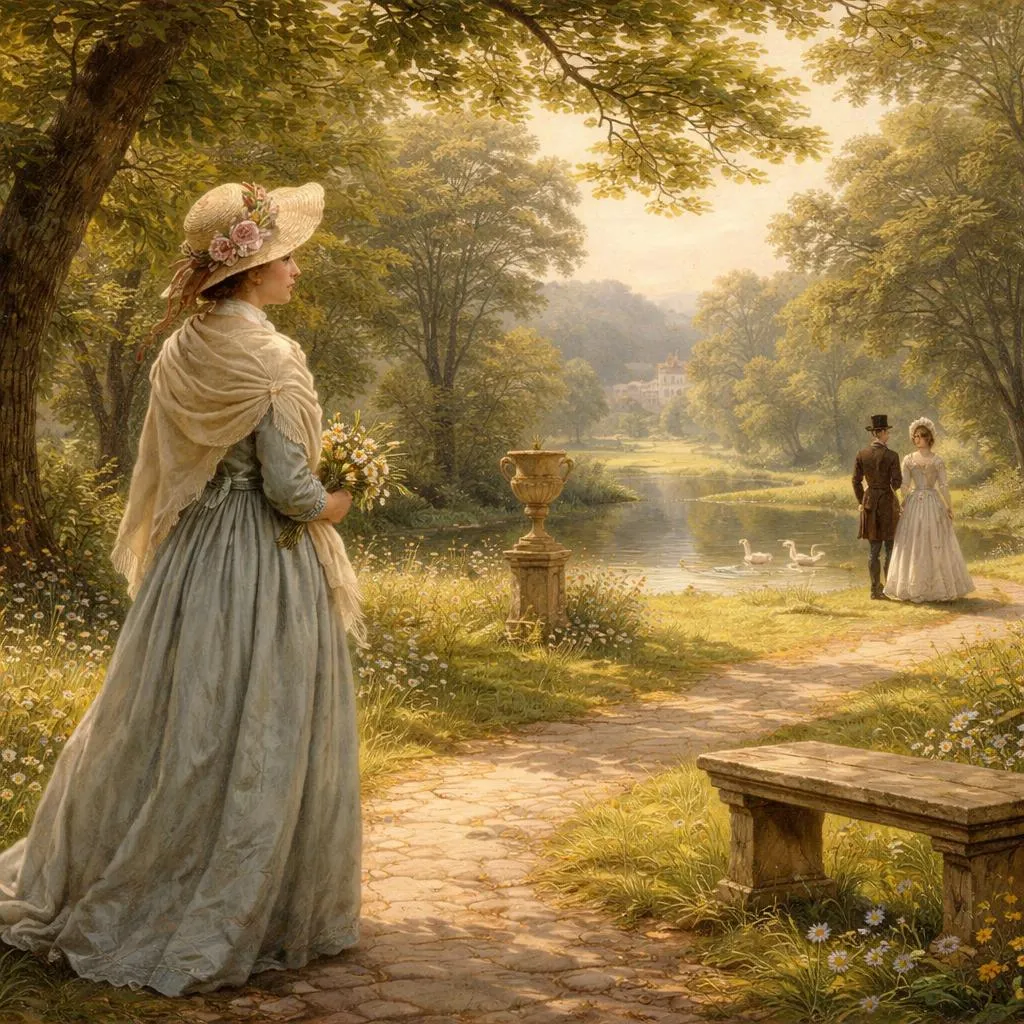

I came down a little before eight the next morning, guided by the distant clock’s chimes. Breakfast was not yet ready, so I waited over an hour, still eager to explore the library. After finishing my solitary meal, I waited another hour and a half, feeling anxious and unsure of what to do next. Finally, Lady Ashby appeared to greet me. She told me she had just finished breakfast and invited me for an early walk in the park. When she asked how long I had been awake and heard my answer, she expressed deep regret and promised again to show me the library. I suggested she do so immediately to avoid any further delays or forgetfulness. She agreed, but only if I promised not to read or bother with the books just yet, as she wanted to show me the gardens and take a walk before the heat became unbearable—which it already nearly was. I gladly agreed, and we set off.
As we strolled through the park, talking about her travels and experiences, a man on horseback rode past us. As he turned and looked directly at me, I got a clear look at him. He was tall and thin, with a slight stoop in his shoulders. His pale face was blotchy and red around the eyes, his features plain, and his expression tired and flat, except for a sinister twist around his mouth and dull, soulless eyes.
“I detest that man!” Lady Ashby whispered bitterly as he slowly trotted by.
“Who is he?” I asked, surprised and reluctant to believe she spoke so harshly of her husband.
“Sir Thomas Ashby,” she answered calmly.
“Do you really detest him, Miss Murray?” I asked, still shocked.
“Yes, Miss Grey, and I despise him too. If you knew him, you wouldn’t blame me.”
“But you knew what he was like before you married him.”
“No, I only thought I did. I didn’t truly know him. I know you warned me, and I wish I had listened—but it’s too late now. Besides, my mother should have known better than either of us, and she never said a word against the marriage—in fact, quite the opposite. I thought he adored me and would let me have my way. He pretended at first, but now he doesn’t care about me at all. I wouldn’t mind that if I could just be free to enjoy myself, stay in London, or have a few friends here. But he insists on controlling everything. The moment he saw I could have fun without him and others appreciated me more, he began accusing me of flirting and extravagance, and he insulted Harry Meltham, a man far better than him. Then he forced me to live in the country like a nun, to protect his reputation, even though he’s been far worse with his gambling, opera girls, and drinking. Oh, I would give anything to be Miss Murray again! It’s so cruel to watch my life, health, and beauty waste away for such a brute!” She burst into tears, overwhelmed by her frustration.
I felt deep pity for her—not only for her mistaken ideas of happiness and neglect of duty but also for the unhappy fate she shared with such a man. I comforted her as best I could and advised her gently. I urged her to try to improve her husband through kindness and persuasion. If that failed, I told her to protect her own integrity and focus on her duties to God and others. I encouraged her to find solace in raising her little daughter, assuring her that nurturing the child’s growth and love would bring her reward.
“But I can’t devote myself entirely to a child,” she said. “It might die, which is quite possible.”
“With care, many fragile infants grow into strong adults,” I replied.
“But it might grow to resemble its father so much that I would hate it.”
“That’s unlikely. It’s a little girl and looks very much like her mother.”
“No matter. I’d prefer a boy, though he won’t leave any inheritance to squander. What joy is there in watching a girl grow up to outshine me and enjoy pleasures I’m forever denied? Even if I could be generous enough to enjoy that, it’s still only a child. I can’t place all my hopes on a child—that’s almost like loving a dog. And all this wisdom and goodness you talk about might be right, but if I were twenty years older, maybe I’d benefit. Young people need to enjoy themselves, and if others won’t let them, they must hate them for it!”
“The best way to enjoy life is to do what is right and avoid hatred. Religion teaches us how to live, not just how to die. The sooner you become wise and good, the more happiness you’ll find. And Lady Ashby, one last piece of advice: don’t make an enemy of your mother-in-law. Don’t keep her at arm’s length or distrust her. Though she may seem cold and demanding, she likely has strong affections for those who earn them. She’s blindly attached to her son but not without good principles or reason. If you try to be friendly and open, even share your real grievances with her, I believe she could become a faithful friend and support instead of a burden.”
Unfortunately, my advice seemed to have little effect. Feeling I could do little to help, my stay at Ashby Park became even more painful. Still, I stayed the day and the next as promised, though I refused to extend my visit further, insisting I must return to my lonely mother, who awaited me impatiently. It was with a heavy heart that I said goodbye to Lady Ashby and left her grand home. Her strong attachment to my company, despite our differences and her usual forgetfulness, was a sad sign of her unhappiness.
Background and Author Introduction
This passage is from a classic 19th-century novel, a genre known for exploring social issues, personal struggles, and moral lessons through detailed character studies and vivid descriptions. The author, often a keen observer of human nature and society, uses the story to highlight the conflicts between personal desires and societal expectations, especially for women in restrictive marriages.
Detailed Interpretation and Significance
The story presents Lady Ashby’s tragic situation: trapped in an unhappy marriage with a selfish, neglectful husband. Her bitterness and despair reflect the limited options available to women of her time, who were often expected to endure suffering silently. The narrator, Miss Grey, serves as a compassionate listener and a voice of reason, offering advice grounded in kindness, duty, and faith.
This passage explores themes of freedom, control, and the search for happiness. Lady Ashby’s lament about losing her youth and beauty to a cruel spouse highlights the emotional toll of oppressive relationships. The advice given to her emphasizes self-respect, moral integrity, and the importance of finding meaning beyond personal unhappiness, such as through caring for her child.
Lessons and Insights for Students
Students can learn several important lessons from this story:
- Empathy and Compassion: Understanding the pain of others, even when their choices or situations differ from our own.
- The Value of Integrity: Maintaining personal principles and dignity, even in difficult circumstances.
- The Importance of Communication: Opening up to others, including family members, can sometimes transform relationships.
- Resilience and Hope: Finding strength in duty, faith, or caring for others can help overcome hardship.
- Critical Thinking about Relationships: Recognizing unhealthy dynamics and the importance of mutual respect and freedom.
Applying These Lessons in Life
- In School: Students can practice empathy by supporting classmates who may be struggling emotionally or socially.
- In Friendships: Open communication and kindness can help resolve conflicts and build stronger bonds.
- In Family: Understanding and patience can improve relationships with parents or siblings, even when disagreements arise.
- Personal Growth: Developing resilience by focusing on positive goals and values helps navigate challenges.
Cultivating Positive Qualities
To embody the spirit of the story’s advice, students can:
- Practice kindness and patience with others.
- Reflect on their values and strive to act with integrity.
- Seek support when facing difficulties and offer support to others.
- Appreciate the importance of education, self-improvement, and faith or personal beliefs.
- Recognize the power of hope and perseverance in overcoming adversity.
By engaging with stories like this, young readers can deepen their understanding of human nature, develop emotional intelligence, and prepare themselves for the complexities of life and relationships.
