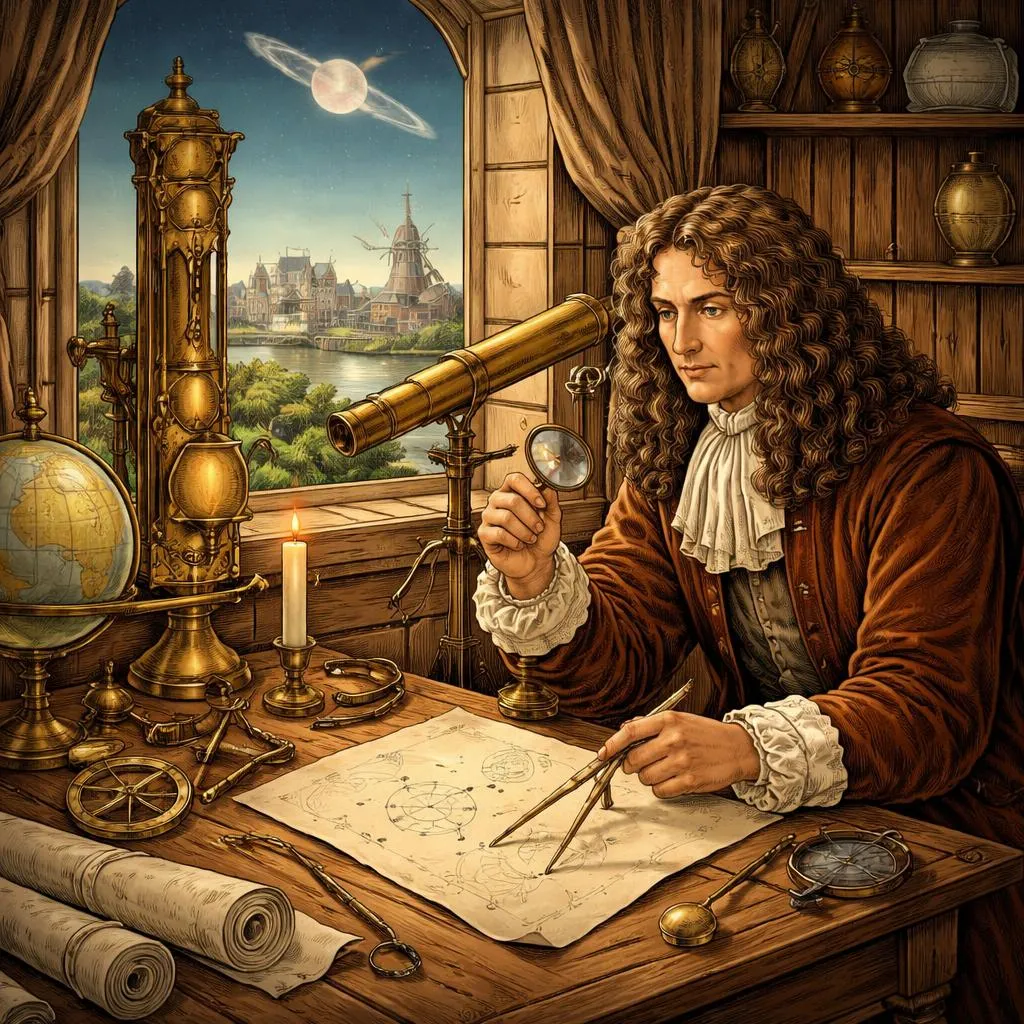

Christian Huygens was born at the Hague on April 14, 1629, and died in the same town on July 8, 1695. He generally wrote his name as Hugens, but I follow the usual custom in spelling it as above: it is also sometimes written as Huyghens. His life was uneventful, and there is little more to record in it than a statement of his various memoirs and researches.
In 1651 he published an essay in which he shewed the fallacy in a system of quadratures proposed by Grégoire de Saint-Vincent, who was well versed in the geometry of the Greeks, but had not grasped the essential points in the more modern methods. This essay was followed by tracts on the quadrature of the conics and the approximate rectification of the circle.
In 1654 his attention was directed to the improvement of the telescope. In conjunction with his brother he devised a new and better way of grinding and polishing lenses. As a result of these improvements he was able during the following two years, 1655 and 1656, to resolve numerous astronomical questions; as, for example, the nature of Saturn's appendage. His astronomical observations required some exact means of measuring time, and he was thus led in 1656 to invent the pendulum clock, as described in his tract Horologium , 1658. The time-pieces previously in use had been balance-clocks.
In the year 1657 Huygens wrote a small work on the calculus of probabilities founded on the correspondence of Pascal and Fermat. He spent a couple of years in England about this time. His reputation was now so great that in 1665 Louis XIV offered him a pension if he would live in Paris, which accordingly then became his place of residence.
In 1668 he sent to the Royal Society of London, in answer to a problem they had proposed, a memoir in which (simultaneously with Wallis and Wren) he proved by experiment that the momentum in a certain direction before the collision of two bodies is equal to the momentum in that direction after the collision. This was one of the points in mechanics on which Descartes had been mistaken.
The most important of Huygens's work was his Horologium Oscillatorium published at Paris in 1673. The first chapter is devoted to pendulum clocks. The second chapter contains a complete account of the descent of heavy bodies under their own weights in a vacuum, either vertically down or on smooth curves. Amongst other propositions he shews that the cycloid is tautochronous. In the third chapter he defines evolutes and involutes, proves some of their more elementary properties, and illustrates his methods by finding the evolutes of the cycloid and the parabola. These are the earliest instances in which the envelope of a moving line was determined. In the fourth chapter he solves the problem of the compound pendulum, and shews that the centres of oscillation and suspension are interchangeable. In the fifth and last chapter he discusses again the theory of clocks, points out that if the bob of the pendulum were, by means of cycloidal clocks, made to oscillate in a cycloid the oscillations would be isochronous; and finishes by shewing that the centrifugal force on a body which moves around a circle of radius r with a uniform velocity v varies directly as v 2 and inversely as r . This work contains the first attempt to apply dynamics to bodies of finite size, and not merely to particles.
In 1675 Huygens proposed to regulate the motion of watches by the use of the balance spring, in the theory of which he had been perhaps anticipated in a somewhat ambiguous and incomplete statement made by Hooke in 1658. Watches or portable clocks had been invented early in the sixteenth century, and by the end of that century were not very uncommon, but they were clumsy and unreliable, being driven by a main spring and regulated by a conical pulley and verge escapement; moreover, until 1687 they had only one hand. The first watch whose motion was regulated by a balance spring was made at Paris under Huygens's directions, and presented by him to Louis XIV.
The increasing intolerance of the Catholics led to his return to Holland in 1681, and after the revocation of the edict of Nantes he refused to hold any further communication with France. He now devoted himself to the construction of lenses of enormous focal length: of these three of focal lengths 123 feet, 180 feet, and 210 feet, were subsequently given by him to the Royal Society of London, in whose possession they still remain. It was about this time that he discovered the achromatic eye-piece (for a telescope) which is known by his name. In 1689 he came from Holland to England in order to make the acquaintance of Newton, whose Principia had been published in 1687. Huygens fully recognized the intellectual merits of the work, but seems to have deemed any theory incomplete which did not explain gravitation by mechanical means.
On his return in 1690 Huygens published his treatise on light in which the undulatory theory was expounded and explained. Most of this had been written as early as 1678. The general idea of the theory had been suggested by Robert Hooke in 1664, but he had not investigated its consequences in any detail. Only three ways have been suggested in which light can be produced mechanically. Either the eye may be supposed to send out something which, so to speak, feels the object (as the Greeks believed); or the object perceived may send out something which hits or affects the eye (as assumed in the emission theory); or there may be some medium between the eye and the object, and the object may cause some change in the form or condition of this intervening medium and thus affect the eye (as Hooke and Huygens supposed in the wave or undulatory theory). According to this last theory space is filled with an extremely rare ether, and light is caused by a series of waves or vibrations in this ether which are set in motion by the pulsations of the luminous body. From this hypothesis Huygens deduced the laws of reflexion and refraction, explained the phenomenon of double refraction, and gave a construction for the extraordinary ray in biaxal crystals; while he found by experiment the chief phenomena of polarization.
The immense reputation and unrivalled powers of Newton led to disbelief in a theory which he rejected, and to the general adoption of Newton's emission theory. Within the present century crucial experiments have been devised which give different results according as one or the other theory is adopted; all these experiments agree with the results of the undulatory theory and differ from the results of the Newtonian theory; the latter is therefore untenable. Until, however, the theory of interference, suggested by Young, was worked out by Fresnel, the hypothesis of Huygens failed to account for all the facts, and even now the properties which, under it, have to be attributed to the intervening medium or ether involve difficulties of which we still seek a solution. Hence the problem as to how the effects of light are really produced cannot be said to be finally solved.
Besides these works Huygens took part in most of the controversies and challenges which then played so large a part in the mathematical world, and wrote several minor tracts. In one of these he investigated the form and properties of the catenary. In another he stated in general terms the rule for finding maxima and minima of which Fermat had made use, and shewed that the subtangent of an algebraical curve f ( x,y ) = 0 was equal to yf y / f x , where f y is the derived function of f ( x,y ) regarded as a function of y . In some posthumous works, issued at Leyden in 1703, he further shewed how from the focal lengths of the component lenses the magnifying power of a telescope could be determined; and explained some of the phenomena connected with haloes and parhelia.
I should add that almost all his demonstrations, like those of Newton, are rigidly geometrical, and he would seem to have made no use of the differential or fluxional calculus, though he admitted the validity of the methods used therein. Thus, even when first written, his works were expressed in an archaic language, and perhaps received less attention than their intrinsic merits deserved.
Background and Author Introduction
Christian Huygens was a brilliant Dutch scientist and mathematician of the 17th century, a time when the world was rapidly expanding its understanding of science and the universe. Born in 1629 in The Hague, Huygens lived during the Scientific Revolution, an era marked by groundbreaking discoveries and inventions. His work spanned many fields including astronomy, physics, mathematics, and horology (the science of timekeeping). Despite living in a period when religious and political tensions were high, Huygens devoted his life to scientific inquiry and innovation.
Huygens is best known for inventing the pendulum clock, which greatly improved timekeeping accuracy, and for his wave theory of light, which laid the groundwork for modern optics. His contributions to mechanics, especially his studies on the motion of bodies and collisions, challenged earlier ideas and helped shape the foundation of classical physics.
Detailed Explanation and Significance of Huygens’s Work
Huygens’s life and work illustrate the power of curiosity and careful observation. His improvements to the telescope allowed astronomers to see celestial bodies more clearly, which led to better understanding of planets like Saturn. By inventing the pendulum clock, he solved a critical problem in measuring time precisely—a breakthrough that was essential for navigation and scientific experiments.
One of his most important works, Horologium Oscillatorium, is a masterpiece of scientific writing that combines theory and practical application. In it, Huygens explains how pendulums move and how this motion can be used to regulate clocks. He also explored the properties of curves like the cycloid, which has the unique property of tautochronism—meaning objects sliding down it take the same time regardless of their starting point. This discovery was not only mathematically beautiful but also practically useful in clock design.
Huygens’s wave theory of light was revolutionary. At a time when Isaac Newton’s particle theory of light was dominant, Huygens proposed that light travels in waves through a medium called ether. This idea explained many optical phenomena such as reflection, refraction, and polarization better than Newton’s theory. Although it took centuries for Huygens’s ideas to be fully accepted, today they form the basis of modern physics and optics.
What Students Can Learn from Huygens’s Story
-
The Importance of Curiosity and Persistence
Huygens’s life teaches students that scientific progress often comes from asking questions and testing ideas carefully. His work on clocks, light, and mechanics shows how curiosity combined with persistence can lead to breakthroughs. -
The Value of Interdisciplinary Learning
Huygens was not limited to one field; he combined mathematics, physics, and engineering. This approach encourages students to explore multiple subjects and see how they connect in real life. -
Critical Thinking and Challenging Established Ideas
Huygens challenged the accepted theories of his time, such as Descartes’s ideas on collisions and Newton’s theory of light. This shows students the importance of critical thinking and being open to new evidence. -
Precision and Attention to Detail
His improvements in lens grinding and clockmaking highlight how small details matter in scientific work. Students can learn that careful work and precision are essential in any discipline.
How to Apply These Lessons in Daily Life
- In Learning: When studying, students can emulate Huygens’s method by questioning what they read, experimenting with ideas, and connecting different subjects like math and science to deepen understanding.
- In Problem-Solving: Whether in school projects or everyday challenges, students should not be afraid to think differently or test new approaches, just as Huygens did with his inventions.
- In Social Interactions: The patience and persistence Huygens showed can inspire students to be patient with themselves and others, understanding that progress often requires time and effort.
- In Personal Growth: Embracing curiosity and a love for learning can lead to lifelong growth and unexpected discoveries, just as it did for Huygens.
Encouraging Positive Traits from Huygens’s Example
- Curiosity: Always ask "why" and seek to understand the world around you.
- Perseverance: Keep working on problems even when solutions are not immediately clear.
- Open-mindedness: Be willing to consider new ideas, even if they challenge what you already believe.
- Attention to Detail: Take care in your work and strive for accuracy.
- Interdisciplinary Thinking: Combine knowledge from different areas to solve complex problems.
By studying Christian Huygens’s life and work, students gain not only knowledge about science and history but also valuable lessons in how to approach learning and life with a thoughtful, persistent, and open mind. His legacy reminds us that great discoveries often come from a blend of imagination, hard work, and the courage to question the world as it is.
