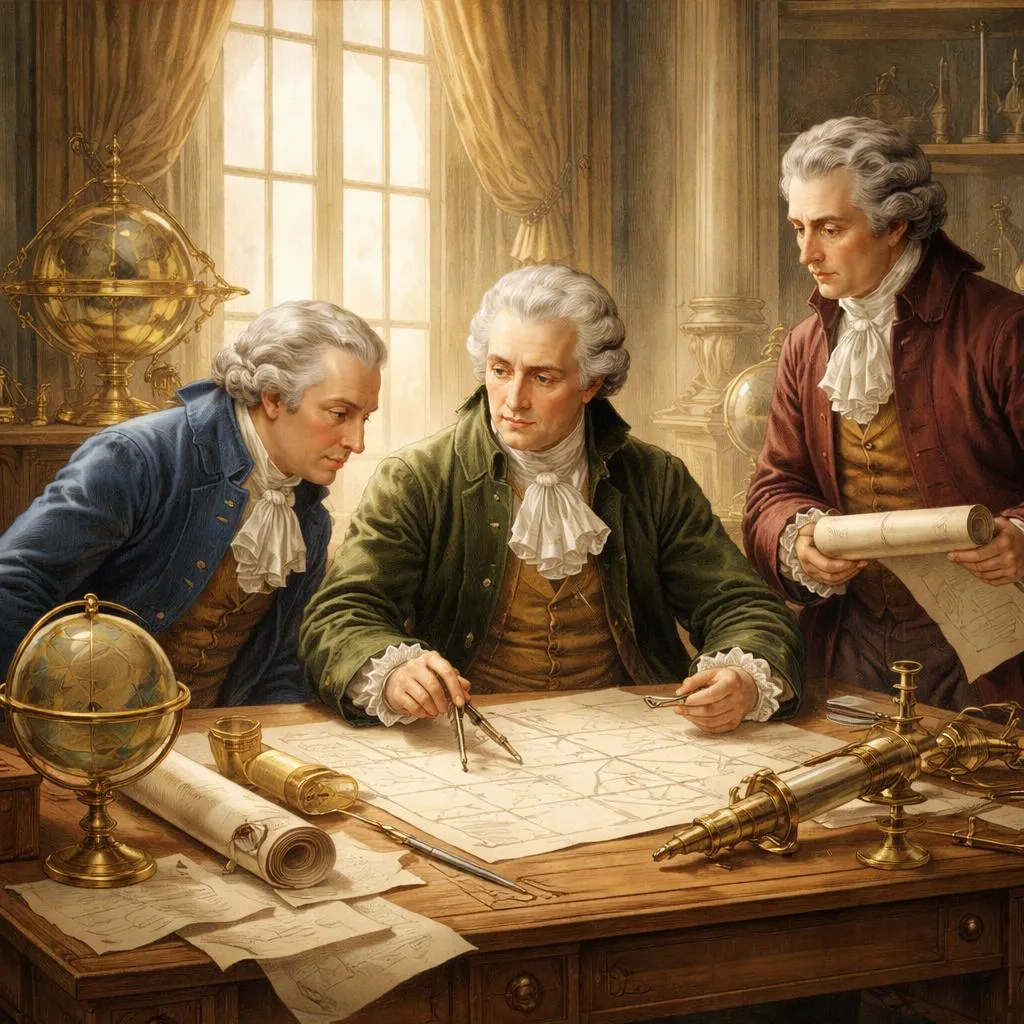

Bézout, Trembley, Arbogast
Étienne Bézout, born at Nemours on March 31, 1730, and died on September 27, 1783, besides numerous minor works, wrote a Théorie générale des équations algébriques , published at Paris in 1779, which in particular contained much new and valuable matter on the theory of elimination and symmetrical functions of the roots of an equation: he used determinants in a paper in the Histoire de l'académie royale , 1764, but did not treat of the general theory. Jean Trembley, born at Geneva in 1749, and died on September 18, 1811, contributed to the development of differential equations, finite differences, and the calculus of probabilities. Louis François Antoine Arbogast, born in Alsace on October 4, 1759, and died at Strassburg, where he was professor, on April 8, 1803, wrote on series and the derivatives known by his name: he was the first writer to separate the symbols of operation from those of quantity.
Carnot
Lazare Nicholas Marguerite Carnot, born at Nolay on May 13, 1753, and died at Magdeburg on Aug. 22, 1823, was educated at Burgundy, and obtained a commission in the engineer corps of Condé. Although in the army, he continued his mathematical studies in which he felt great interest. His first work, published in 1784, was on machines; it contains a statement which foreshadows the principle of energy as applied to a falling weight, and the earliest proof of the fact that kinetic energy is lost in the collision of imperfectly elastic bodies. On the outbreak of the revolution in 1789 he threw himself into politics. In 1793 he was elected on the committee of public safety, and the victories of the French army were largely due to his powers of organization and enforcing discipline. He continued to occupy a prominent place in every successive form of government till 1796 when, having opposed Napoleon's coup d'état , he had to fly from France. He took refuge in Geneva, and there in 1797 issued his La métaphysique du calcul infinitésimal . In 1802 he assisted Napoleon, but his sincere republican convictions were inconsistent with the retention of office. In 1803 he produced his Géométrie de position . This work deals with projective rather than descriptive geometry, it also contains an elaborate discussion of the geometrical meaning of negative roots of an algebraical equation. In 1814 he offered his services to fight for France, though not for the empire; and on the restoration he was exiled.
Poncelet
Jean Victor Poncelet, born at Metz on July 1, 1788, and died at Paris on Dec. 1867, held a commission in the French engineers. Having been made a prisoner in the French retreat from Moscow in 1812 he occupied his enforced leisure by writing the Traité des propriétés projectives des figures , published in 1822, which was long one of the best known text-books on modern geometry. By means of projection, reciprocation, and homologous figures, he established all the chief properties of conics and quadrics. He also treated the theory of polygons. His treatise on practical mechanics in 1826, his memoir on water-mills in 1826, and his report on the English machinery and tools exhibited at the International Exhibition held in London in 1851 deserve mention. He contributed numerous articles to Crelle's journal; the most valuable of these deal with the explanation, by the aid of the doctrine of continuity, of imaginary solutions in geometrical problems.
Introduction to the Mathematicians and Their Contributions
The passage above introduces us to several important mathematicians from the 18th and 19th centuries: Étienne Bézout, Jean Trembley, Louis François Antoine Arbogast, Lazare Nicholas Marguerite Carnot, and Jean Victor Poncelet. Each of these men made significant contributions to mathematics and science, shaping the way we understand algebra, geometry, mechanics, and probability today. Their work not only advanced academic knowledge but also had practical applications in engineering, military strategy, and technology.
Background and Historical Context
During the 18th and early 19th centuries, Europe was a hotbed of scientific discovery and political change. The Enlightenment encouraged reason, logic, and scientific inquiry, which motivated many scholars to explore complex mathematical theories. At the same time, political upheavals such as the French Revolution and Napoleonic Wars influenced the lives and careers of these mathematicians. For example, Carnot was deeply involved in politics and military organization, while Poncelet’s time as a prisoner of war led him to write important mathematical treatises.
Detailed Explanation of Their Work and Its Significance
-
Étienne Bézout is best known for Bézout’s theorem in algebraic geometry, which deals with the intersections of polynomial equations. His work on elimination theory and symmetrical functions helped lay the foundation for modern algebra.
-
Jean Trembley contributed to differential equations and probability theory, fields essential for understanding natural phenomena and making predictions based on data.
-
Louis Arbogast introduced new ways to handle mathematical operations, separating symbols of operation from quantities, which clarified the notation and helped future mathematicians develop calculus more effectively.
-
Lazare Carnot combined his military expertise with mathematics. His work on energy and mechanics foreshadowed principles that are fundamental in physics today. Beyond his scientific work, his role in organizing the French army during the Revolution showed how mathematical thinking can be applied to leadership and strategy.
-
Jean Victor Poncelet made major advances in projective geometry, a branch of mathematics that studies properties of figures that remain unchanged under projection. His work influenced engineering and mechanics, demonstrating the deep connection between abstract mathematics and practical technology.
What Students Can Learn from These Stories
-
The Power of Curiosity and Dedication: These mathematicians show us that curiosity about the world combined with persistent study can lead to groundbreaking discoveries. Students can be inspired to pursue their interests deeply, even when the subject seems difficult.
-
Interdisciplinary Thinking: The blending of mathematics with politics, engineering, and military strategy illustrates how knowledge in one area can enhance understanding and effectiveness in another. Students should appreciate the value of learning broadly and connecting ideas across subjects.
-
Resilience in Adversity: Poncelet’s ability to produce important work while a prisoner of war, and Carnot’s exile and political struggles, teach us about resilience. Challenges and setbacks do not have to stop progress; they can be opportunities for growth and creativity.
-
The Importance of Clear Communication: Arbogast’s contribution to mathematical notation reminds students that how we express ideas matters. Clear communication helps others understand and build upon our work.
Applying These Lessons in Daily Life
-
In Learning: Students can apply the mathematicians’ dedication by setting goals, practicing regularly, and seeking to understand concepts deeply rather than just memorizing facts.
-
In Social Settings: The example of Carnot’s leadership and organization skills can inspire students to develop teamwork, discipline, and responsibility in group activities.
-
In Problem Solving: The innovative approaches these mathematicians took encourage creative thinking. When facing challenges, students should try different perspectives and methods.
-
In Personal Growth: Learning from their resilience, students can cultivate patience and perseverance, understanding that failure is often a step toward success.
Encouraging Positive Values Through Stories of Mathematicians
Stories of these mathematicians can help students appreciate values such as curiosity, hard work, resilience, and clear communication. Teachers can encourage students to:
- Ask questions and explore beyond the textbook.
- Collaborate with peers to solve problems.
- Reflect on mistakes as learning opportunities.
- Express their ideas clearly in writing and speech.
By embracing these values, students not only improve academically but also develop skills and attitudes that benefit them throughout life.
Conclusion
While the original passage focuses on the technical achievements of these mathematicians, understanding their lives and the context of their work enriches our appreciation of their contributions. Their stories are not just about numbers and formulas but about human curiosity, perseverance, and the pursuit of knowledge. Students who engage with these stories can find inspiration to explore their own potential and apply the lessons learned in various aspects of their lives.