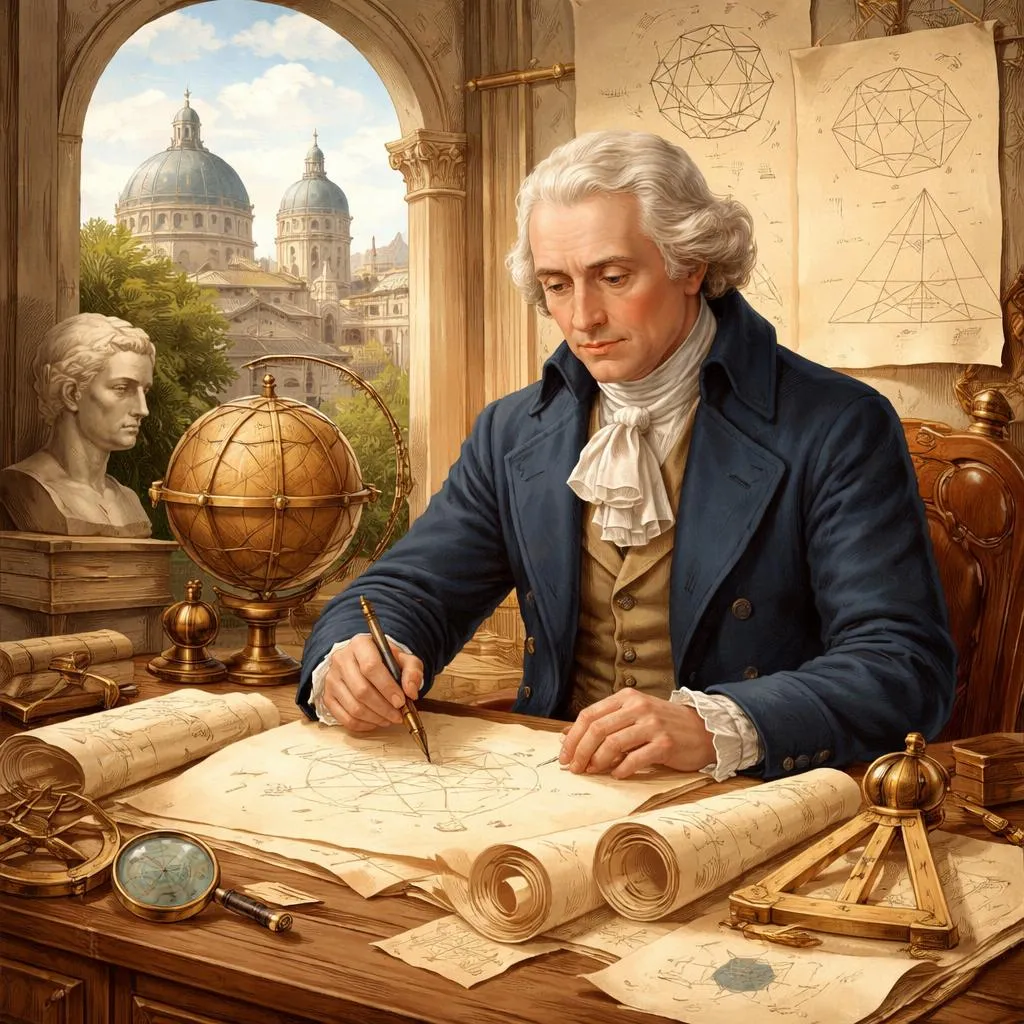

Gaspard Monge was born at Beaune on May 10, 1746, and died at Paris on July 28, 1818. He was the son of a small pedlar, and was educated in the schools of the Oratorians, in one of which he subsequently became an usher. A plan of Beaune which he had made fell into the hands of an officer who recommended the military authorities to admit him to their training school at Mézières. His birth, however, precluded his receiving a commission in the army, but his attendance at an annexe of the school where surveying and drawing were taught was tolerated, though he was told that he was not sufficiently well born to be allowed to attempt problems which required calculation. At last his opportunity came. A plan of a fortress having to be drawn from the data supplied by certain observations, he did it by a geometrical construction. At first the officer in charge refused to receive it, because etiquette required that not less than a certain time should be used in making such drawings, but the superiority of the method over that then taught was so obvious that it was accepted; and in 1768 Monge was made professor, on the understanding that the results of his descriptive geometry were to be a military secret confined to officers above a certain rank.
In 1780 he was appointed to a chair in mathematics in Paris, and this with some provincial appointments which he held gave him a comfortable income. The earliest paper of any special importance which he communicated to the French Academy was one in 1781, in which he discussed the lines of curvature drawn on a surface. These had been first considered by Euler in 1760, and defined as those normal sections whose curvature was a maximum or a minimum. Monge treated them as the locus of those points on the surface at which successive normals intersect, and thus obtained the general differential equation. He applied his results to the central quadrics in 1795. In 1786 he published his well-known work on statics.
Monge eagerly embraced the doctrines of the revolution. In 1792 he became minister of the marine, and assisted the committee of public safety in utilizing science for the defence of the republic. When the Terrorists obtained power he was denounced, and escaped the guillotine only by a hasty flight. On his return in 1794 he was made a professor at the short-lived Normal school, where he gave lectures on descriptive geometry; the notes of these were published under the regulation above alluded to. In 1796 he went to Italy on the roving commission which was sent with orders to compel the various Italian towns to offer pictures, sculpture, or other works of art that they might possess, as a present or in lieu of contributions to the French republic for removal to Paris. In 1798 he accepted a mission to Rome, and after executing it joined Napoleon in Egypt. Thence after the naval and military victories of England he escaped to France.
Monge then settled down at Paris, and was made professor at the Polytechnic school, where he gave lectures on descriptive geometry; these were published in 1800 in the form of a textbook entitled Géométrie descriptive . This work contains propositions on the form and relative position of geometrical figures deduced by the use of transversals. The theory of perspective is considered; this includes the art of representing in two dimensions geometrical objects which are of three dimensions, a problem which Monge usually solved by the aid of two diagrams, one being the plan and the other the elevation. Monge also discussed the question as to whether, if in solving a problem certain subsidiary quantities introduced to facilitate the solution become imaginary, the validity of the solution is thereby impaired, and he shewed that the result would not be affected. On the restoration he was deprived of his offices and honours, a degradation which preyed on his mind and which he did not long survive.
Most of his miscellaneous papers are embodied in his works, Application de l'algèbre à la géométrie , published in 1805, and Application de l'analyse à la géométrie , the fourth edition of which, published in 1819, was revised by him just before his death. It contains among other results his solution of a partial differential equation of the second order.
Background and Author Introduction
Gaspard Monge was a remarkable French mathematician and scientist born in 1746 in Beaune, France. Coming from a humble background as the son of a small pedlar, Monge's life story is one of determination and intellectual brilliance overcoming social barriers. Despite early obstacles due to his birth status, he pursued education with passion and quickly distinguished himself in the fields of geometry and mathematics. His work laid the foundation for descriptive geometry, a branch of mathematics that helps us represent three-dimensional objects in two dimensions—a crucial skill in engineering, architecture, and art.
Monge lived through a turbulent period in French history, including the French Revolution. He was not only a scientist but also a public servant who used his knowledge to support the revolutionary government. His career included roles as a professor, minister, and scientific advisor to Napoleon. His contributions to mathematics and science were deeply intertwined with the social and political changes of his time.
Detailed Interpretation and Significance
The story of Gaspard Monge is not a fictional tale but a real-life narrative of perseverance, innovation, and the power of education. His development of descriptive geometry was a breakthrough in how we visualize and solve spatial problems. This method allows complex three-dimensional shapes to be understood through two-dimensional drawings, which is fundamental in many fields today.
Monge's work on curvature lines, statics, and differential equations also advanced mathematical understanding significantly. His approach combined theoretical insight with practical application, showing how abstract mathematics can solve real-world problems. Furthermore, his role during the French Revolution highlights how science and politics can intersect, sometimes with great personal risk.
Lessons and Insights for Students
Students reading about Monge can learn several valuable lessons:
-
Overcoming Obstacles: Monge’s early life teaches us that background or social status does not determine one’s potential. With dedication and hard work, anyone can achieve greatness.
-
The Importance of Education: Monge’s success was built on his deep knowledge and continuous learning. This encourages students to value their education and strive to understand subjects deeply.
-
Innovation and Creativity: Monge’s new methods in geometry show how creative thinking can lead to breakthroughs. Students should be encouraged to think outside the box and approach problems from new angles.
-
Science and Society: Monge’s involvement in politics reminds us that science is not isolated from the world. Knowledge can be used to serve society and contribute to important causes.
Practical Applications in Daily Life
-
In Learning: Monge’s descriptive geometry can inspire students to improve their spatial reasoning skills, useful in subjects like math, physics, and art.
-
In Problem Solving: His example encourages students to be patient and persistent when facing difficult problems, knowing that innovative solutions often require time and effort.
-
In Social Interaction: Understanding Monge’s courage in the face of political danger can inspire students to stand up for their beliefs and contribute positively to their communities.
Cultivating Positive Qualities
To embody the spirit of Monge, students can:
-
Develop curiosity and a love for learning, exploring subjects beyond the classroom.
-
Practice resilience by viewing failures as opportunities to learn.
-
Embrace creativity by experimenting with new ideas and approaches.
-
Recognize the value of contributing to society, whether through science, art, or social action.
Conclusion
Gaspard Monge’s life and work offer a rich source of inspiration for young learners. His journey from a modest background to becoming a pioneer in mathematics and a key figure in history shows the power of education, innovation, and courage. By studying his story, students can gain not only knowledge but also the motivation to pursue their own goals with determination and integrity.
