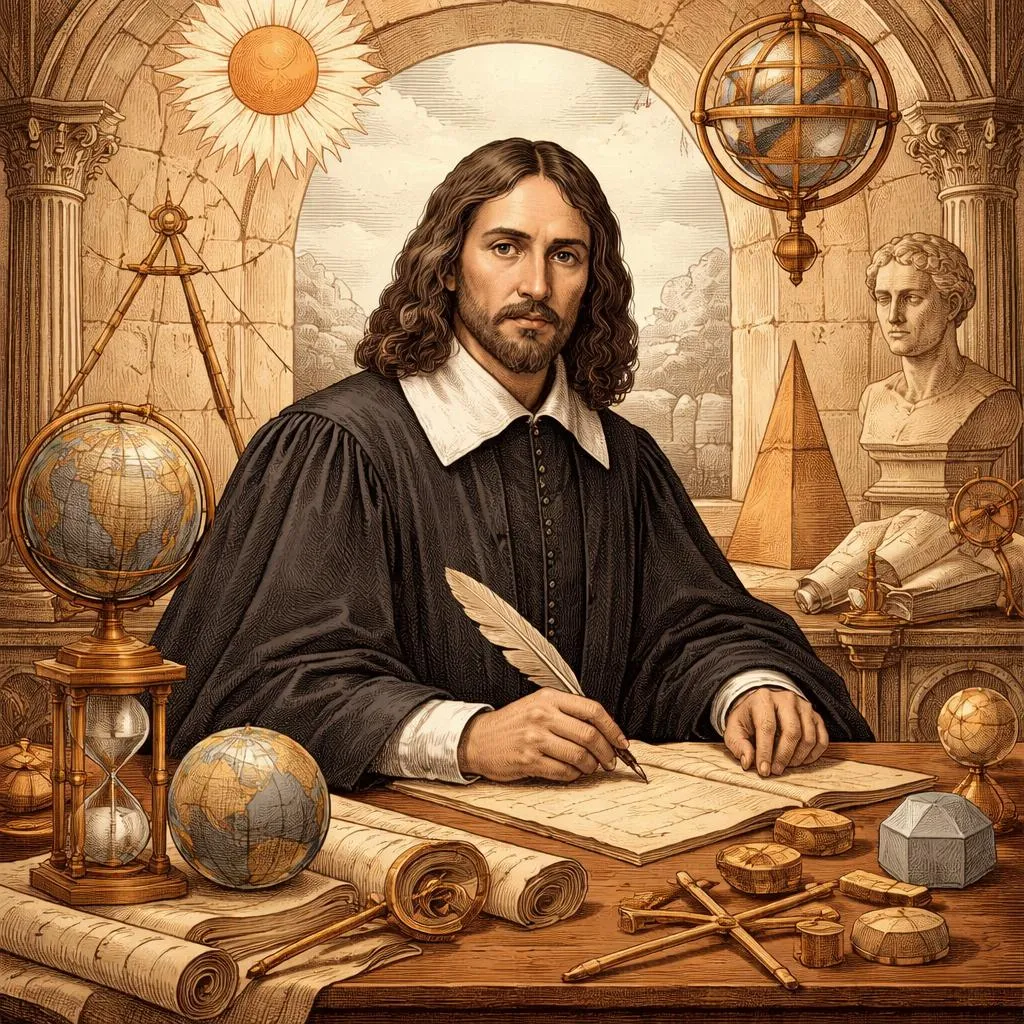

Isaac Barrow was born in London in 1630, and died at Cambridge in 1677. He went to school first at Charterhouse (where he was so troublesome that his father was heard to pray that if it pleased God to take any of his children he could best spare Isaac), and subsequently to Felstead. He completed his education at Trinity College, Cambridge; after taking his degree in 1648, he was elected to a fellowship in 1649; he then resided for a few years in college, but in 1655 he was driven out by the persecution of the Independents. He spent the next four years in the East of Europe, and after many adventures returned to England in 1659. He was ordained the next year, and appointed to the professorship of Greek at Cambridge. In 1662 he was made professor of geometry at Gresham College, and in 1663 was selected as the first occupier of the Lucasian chair at Cambridge. He resigned the latter to his pupil Newton in 1669, whose superior abilities he recognized and frankly acknowledged. For the remainder of his life he devoted himself to the study of divinity. He was appointed master of Trinity College in 1672, and held the post until his death.
He is described as "low in stature, lean, and of a pale complexion," slovenly in his dress, and an inveterate smoker. He was noted for his strength and courage, and once when travelling in the East he saved the ship by his own prowess from capture by pirates. A ready and caustic wit made him a favourite of Charles II., and induced the courtiers to respect even if they did not appreciate him. He wrote with a sustained and somewhat stately eloquence, and with his blameless life and scrupulous conscientiousness was an impressive personage of the time.
His earliest work was a complete edition of the Elements of Euclid, which he issued in Latin in 1655, and in English in 1660; in 1657 he published an edition of the Data. His lectures, delivered in 1664, 1665, and 1666, were published in 1683 under the title Lectiones Mathematicae; these are mostly on the metaphysical basis for mathematical truths. His lectures for 1667 were published in the same year, and suggest the analysis by which Archimedes was led to his chief results. In 1669 he issued his Lectiones Opticae et Geometricae. It is said in the preface that Newton revised and corrected these lectures, adding matter of his own, but it seems probable from Newton's remarks in the fluxional controversy that the additions were confined to the parts which dealt with optics. This, which is his most important work in mathematics, was republished with a few minor alterations in 1674. In 1675 he published an edition with numerous comments of the first four books of the Conics of Apollonius, and of the extant works of Archimedes and Theodosius.
In the optical lectures many problems connected with the reflexion and refraction of light are treated with ingenuity. The geometrical focus of a point seen by reflexion or refraction is defined; and it is explained that the image of an object is the locus of the geometrical foci of every point on it. Barrow also worked out a few of the easier properties of thin lenses, and considerably simplified the Cartesian explanation of the rainbow.
The geometrical lectures contain some new ways of determining the areas and tangents of curves. The most celebrated of these is the method given for the determination of tangents to curves, and this is sufficiently important to require a detailed notice, because it illustrates the way in which Barrow, Hudde and Sluze were working on the lines suggested by Fermat towards the methods of the differential calculus.
Fermat had observed that the tangent at a point P on a curve was determined if one other point besides P on it were known; hence, if the length of the subtangent MT could be found (thus determining the point T), then the line TP would be the required tangent. Now Barrow remarked that if the abscissa and ordinate at a point Q adjacent to P were drawn, he got a small triangle PQR (which he called the differential triangle, because its sides PR and PQ were the differences of the abscissae and ordinates of P and Q), so that
TM : MP = QR : RP.
To find QR : RP he supposed that x, y were the co-ordinates of P, and x - e, y - a those of Q (Barrow actually used p for x and m for y, but I alter these to agree with modern practice). Substituting the co-ordinates of Q in the equation of the curve, and neglecting the squares and higher powers of e and a as compared with their first powers, he obtained e : a. The ratio a/e was subsequently (in accordance with a suggestion made by Sluze) termed the angular coefficient of the tangent at the point. Barrow applied this method to the curves (i) x² (x² + y²) = r²y²;(ii) x³ + y³ = r³; (iii) x³ + y³ = rxy, called la galande; (iv) y = (r - x) tan πx/2r, the quadratrix; and (v) y = r tan πx/2r. It will be sufficient here if I take as an illustration the simpler case of the parabola y² = px. Using the notation given above, we have for the point P, y² = px; and for the point Q, (y - a)² = p(x - e). Subtracting we get 2ay - a² = pe. But, if a be an infinitesimal quantity, a² must be infinitely smaller and therefore may be neglected when compared with the quantities 2ay and pe. Hence 2ay = pe, that is, e : a = 2y : p. Therefore TP : y = e : a = 2y : p. Hence TM = 2y²/p = 2x. This is exactly the procedure of the differential calculus, except that there we have a rule by which we can get the ratio a/e or dy/dx directly without the labour of going through a calculation similar to the above for every separate case.
Background and Author Introduction
Isaac Barrow was a remarkable mathematician and theologian of the 17th century. Born in London in 1630, he lived during a time of great scientific discovery and intellectual change. Barrow was not just a scholar but also a courageous adventurer, known for his strength and wit. Despite his somewhat unruly youth, he became one of the leading mathematicians of his era, holding prestigious academic positions at Cambridge University. Barrow’s work laid important foundations for calculus, a branch of mathematics that would later be developed further by his famous student, Isaac Newton.
Barrow’s life story teaches us about perseverance, intellectual curiosity, and the importance of recognizing and encouraging talent in others. His decision to resign his prestigious Lucasian Chair to Newton shows humility and a commitment to the advancement of knowledge beyond personal ambition.
Detailed Explanation and Significance
The text above describes Barrow’s contributions to mathematics, especially in geometry and optics. He worked on problems involving light reflection and refraction, explaining how images are formed through lenses—a topic still fundamental in physics and optics today. His lectures on geometry introduced new methods for finding tangents to curves, which is a key concept in calculus.
Barrow’s approach to tangents involved what we now call the "differential triangle," a clever geometric tool that helped him approximate slopes of curves before the formal development of calculus. This method was a stepping stone toward the powerful techniques that Newton and Leibniz would later formalize. Barrow’s work on conic sections and his commentary on ancient mathematicians like Apollonius and Archimedes also helped preserve and advance classical mathematical knowledge.
What Students Can Learn
-
Historical Context of Mathematics: Understanding Barrow’s work helps students appreciate how mathematical ideas evolve over time. It shows that calculus, a subject often seen as difficult, was developed step-by-step by many thinkers building on each other’s discoveries.
-
Interdisciplinary Learning: Barrow combined his interests in mathematics, theology, and philosophy, demonstrating the value of a broad education and the interconnectedness of different fields.
-
Critical Thinking and Problem Solving: Barrow’s method of analyzing curves and light teaches students to approach problems creatively and logically, breaking down complex ideas into simpler parts.
-
Humility and Mentorship: Barrow’s recognition of Newton’s superior talent and his willingness to step aside is a powerful lesson in humility and the importance of supporting others’ growth.
Applications in Life and Learning
-
In School: Students can apply Barrow’s example by being curious and persistent in their studies, especially in challenging subjects like math and science. Learning the history behind concepts can make them more interesting and easier to understand.
-
In Social Settings: Barrow’s story encourages respect for others’ talents and the importance of mentorship. Helping classmates and recognizing their strengths can build a positive learning community.
-
In Personal Growth: Barrow’s life shows that early mistakes or difficulties don’t define a person’s future. With effort and dedication, anyone can achieve great things.
How to Cultivate Positive Traits from Barrow’s Story
-
Curiosity: Always ask questions and seek to understand how things work, just like Barrow explored the nature of light and curves.
-
Courage: Don’t be afraid to face challenges or new experiences, as Barrow did when traveling and standing up to pirates.
-
Humility: Recognize when others have better ideas and be willing to learn from them.
-
Conscientiousness: Strive for integrity and careful work, as Barrow did in his scholarly and personal life.
Reflection and Appreciation
Reading about Isaac Barrow can inspire students to value both knowledge and character. His blend of intellectual brilliance and personal courage makes him a role model not only for aspiring scientists and mathematicians but for anyone who wants to grow as a thoughtful, respectful, and courageous individual. By studying his life and work, young learners can see how dedication to learning and kindness to others go hand in hand in making a meaningful impact on the world.
