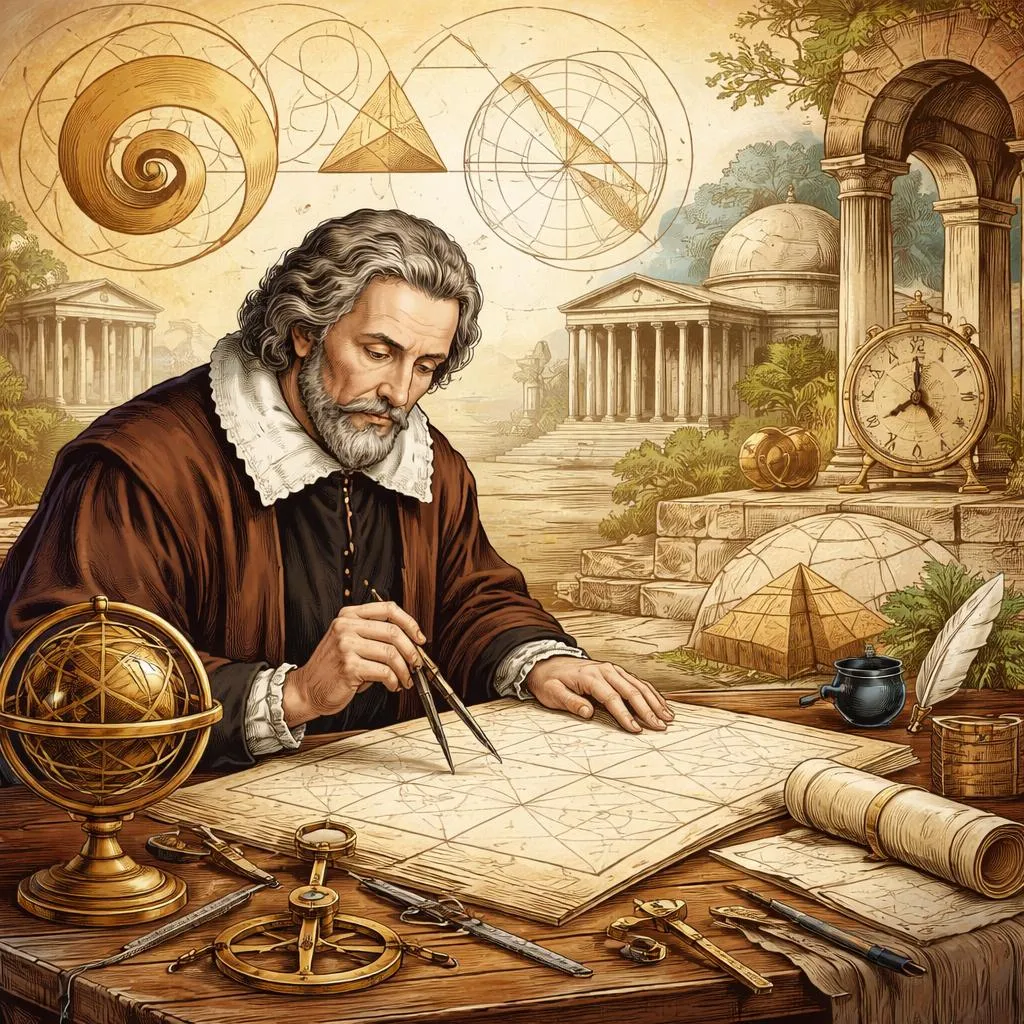

James Gregory, born at Drumoak near Aberdeen in 1638, and died at Edinburgh in October 1675, was successively professor at St. Andrews and Edinburgh. In 1660 he published his Optica Promota , in which the reflecting telescope known by his name is described. In 1667 he issued his Vera Circuli et Hyperbolae Quadratura , in which he shewed how the areas of the circle and hyperbola could be obtained in the form of infinite convergent series, and here (I believe for the first time) we find a distinction drawn between convergent and divergent series. This work contains a remarkable geometrical proposition to the effect that the ratio of the area of any arbitrary sector of a circle to that of the inscribed or circumscribed regular polygons is not expressible by a finite number of terms. Hence he inferred that the quadrature of the circle was impossible; this was accepted by Montucla, but it is not conclusive, for it is conceivable that some particular sector might be squared, and this particular sector might be the whole circle. This book contains also the earliest enunciation of the expansions in series of sin x , cos x , sin -1 x or arc sin x , and cos -1 x or arc cos x . It was reprinted in 1668 with an appendix, Geometriae Pars , in which Gregory explained how the volumes of solids of revolution could be determined. In 1671, or perhaps earlier, he established the theorem that
the result being true only if θ lie between -1/4 π and 1/4 π. This is the theorem on which many of the subsequent calculations of approximations to the numerical value of π have been based.
Background and Author Introduction
James Gregory was a remarkable mathematician and astronomer of the 17th century, born in Scotland near Aberdeen in 1638. He lived during a time when science and mathematics were rapidly evolving, and his work contributed significantly to the fields of optics and geometry. Gregory held important academic positions at the universities of St. Andrews and Edinburgh, where he influenced many students and scholars. His contributions, especially in the development of the reflecting telescope and the study of infinite series, laid important groundwork for future mathematicians and scientists.
Detailed Explanation of the Work
Gregory’s book Vera Circuli et Hyperbolae Quadratura is a pioneering mathematical treatise where he explored how to calculate the areas of circles and hyperbolas using infinite series — an advanced concept even by today’s standards. He was among the first to clearly distinguish between convergent series (which approach a specific value) and divergent series (which do not). This distinction is fundamental in calculus and mathematical analysis.
One of the key ideas Gregory presented was about the "quadrature of the circle," a famous problem in mathematics that asks whether the area of a circle can be exactly calculated using a finite number of steps and simple geometric shapes. Gregory argued that this was impossible, which was a widely accepted view for centuries. He also introduced early expansions of trigonometric functions like sine and cosine into infinite series, which are now essential tools in mathematics, physics, and engineering.
Significance and Meaning
Gregory’s work is important not just for its mathematical content but for its demonstration of how human curiosity and logical thinking can push the boundaries of knowledge. His efforts to understand complex shapes and infinite processes show the power of perseverance and creativity in solving difficult problems. The reflecting telescope he designed also represents the spirit of innovation, improving how we observe and understand the universe.
What Students Can Learn
From Gregory’s story and work, students can learn several valuable lessons:
- Curiosity and Inquiry: Gregory’s lifelong dedication to exploring mathematical and scientific questions encourages students to be curious and ask deep questions about the world around them.
- Persistence: Many of Gregory’s ideas were new and challenging. His persistence in studying difficult problems teaches students not to give up when faced with obstacles.
- Critical Thinking: Understanding the difference between convergent and divergent series requires careful analysis and logical thinking, skills that are useful in all areas of study.
- Innovation: Gregory’s invention of the reflecting telescope shows how combining knowledge from different fields (mathematics and optics) can lead to breakthroughs.
How to Apply These Lessons in Life and Learning
- In School: Students can apply Gregory’s example by approaching their studies with curiosity and persistence, especially in subjects like math and science that may seem difficult at first.
- In Social Settings: The critical thinking skills developed through studying Gregory’s work can help students make better decisions and solve problems in everyday life.
- In Personal Growth: Embracing challenges and learning from failure, as Gregory did, can build resilience and confidence.
Cultivating Positive Traits from Gregory’s Story
- Patience and Dedication: Complex problems require time and effort. Students should learn to be patient and dedicated, understanding that mastery comes gradually.
- Open-mindedness: Gregory’s work involved questioning accepted ideas, showing the importance of being open to new perspectives and willing to explore unconventional approaches.
- Collaboration and Sharing Knowledge: As a professor, Gregory shared his discoveries with others, highlighting the value of teaching and learning together.
Conclusion
James Gregory’s contributions to mathematics and science are a testament to the power of human intellect and determination. His story inspires students to be curious, persistent, and innovative. By studying his work, young learners can develop important skills and attitudes that will benefit them in school, social life, and beyond. Gregory’s legacy reminds us that through careful thought and hard work, even the most challenging problems can be approached and understood.
