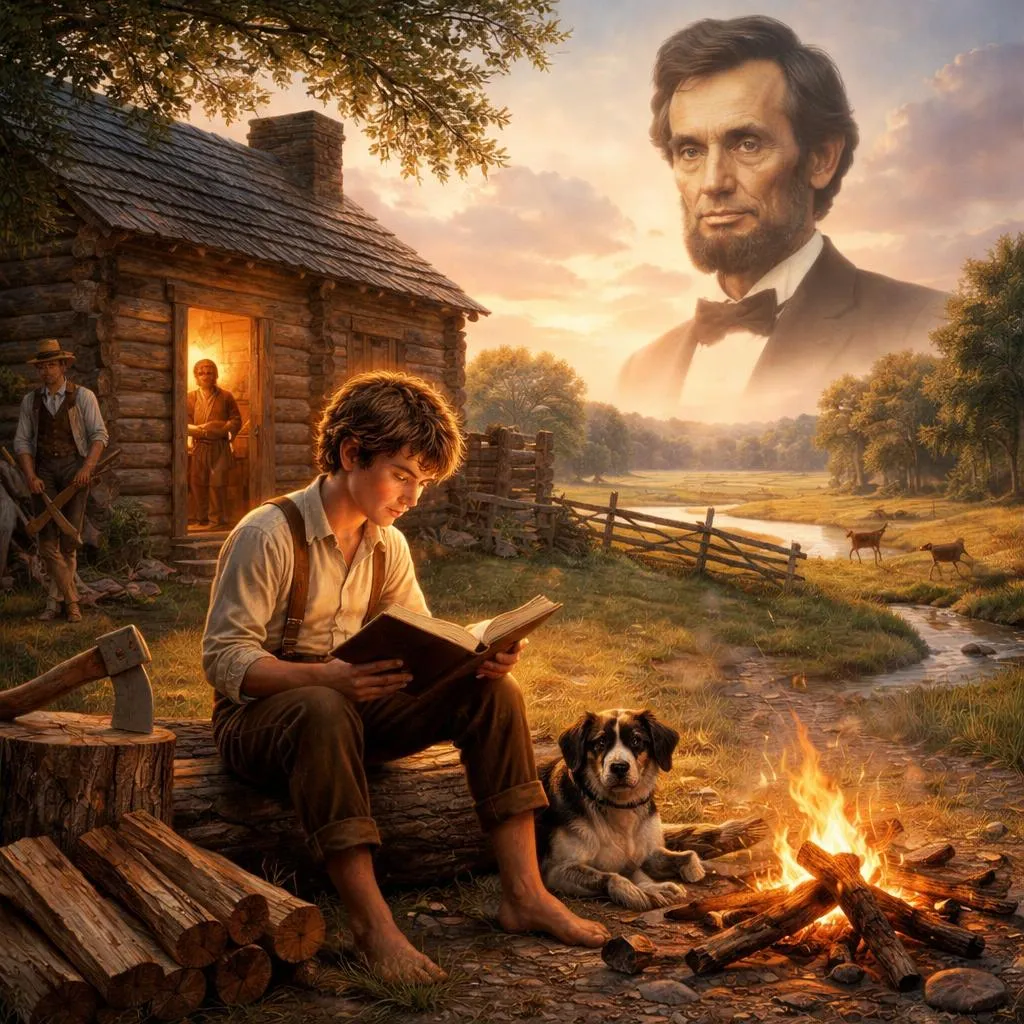

A severe and mysterious sickness broke out in the little Kentucky settlement where the Lincolns lived when Abe was about seven. Nancy Hanks Lincoln, the mother of young Abraham Lincoln died. Meanwhile, Sarah Bush Johnston had married about the time Lincoln’s father married Nancy Hanks. Her husband had died too. She was left with three children. Lincoln’s father went back to his home and married the widow Sarah.
The household goods that she brought with her to the Lincoln home filled a four-horse wagon. Her own three children were well clothed and cared for. She was able to bring little Abraham and his eleven year old sister Sarah comforts they had never known.
The new stepmother quickly became very fond of Abraham. She encouraged him in every way to study and improve himself. Mr. Lincoln once wrote, “It was a wild region, with many bears and other wild animals still in the woods. There I grew up.”
The family moved to Indiana. For two years Lincoln went without schooling of any sort. The school he attended shortly after Sarah came was very simple. The Pigeon Creek settlement had only eight or ten very poor families. They lived deep in the forest. Even if they had the money, it would have been impossible to buy books, slates, pens, ink, or paper.
In Lincoln’s seventeenth year he had more books and better teachers, but he had to walk four or five miles to reach them. We know that he learned to write, and was given pen, ink, a copybook, and a very small supply of writing paper. The instruction he received from his five teachers—two in Kentucky and three in Indiana—stretched over nine years. All together his schooling did not amount to one year.
The fact that he received this instruction, as he himself said, “by littles,” was an advantage. A lazy or not caring boy would have forgotten what was taught him at school. Abraham was neither indifferent or not caring. Every moment of instruction was a precious step to self-help. He worked on his studies with very unusual purpose and determination. He wanted to understand them at the moment. He also wanted to fix them firmly in his mind. His early companions all agree that he employed every spare moment to his studies. His stepmother tells us that “When he came across a passage that struck him, he would write it down on boards if he had no paper. He would keep it there until he did get paper. Then he would rewrite it, look at it, and repeat it. He had a copybook, a kind of scrapbook, in which he put down all things, and thus saved them.” He spent long evenings writing sums on the fire-shovel. Abraham worked his sums by the flickering firelight, making his figures with a piece of charcoal. When the shovel was all covered, he used a drawing-knife to shave it clean again.
He borrowed every book in the neighborhood. The list is a short one: Robinson Crusoe, Aesop’s Fables, Bunyan’s Pilgrim’s Progress, Weems’s Life of Washington, and A History of the United States. When everything else had been read, he began on the Revised Statutes of Indiana, which he visited a neighbor in order to read.
He was a social, sunny-tempered lad, as fond of jokes and fun as he was kindly and industrious. His stepmother said of him: “I can say, what scarcely one mother in a thousand can say, Abe never gave me a cross word or look, and never refused . . . to do anything I asked him. . . I must say . . that Abe was the best boy I ever saw or expect to see.”
He was not only a tall, strong country boy: he soon grew to be a tall, strong, sinewy man. He soon reached the unusual height of six feet four inches. His long arms gave him power as an axman. He usually beat his friends in races and mind puzzles. He could out-run, out-lift, out-wrestle his friends, that he could chop faster, split more rails in a day, carry a heavier log at a “raising,” or beat the neighborhood champion in any frontier athletics made him proud; but stronger than that was his hunger for learning. He felt that using the mind rather than muscle was the key to success. He wished not only to wrestle with the best of them, but also to be able to talk like the preacher, spell and cipher like the schoolmaster, argue like the lawyer, and write like the editor.
Because of his reading and his excellent memory, he soon became the best storyteller among his companions. The training from his studies made his naturally bright mind grow. His wit might be mischievous, but it was never malicious, and his nonsense was never intended to wound. He took no pleasure in hunting. Almost every youth of the backwoods early became an excellent shot and sportsman. The woods still swarmed with game, and every cabin depended largely upon this for its supply of food. But to his strength was added a gentleness, which made him shrink from killing or inflicting pain. The time the other boys spent lying in ambush, he preferred to spend in reading or improving his mind.
In March, 1831, at the end of a terrible winter, Abraham Lincoln left his father’s cabin to seek his own fortune in the world.
Background and Author Introduction
This story recounts the early life of Abraham Lincoln, the 16th President of the United States, known for his leadership during the American Civil War and his efforts to abolish slavery. The narrative is drawn from historical accounts and biographies that detail Lincoln’s humble beginnings in a frontier settlement. Lincoln’s life story has been told and retold in countless biographies, children’s books, and historical novels, emphasizing his perseverance, self-education, and moral character.
Abraham Lincoln’s story is not just about a famous leader but about the power of determination and learning despite hardships. The author of many such biographical stories aims to inspire young readers by showing how Lincoln overcame poverty, loss, and limited schooling to become a great man.
Detailed Interpretation and Significance
This story highlights several key themes: resilience in the face of adversity, the value of education, and the importance of character. Lincoln’s mother’s death and the arrival of a caring stepmother show how family support plays a crucial role in personal development. Despite limited resources and opportunities, Lincoln’s thirst for knowledge and self-improvement shines through.
The story also reveals the challenges of frontier life—scarce schools, long distances to teachers, and the need to balance physical labor with study. Lincoln’s method of writing on boards and re-copying passages illustrates his creativity and determination to learn. His borrowing of books like Robinson Crusoe and Aesop’s Fables shows his eagerness to explore different ideas and stories.
Lincoln’s physical strength and athleticism are balanced by his gentle nature and intellectual curiosity, portraying a well-rounded character. His preference for reading over hunting suggests a thoughtful mind focused on growth rather than mere survival.
Lessons and Insights for Students
- Perseverance and Self-Discipline: Lincoln’s story teaches students the importance of working hard and making the most of every learning opportunity, even when circumstances are difficult.
- Value of Education: Even with less than a year of formal schooling, Lincoln’s dedication to reading and writing helped him succeed. This shows that education is not just about time spent in school but about the quality of effort and engagement.
- Creativity in Learning: Using whatever materials were available, Lincoln found ways to practice writing and memorize important passages. This encourages students to be resourceful and persistent.
- Character and Kindness: Lincoln’s respectful and kind behavior towards his stepmother and friends sets an example of good manners and positive social interaction.
- Balancing Strength and Gentleness: Being strong does not mean being harsh; Lincoln’s gentleness alongside his physical power teaches empathy and respect for others.
Applications in Daily Life
- In Learning: Students can emulate Lincoln by dedicating time to study regularly, using creative methods if resources are limited, and seeking knowledge beyond textbooks.
- In Social Settings: Lincoln’s respectful attitude reminds students to treat others kindly and be cooperative, which helps build strong relationships.
- In Overcoming Challenges: When facing difficulties, students can remember Lincoln’s example of persistence and optimism, understanding that setbacks are part of growth.
- In Personal Growth: Balancing physical activities with intellectual pursuits can help develop a well-rounded personality, just as Lincoln combined strength with a love for reading.
Cultivating Positive Traits from the Story
- Curiosity: Encourage asking questions and exploring new topics.
- Diligence: Set goals for study and practice regularly.
- Respect: Show appreciation for family, teachers, and peers.
- Resilience: Learn to bounce back from failures or obstacles.
- Empathy: Understand others’ feelings and avoid causing harm.
Abraham Lincoln’s early life story is a powerful example for young readers. It shows that greatness begins with small, consistent efforts and that character and kindness are as important as intelligence and strength. By learning from his journey, students can find inspiration to pursue their own dreams with courage and heart.
