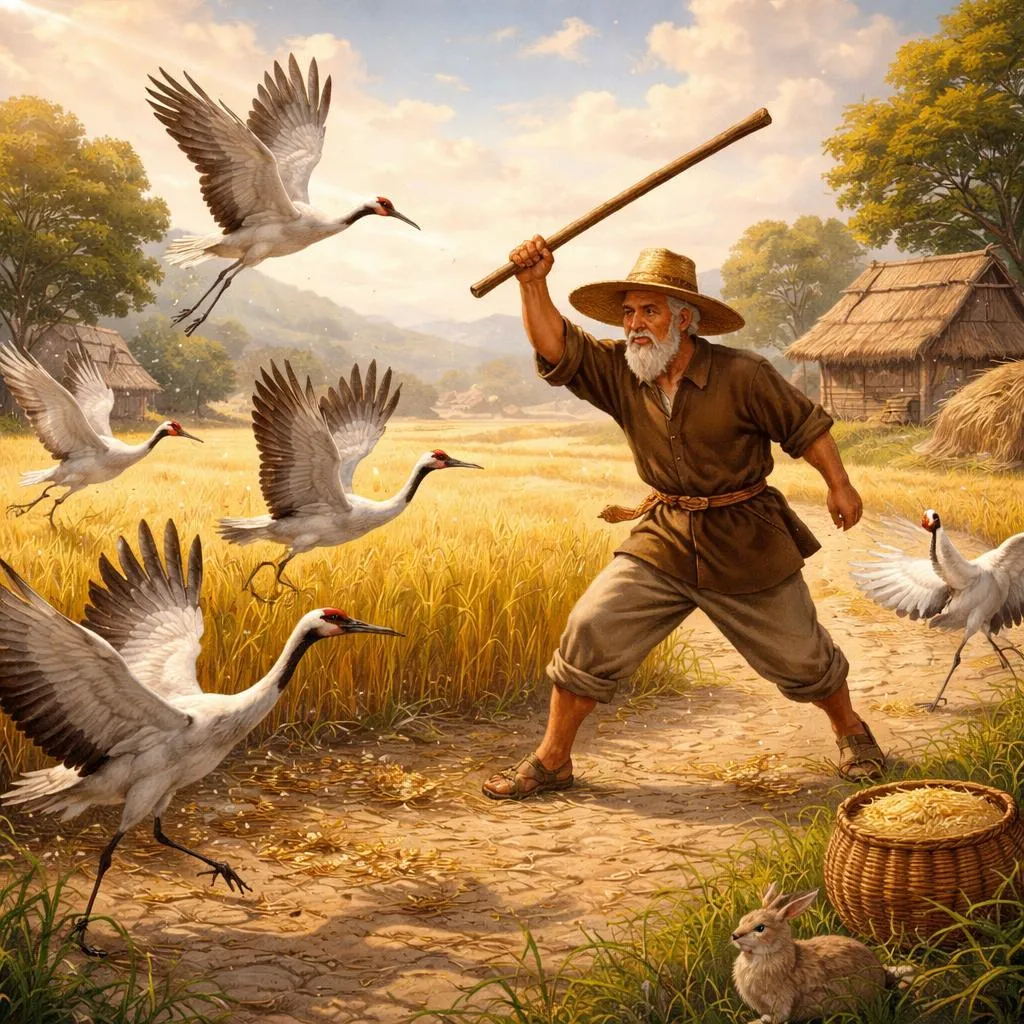

SOME CRANES made their feeding grounds on some plowlands newly sown with wheat. For a long time the Farmer, brandishing an empty sling, chased them away by the terror he inspired; but when the birds found that the sling was only swung in the air, they ceased to take any notice of it and would not move. The Farmer, on seeing this, charged his sling with stones, and killed a great number. The remaining birds at once forsook his fields, crying to each other, “It is time for us to be off to Liliput: for this man is no longer content to scare us, but begins to show us in earnest what he can do.”
If words suffice not, blows must follow.
Background and Author Introduction
This fable is one of the many traditional stories that use animals to teach moral lessons. It belongs to the genre of Aesop’s Fables, a collection of short tales attributed to Aesop, a storyteller believed to have lived in ancient Greece around the 6th century BCE. These fables use simple narratives and animal characters to illustrate human virtues and vices, making complex ideas accessible and memorable, especially for young readers.
Detailed Interpretation and Meaning
The story of the cranes and the farmer is a vivid example of how actions speak louder than words. The cranes initially fear the farmer because of his threatening gestures, even though he is not actually harming them. When they realize that the farmer’s threats are empty, they become bold and continue to feed on the crops. However, when the farmer takes real action by throwing stones, the cranes understand the seriousness of the situation and decide to leave.
This tale teaches an important lesson about the consequences of empty threats and the power of real action. It also highlights the idea that sometimes, words or warnings are not enough to solve a problem; decisive action may be necessary.
Lessons and Insights for Students
-
Understanding Consequences: Students can learn that threats without follow-through lose their power. In life, it is important to be consistent and sincere in what we say and do. Empty promises or warnings can lead to others not taking us seriously.
-
Courage and Caution: The cranes initially show courage by ignoring the farmer’s empty threats, but they wisely retreat when faced with real danger. This teaches the balance between bravery and knowing when to be cautious.
-
Problem-Solving and Responsibility: The farmer’s shift from empty threats to action shows responsibility in protecting his livelihood. Students can relate this to taking responsibility for their own problems and not just relying on words or excuses.
Application in Daily Life
-
In School: When students face challenges, such as conflicts with classmates or difficulties in learning, this story encourages them to take meaningful actions rather than just complaining or making empty threats. For example, if a student is being bullied, telling a teacher or standing up respectfully is more effective than just warning the bully without action.
-
In Social Settings: The story also teaches the importance of sincerity in communication. If a person frequently threatens to do something but never follows through, friends or peers may stop respecting or trusting them.
-
In Personal Growth: The tale encourages students to be mindful of their behavior and the impact of their actions. It suggests that integrity and follow-through are key to building trust and respect.
Cultivating Positive Traits
-
Consistency and Integrity: Encourage students to match their words with actions. This builds credibility and trustworthiness.
-
Wisdom in Action: Teach students to assess situations carefully and decide when to act boldly and when to be cautious, just like the cranes.
-
Respect for Others’ Boundaries: The cranes initially take advantage of the farmer’s empty threats, but the story shows that respecting others’ rights and property is important to avoid conflict.
Reflection and Appreciation
After reading this story, students can reflect on times when they or others have made empty threats or promises. They can discuss how those situations were resolved and what might have been done differently. This reflection helps deepen their understanding of effective communication and responsible behavior.
In literature, fables like this one are valuable because they use simple stories to teach lessons that apply to all ages. By appreciating these stories, students develop critical thinking and moral reasoning skills that will benefit them throughout life.
In summary, this fable is not just about cranes and farmers; it is a timeless lesson on the importance of sincerity, responsibility, and the power of action. Students who learn from this story can apply its wisdom in their studies, friendships, and personal challenges, growing into thoughtful and trustworthy individuals.
