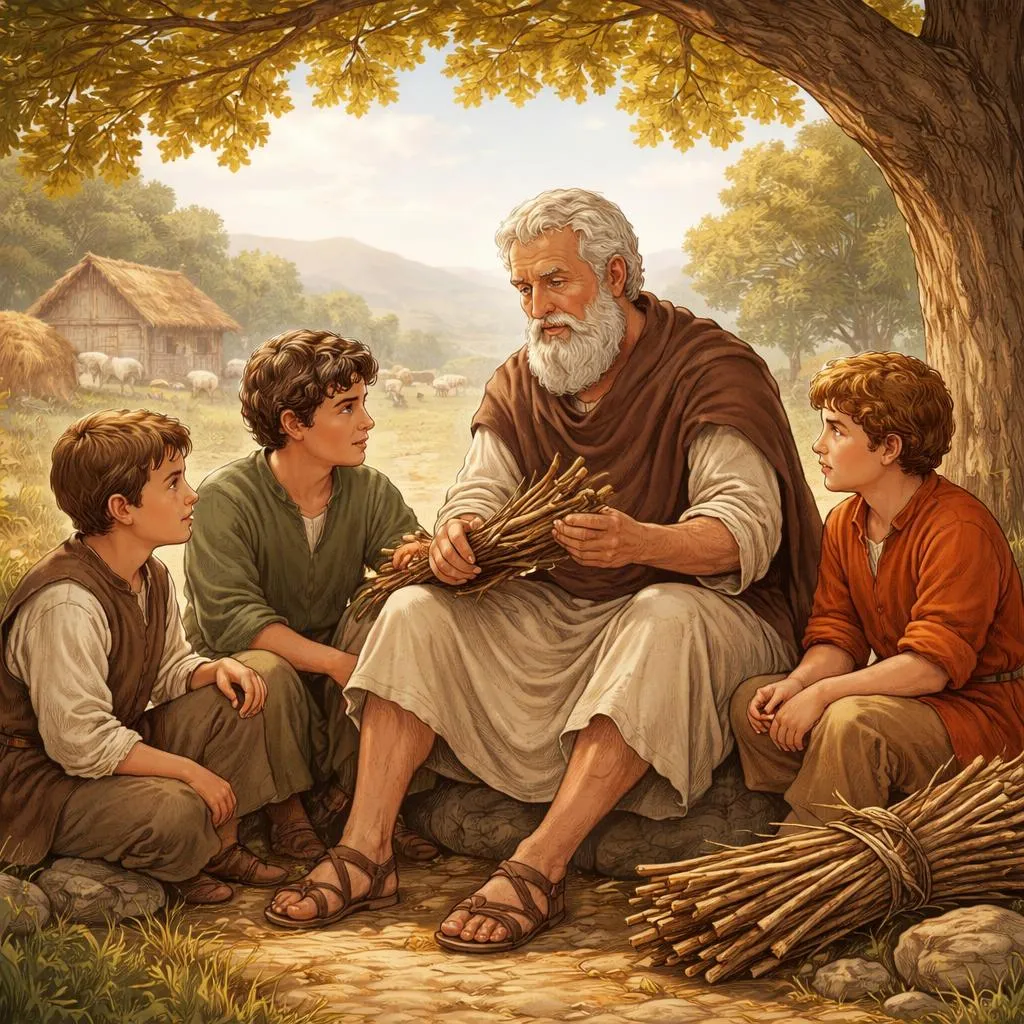

A FATHER had a family of sons who were perpetually quarreling among themselves. When he failed to heal their disputes by his exhortations, he determined to give them a practical illustration of the evils of disunion; and for this purpose he one day told them to bring him a bundle of sticks. When they had done so, he placed the bundle of sticks into the hands of each of them in succession, and ordered them to break it in pieces. They tried with all their strength, and were not able to do it. He next opened the bundle of sticks, took the sticks separately, one by one, and again put them into his sons’ hands, upon which they broke them easily. He then addressed them in these words: “My sons, if you are of one mind, and unite to assist each other, you will be as this bundle of sticks, uninjured by all the attempts of your enemies; but if you are divided among yourselves, you will be broken as easily as these sticks.”
Background and Origin of the Story
This story is a classic fable often attributed to Aesop, an ancient Greek storyteller believed to have lived around the 6th century BCE. Aesop’s fables are short tales that use animals, objects, or people to teach moral lessons. This particular fable is commonly known as "The Bundle of Sticks" or "The Father and His Sons." It has been passed down through generations and appears in many cultures worldwide, illustrating the universal value of unity and cooperation.
Detailed Interpretation and Meaning
The story uses a simple yet powerful metaphor: a bundle of sticks tied together represents strength in unity, while individual sticks symbolize vulnerability when separated. The father’s experiment shows his sons that while they may be strong individually, they are far stronger when they support each other. This lesson highlights the importance of family harmony, teamwork, and solidarity.
The deeper meaning of the story encourages readers to understand that conflicts and quarrels weaken relationships and communities. When people are divided, they become easy targets for failure or harm. However, when they cooperate and support one another, they become resilient and capable of overcoming challenges.
What Students and Children Can Learn
-
The Value of Unity: The story teaches young readers that working together and supporting each other is more effective than acting alone. Whether in family, school, or friendships, unity brings strength.
-
Conflict Resolution: It shows that constant fighting and disagreements can weaken bonds. Instead, understanding and cooperation help maintain peace and harmony.
-
Teamwork Skills: Students learn that collaboration is essential not only in personal relationships but also in group projects, sports, and other activities.
-
Practical Wisdom: The father’s method of teaching through a hands-on demonstration encourages critical thinking and learning by experience.
Life Applications: How to Use This Lesson
-
In Family Life: Children can apply this lesson by resolving conflicts with siblings or parents, understanding that family members are strongest when they support each other.
-
At School: Students can practice teamwork in group assignments, helping classmates, and avoiding unnecessary arguments.
-
In Friendships: Being united with friends and standing together during difficulties can build lasting relationships.
-
In Community and Society: The story encourages young people to contribute to community harmony by promoting cooperation and kindness.
Cultivating Positive Traits from the Story
To develop the spirit of unity and cooperation, children and teenagers can:
-
Practice empathy by trying to understand others’ feelings and viewpoints.
-
Communicate openly and respectfully to resolve misunderstandings.
-
Participate in group activities that require collaboration.
-
Reflect on the consequences of quarrels and the benefits of peace.
-
Encourage others to work together rather than compete destructively.
Reflection and Appreciation
Reading this fable invites students to reflect on their own behavior and relationships. It encourages self-awareness about how their actions affect others and the collective strength of their social circles. Appreciating the story’s simple yet profound message helps cultivate a mindset that values harmony, patience, and mutual support.
In summary, "The Bundle of Sticks" is more than just a tale; it is a timeless lesson on the power of unity. By embracing this lesson, young readers can build stronger families, friendships, and communities, preparing them for a successful and fulfilling life.
