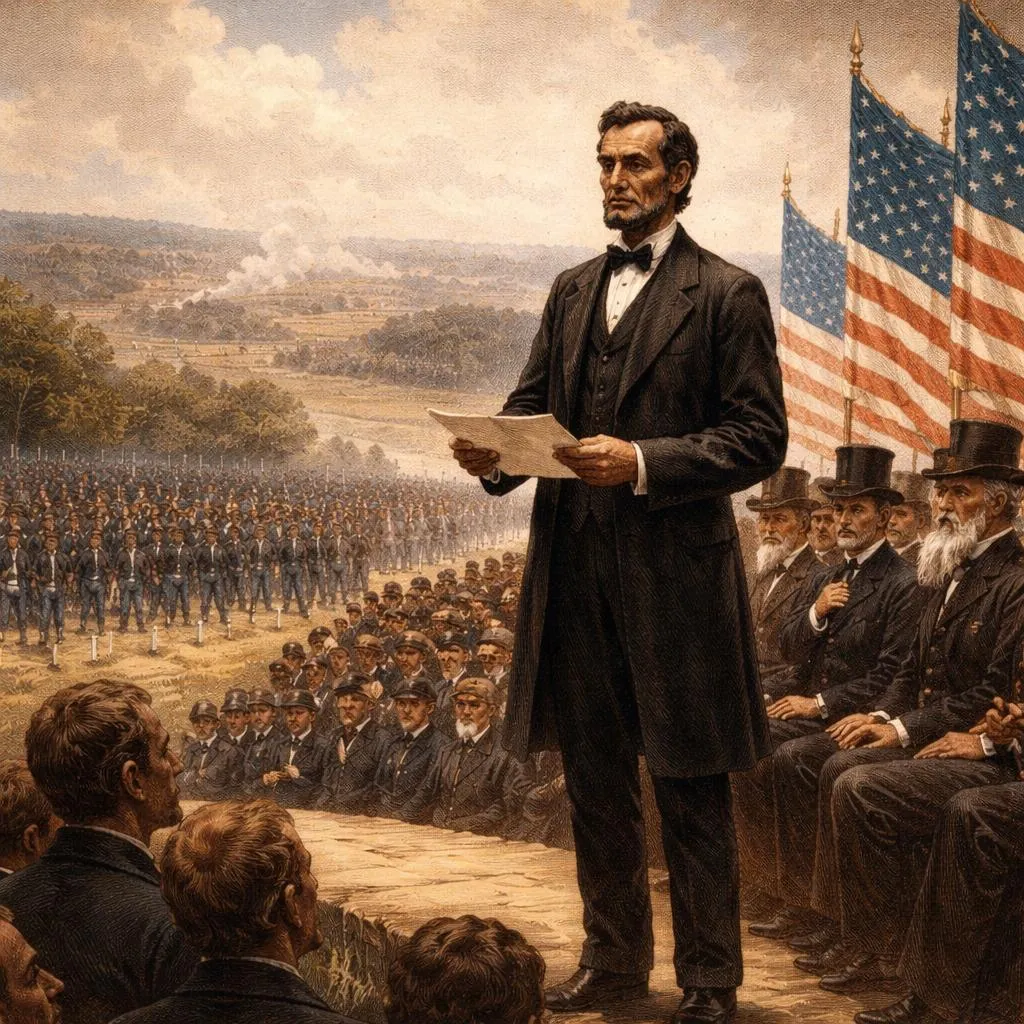

Four score and seven years ago our fathers brought forth on this continent a new nation, conceived in Liberty, and dedicated to the proposition that all men are created equal.
Now we are engaged in a great civil war, testing whether that nation, or any nation, so conceived and so dedicated, can long endure. We are met on a great battle-field of that war. We have come to dedicate a portion of that field, as a final resting place for those who here gave their lives that that nation might live. It is altogether fitting and proper that we should do this.
But, in a larger sense, we can not dedicate–we can not consecrate–we can not hallow–this ground. The brave men, living and dead, who struggled here, have consecrated it, far above our poor power to add or detract. The world will little note, nor long remember what we say here, but it can never forget what they did here. It is for us the living, rather, to be dedicated here to the unfinished work which they who fought here have thus far so nobly advanced. It is rather for us to be here dedicated to the great task remaining before us – that from these honored dead we take increased devotion to that cause for which they gave the last full measure of devotion – that we here highly resolve that these dead shall not have died in vain – that this nation, under God, shall have a new birth of freedom – and that government of the people, by the people, for the people, shall not perish from the earth.
Background and Author Introduction
This famous passage is from the Gettysburg Address, delivered by Abraham Lincoln, the 16th President of the United States, on November 19, 1863. The speech was given during the American Civil War, a brutal conflict between the Northern states (the Union) and the Southern states (the Confederacy) primarily over issues of slavery and states' rights. The Battle of Gettysburg was one of the bloodiest and most decisive battles of this war, and Lincoln’s speech was made at the dedication of the Soldiers' National Cemetery in Gettysburg, Pennsylvania.
Abraham Lincoln, known for his leadership during one of the most turbulent times in American history, was a self-taught lawyer and politician who rose from humble beginnings to become president. His words in the Gettysburg Address are considered a profound expression of American ideals, emphasizing liberty, equality, and the importance of national unity.
Detailed Interpretation and Significance
The Gettysburg Address is remarkably brief, yet it carries deep meaning. Lincoln begins by recalling the founding of the nation "four score and seven years ago" (87 years ago), emphasizing that the country was founded on the principle that "all men are created equal." This sets the stage for the central theme of the speech: the struggle to preserve that ideal during the Civil War.
Lincoln then acknowledges the immense sacrifice made by soldiers who fought and died at Gettysburg. He humbly states that no words can truly consecrate the battlefield, because the soldiers’ actions have already done so. The speech shifts to a call for the living to dedicate themselves to the "unfinished work" — the ongoing fight for freedom and equality. Finally, Lincoln expresses hope that the nation will experience a "new birth of freedom" and that government "of the people, by the people, for the people, shall not perish from the earth."
This speech redefined the Civil War as not just a fight to preserve the Union, but as a struggle to uphold the fundamental values of democracy and human equality.
Lessons and Insights for Students
-
The Power of Words and Leadership
Lincoln’s Gettysburg Address teaches us how powerful and concise language can inspire and unite people. Students can learn the importance of clear communication and how words can influence society and history. -
Sacrifice and Dedication
The speech honors those who sacrificed their lives for a greater cause. It encourages young people to appreciate the value of dedication and selflessness, whether in school, family, or community. -
Equality and Justice
Lincoln’s emphasis on equality reminds students about the importance of fairness and respect for all people. This is a timeless lesson relevant to social interactions and building inclusive communities. -
Perseverance in Difficult Times
The Civil War was a period of great hardship, yet Lincoln’s words inspire perseverance and hope. Students can learn to face challenges with courage and a commitment to their goals.
Applying These Lessons in Daily Life
- In Learning: Students can adopt Lincoln’s dedication to the “unfinished work” by setting personal goals and working persistently to achieve them, even when obstacles arise.
- In Social Situations: Embracing the principle that “all men are created equal” encourages kindness, empathy, and fairness toward peers from diverse backgrounds.
- In Community and Citizenship: The idea of government “of the people, by the people, for the people” highlights the importance of participation and responsibility in society, inspiring young people to be active, informed citizens.
- In Personal Growth: The speech encourages reflection on one’s values and the impact of individual actions on the broader community.
Cultivating Positive Spirit and Behavior
To embody the spirit of the Gettysburg Address, students can:
- Practice empathy and respect for others, recognizing the inherent worth of every person.
- Show dedication and responsibility in their studies and extracurricular activities.
- Understand the importance of standing up for justice and equality in their communities.
- Develop resilience by learning from setbacks and continuing to strive for improvement.
By studying this historic speech, students not only gain insight into American history but also learn universal values that help shape character and guide ethical behavior throughout life.
