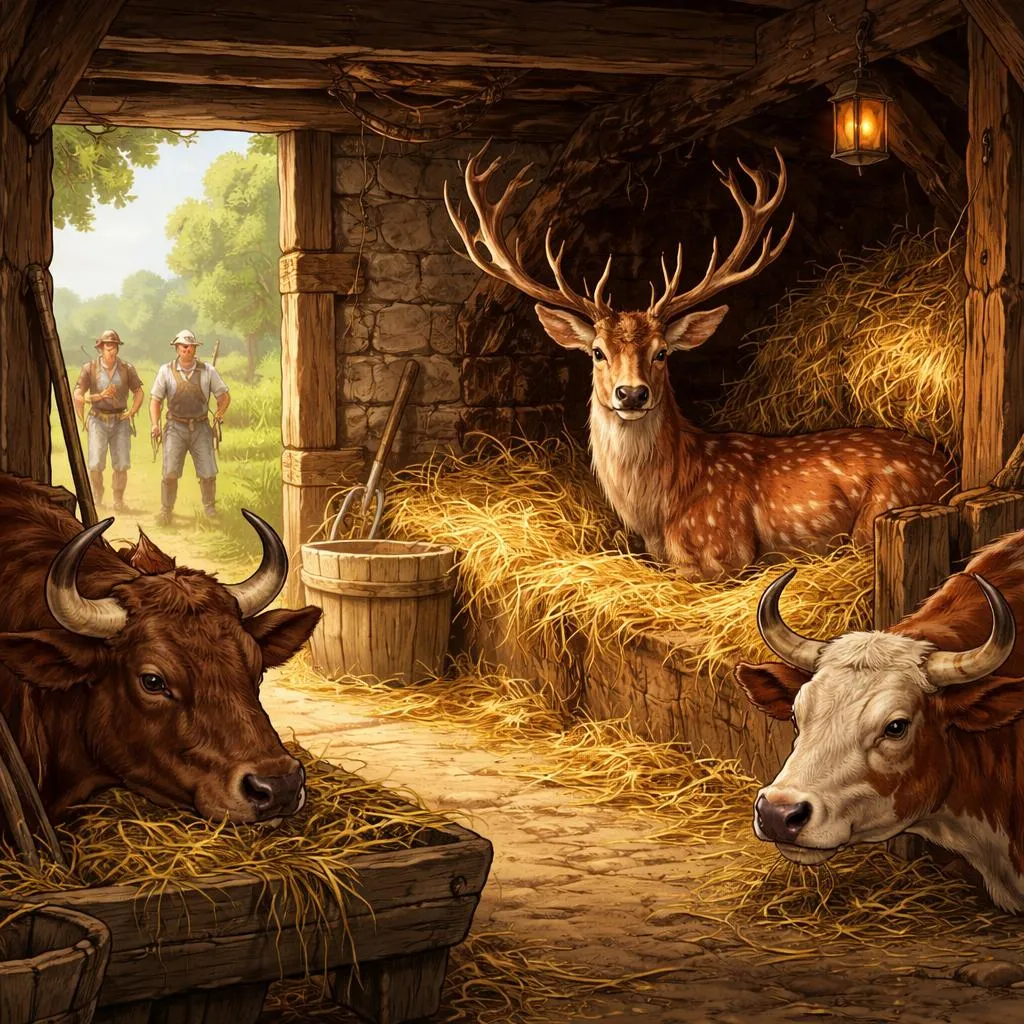

A Hart hotly pursued by the hounds fled for refuge into an ox-stall, and buried itself in a truss of hay, leaving nothing to be seen but the tips of his horns. Soon after the Hunters came up and asked if any one had seen the Hart. The stable boys, who had been resting after their dinner, looked round, but could see nothing, and the Hunters went away. Shortly afterwards the master came in, and looking round, saw that something unusual had taken place. He pointed to the truss of hay and said: “What are those two curious things sticking out of the hay?” And when the stable boys came to look they discovered the Hart, and soon made an end of him. He thus learnt that
Nothing escapes the master’s eye.
Background and Author Introduction
This story is a classic fable that belongs to the rich tradition of Aesop’s Fables, a collection of short tales attributed to Aesop, a storyteller believed to have lived in ancient Greece around the 6th century BCE. These fables often feature animals with human characteristics and conclude with a moral lesson. The simplicity of the narratives combined with profound wisdom has allowed these stories to transcend time and cultures, making them a valuable resource for teaching ethics and life lessons to children and young adults.
Detailed Interpretation and Meaning
In this particular fable, the hart (a male deer) is desperately trying to escape the hounds chasing it. It hides inside an ox-stall, covering itself with hay so that only the tips of its horns are visible. The hunters ask the stable boys if they have seen the hart, but the boys, unaware of the hidden animal, say no. However, the master of the stable notices the unusual sight of the horns sticking out and exposes the hart’s hiding place, leading to its capture.
The moral, “Nothing escapes the master’s eye,” teaches us that no matter how cleverly one tries to hide or avoid responsibility, those in authority or those who are observant will eventually discover the truth. It underscores the importance of honesty and the futility of deceit.
Lessons and Insights for Students and Young Readers
-
Honesty is the Best Policy: The hart’s attempt to hide represents the tendency some might have to avoid consequences by hiding the truth. This story encourages students to face challenges openly rather than trying to escape or deceive.
-
Awareness and Observation: The master’s keen observation contrasts with the stable boys’ ignorance. It reminds students to pay attention to details in their environment and to develop critical thinking skills.
-
Accountability: The story highlights that actions have consequences and that one cannot easily evade responsibility. This is a vital lesson for young people as they grow into responsible individuals.
-
Authority and Respect: Understanding that those in positions of authority, like teachers, parents, or leaders, often have insights and experience that help them see beyond surface appearances.
Application in Daily Life, Learning, and Social Situations
-
In School: Students can apply the lesson by being truthful about their work and behavior. Cheating or hiding mistakes might seem like a quick fix, but ultimately, honesty leads to trust and better learning outcomes.
-
In Friendships: Being honest with friends builds stronger relationships. Trying to hide feelings or actions can lead to misunderstandings and loss of trust.
-
At Home: Respecting parents and guardians by being open about one’s actions helps build a healthy family environment.
-
Self-Reflection: The story encourages young people to be honest with themselves and to recognize when they might be avoiding problems instead of addressing them.
How to Cultivate the Positive Spirit and Behavior from the Story
-
Practice Honesty: Make a habit of telling the truth, even when it is difficult. This builds integrity and self-respect.
-
Develop Observation Skills: Pay attention to your surroundings and listen carefully. This can help you understand situations better and avoid misunderstandings.
-
Accept Responsibility: When mistakes happen, own up to them and learn from the experience. This attitude fosters growth and maturity.
-
Respect Authority with Understanding: Recognize that teachers, parents, and mentors often have your best interests at heart, even if their decisions seem strict at times.
Reflection and Appreciation
This fable, though simple, offers a timeless lesson that is relevant across cultures and ages. It teaches that trying to deceive or hide from problems is ultimately futile and that transparency and responsibility are virtues worth cultivating. For young readers, it is an invitation to embrace honesty and to understand that being truthful is a strength, not a weakness.
By reflecting on this story, students can develop a mindset that values integrity, sharpens their awareness, and encourages them to build trustworthy relationships. These qualities will serve them well not only in their academic journey but throughout their lives.
