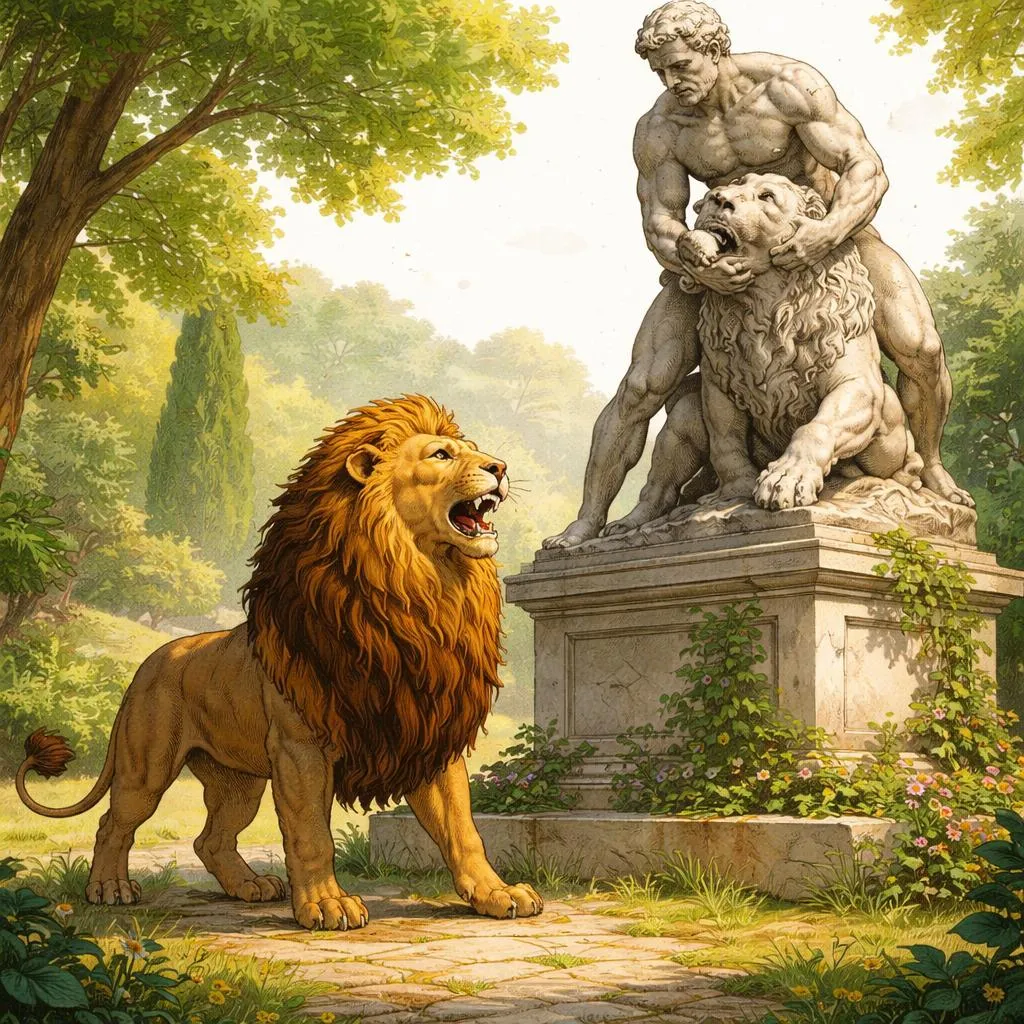

A Man and a Lion were discussing the relative strength of men and lions in general. The Man contended that he and his fellows were stronger than lions by reason of their greater intelligence. “Come now with me,” he cried, “and I will soon prove that I am right.” So he took him into the public gardens and showed him a statue of Hercules overcoming the Lion and tearing his mouth in two.
“That is all very well,” said the Lion, “but proves nothing, for it was a man who made the statue.”
We can easily represent things as we wish them to be.
Background and Author Introduction
This short fable is a classic example of Aesop’s Fables, a collection of stories attributed to Aesop, a storyteller believed to have lived in ancient Greece around the 6th century BCE. These fables are famous for their simple yet profound moral lessons, often conveyed through animals acting with human traits. This particular story explores themes of perception, truth, and the power of representation.
Detailed Interpretation and Significance
The story depicts a conversation between a man and a lion debating who is stronger. The man argues that humans are stronger because of their intelligence and tries to prove this by showing a statue of Hercules defeating a lion. The lion’s response reveals a deeper truth: the statue’s existence and portrayal are influenced by human perspective and creativity, not an objective fact about strength. This highlights how reality can be shaped by those who tell the story or create representations, emphasizing the importance of critical thinking and questioning appearances.
The fable teaches readers to be cautious about accepting things at face value, especially when information is presented by those who may have biases or interests. It also suggests that intelligence and creativity are powerful tools, but they can be used to manipulate perceptions rather than reveal absolute truths.
Lessons and Insights for Students and Young Readers
-
Critical Thinking and Skepticism
Students learn to question what they see and hear, understanding that not all information is impartial or true. This skill is vital in an age of abundant information and media where facts can be distorted. -
The Power of Perspective
The story encourages young readers to appreciate different viewpoints. Just as the man and the lion see strength differently, people may interpret situations in diverse ways. Understanding this helps in developing empathy and open-mindedness. -
Intelligence and Creativity
While the man’s intelligence allows him to create art and symbols, the story warns that intelligence should be used responsibly. Creativity can shape reality, but it should not be used to deceive or mislead others. -
Humility and Respect for Others
The lion’s calm rebuttal reminds us that strength and power are not always obvious or easily measured. It teaches humility and respect for others, even those who seem different or opposing.
Application in Daily Life, Learning, and Social Situations
- In Learning: Students can apply the lesson by always verifying facts and seeking multiple sources of information. This habit strengthens research skills and academic integrity.
- In Social Interactions: Understanding that people have different perspectives can improve communication and reduce conflicts. Students can practice empathy by trying to see situations from others’ points of view.
- In Personal Growth: Recognizing the limits of one’s knowledge and being open to correction fosters humility and continuous learning.
- In Creativity and Expression: Students are encouraged to use their intelligence and creativity positively—to inspire, educate, and build rather than manipulate or mislead.
Cultivating Positive Values from the Story
- Honesty: Encourage truthful representation of facts and situations.
- Open-mindedness: Be willing to listen and consider opinions different from your own.
- Respect: Value the strengths and qualities of others, even if they differ from yours.
- Critical Awareness: Develop the habit of questioning and analyzing information critically.
Conclusion: Why This Story Matters
This brief but powerful fable remains relevant today as it teaches timeless lessons about truth, perception, and the responsible use of intelligence. For young readers, it serves as a reminder that strength is not just physical but also intellectual and moral. It encourages them to think deeply, respect others, and use their abilities wisely in all areas of life.
