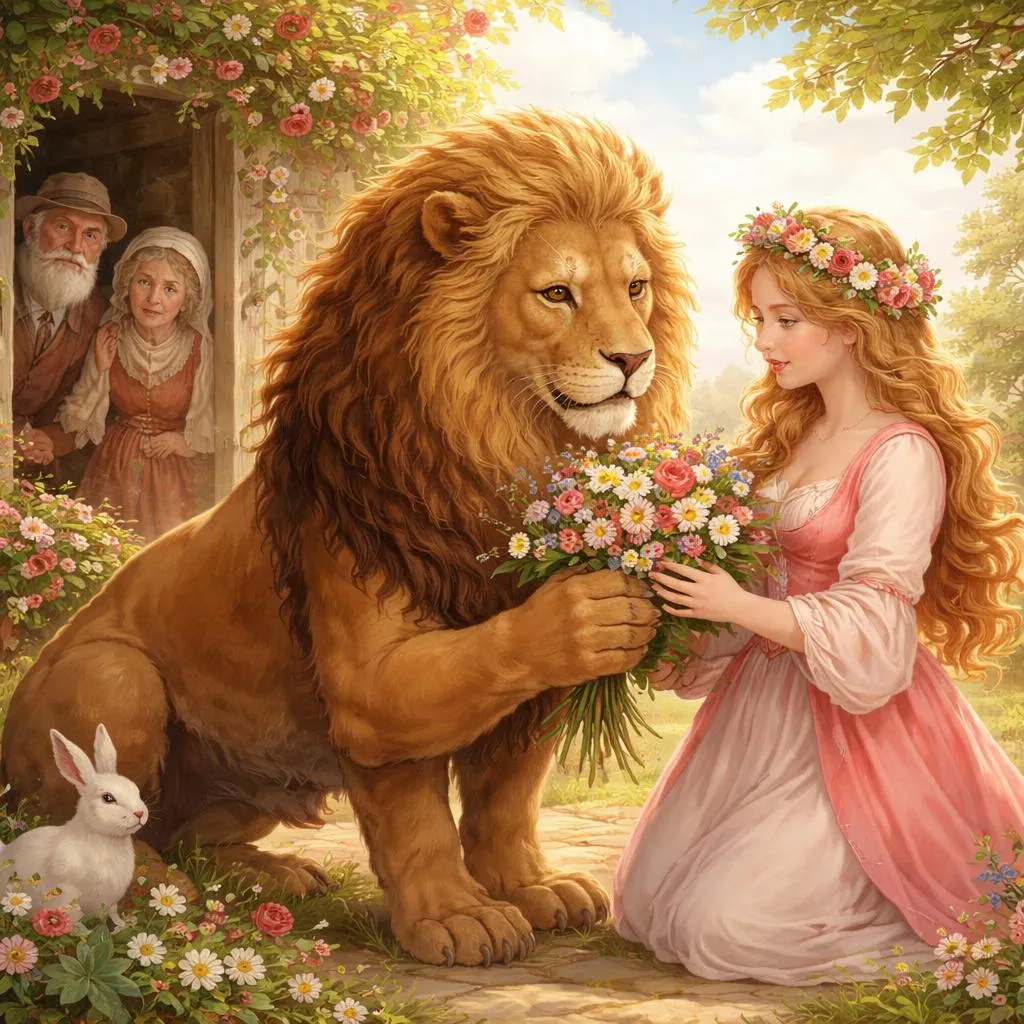

A Lion once fell in love with a beautiful maiden and proposed marriage to her parents. The old people did not know what to say. They did not like to give their daughter to the Lion, yet they did not wish to enrage the King of Beasts. At last the father said: “We feel highly honoured by your Majesty’s proposal, but you see our daughter is a tender young thing, and we fear that in the vehemence of your affection you might possibly do her some injury. Might I venture to suggest that your Majesty should have your claws removed, and your teeth extracted, then we would gladly consider your proposal again.” The Lion was so much in love that he had his claws trimmed and his big teeth taken out. But when he came again to the parents of the young girl they simply laughed in his face, and bade him do his worst.
Love can tame the wildest.
Background and Author Introduction
This story is a classic fable, a type of short tale that uses animals with human traits to teach moral lessons. Fables have been told for thousands of years across many cultures. This particular story, often attributed to Aesop or inspired by Aesopian tradition, uses the lion—a symbol of strength and power—to explore themes of love, sacrifice, and the nature of true affection. Aesop was a storyteller believed to have lived in ancient Greece around the 6th century BCE, and his fables have been passed down through generations because they convey important life lessons in simple, memorable ways.
Detailed Interpretation and Meaning
At its core, this story illustrates how love can inspire change, even in the wildest of creatures. The lion, known for his fierce and dangerous nature, is willing to give up his natural weapons—the claws and teeth—to win the approval of the maiden’s parents and marry her. This act symbolizes the power of love to soften even the most ferocious hearts.
However, the story also warns about the consequences of losing one’s true nature. When the lion returns without his claws and teeth, the parents mock him, showing that appearances or sacrifices alone may not guarantee acceptance or success. The phrase “Love can tame the wildest” suggests that love has the power to change behavior and attitudes, but it also implies that true love involves balance—one should not lose their essence or strength entirely.
Lessons and Insights for Students
-
The Power of Love and Sacrifice: The lion’s willingness to change shows that love can motivate us to become better and more considerate. Students can learn that love often requires compromise and self-improvement, but it should never demand losing who you truly are.
-
Courage to Change: The lion’s decision to trim his claws and remove his teeth is a brave step. Change can be difficult, especially when it means giving up something important. This teaches students to be courageous when they want to improve themselves or their relationships.
-
Understanding True Acceptance: The parents’ reaction reminds us that acceptance from others is not always guaranteed, even when we try hard to please them. Students can learn to value self-respect and to understand that not everyone will accept us, no matter what we do.
-
Balance Between Strength and Gentleness: The story encourages finding a balance between being strong and being gentle. In life and social interactions, students can practice being kind and loving without losing their confidence or integrity.
Applications in Daily Life, Learning, and Social Situations
-
In Friendships and Relationships: Students can apply the lesson of love’s power to soften hearts by being patient, kind, and willing to listen to others. However, they should also remember to maintain their own boundaries and values.
-
In School and Personal Growth: Just as the lion changed to win approval, students can work on improving their skills, attitudes, and behaviors to succeed academically and socially. They should do so with courage and self-awareness, not by pretending to be someone they are not.
-
In Conflict Resolution: The story shows that sometimes, to resolve conflicts, we need to change our approach or be more understanding. But it also teaches that respect must be mutual; one should not give up their dignity to please others.
Cultivating Positive Values and Behaviors
To nurture the positive spirit shown in the story, students can:
- Practice empathy by trying to understand others’ feelings and perspectives.
- Develop self-discipline to improve themselves while staying true to their identity.
- Learn to communicate honestly and respectfully, balancing assertiveness with kindness.
- Reflect on their actions and motivations, ensuring that changes they make come from genuine care, not just to gain approval.
Conclusion
This simple yet profound fable teaches timeless lessons about love, change, courage, and acceptance. By reflecting on the lion’s story, students can gain valuable insights into how to build healthy relationships, grow as individuals, and face life’s challenges with both strength and compassion. The story encourages young readers to believe in the transformative power of love while reminding them to cherish and protect their true selves.
