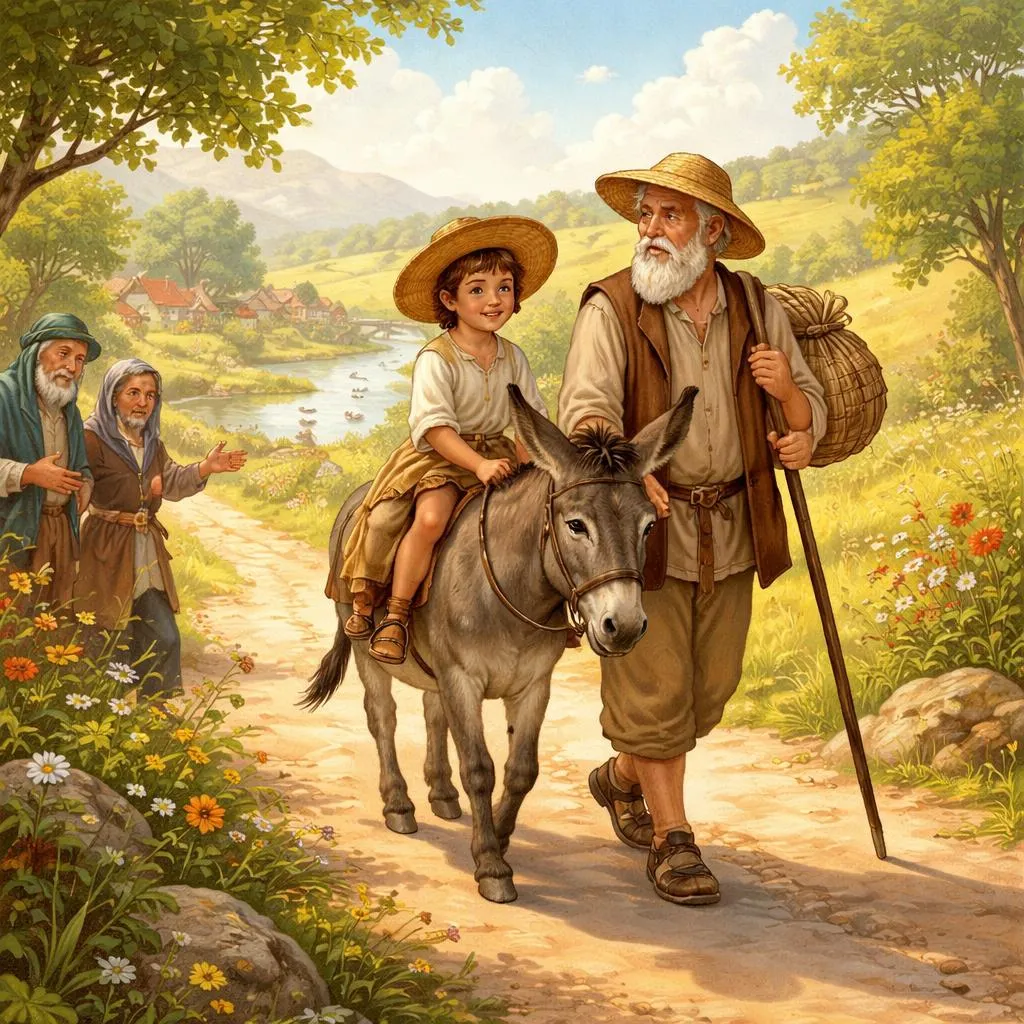

A Man and his son were once going with their Donkey to market. As they were walking along by its side a countryman passed them and said: “You fools, what is a Donkey for but to ride upon?”
So the Man put the Boy on the Donkey and they went on their way. But soon they passed a group of men, one of whom said: “See that lazy youngster, he lets his father walk while he rides.”
So the Man ordered his Boy to get off, and got on himself. But they hadn’t gone far when they passed two women, one of whom said to the other: “Shame on that lazy lout to let his poor little son trudge along.”
Well, the Man didn’t know what to do, but at last he took his Boy up before him on the Donkey. By this time they had come to the town, and the passers-by began to jeer and point at them. The Man stopped and asked what they were scoffing at. The men said: “Aren’t you ashamed of yourself for overloading that poor donkey of yours and your hulking son?”
The Man and Boy got off and tried to think what to do. They thought and they thought, till at last they cut down a pole, tied the donkey’s feet to it, and raised the pole and the donkey to their shoulders. They went along amid the laughter of all who met them till they came to Market Bridge, when the Donkey, getting one of his feet loose, kicked out and caused the Boy to drop his end of the pole. In the struggle the Donkey fell over the bridge, and his fore-feet being tied together he was drowned.
“That will teach you,” said an old man who had followed them:
“Please all, and you will please none.”
Background and Author Introduction
This story, often known as "The Man, the Boy, and the Donkey," is a classic fable that has been told in various cultures for centuries. The exact origin is uncertain, but it is commonly attributed to Aesop, a storyteller believed to have lived in ancient Greece around the 6th century BCE. Aesop’s fables are short tales that use animals and human characters to teach moral lessons. These stories have been passed down through generations and remain popular because of their simplicity and timeless wisdom.
Detailed Interpretation and Meaning
At its core, this fable teaches the lesson that trying to please everyone is impossible and often leads to failure or harm. The man and his son attempt to satisfy every critic they meet, changing their behavior each time based on others’ opinions. This constant shifting causes confusion, ridicule, and ultimately, the tragic loss of their donkey. The story warns against excessive concern with the judgments of others, emphasizing the importance of making thoughtful decisions based on one’s own values and circumstances.
The donkey symbolizes the burden or responsibility that the man and his son carry. Their attempts to manage this burden by reacting to external criticism rather than internal judgment lead to disaster. The moral, “Please all, and you will please none,” highlights the futility of trying to satisfy everyone and the value of self-confidence and discernment.
Lessons and Insights for Students and Young Readers
-
The Importance of Independent Thinking:
Students can learn that it is essential to think independently rather than constantly changing their actions to fit others’ expectations. In school, this might mean choosing subjects or activities that genuinely interest them instead of trying to impress peers or teachers. -
Understanding Criticism:
Not all criticism is valuable or constructive. This story teaches young readers to evaluate feedback carefully and not be swayed by every opinion. Learning to distinguish between helpful advice and mere judgment can help them grow stronger and more confident. -
Balancing Social Influence:
While listening to others is important, it should not lead to losing one’s own identity or values. Students can apply this by maintaining their principles even when peer pressure is strong, fostering resilience and self-respect. -
Consequences of Over-Accommodation:
The story shows that trying to accommodate everyone’s wishes can backfire. In social situations, this might mean that trying to be liked by all can cause misunderstandings or conflicts. Learning to say no and set boundaries is a valuable skill.
Application in Daily Life and Learning
-
In School: When working on group projects or participating in class discussions, students should share their honest ideas and not change their opinions just to fit in. This encourages creativity and leadership.
-
In Friendships: Friends may have different views, and it’s natural to want to be accepted. However, maintaining one’s own beliefs and respecting differences leads to healthier, more genuine relationships.
-
In Family: Sometimes family members have strong opinions. This story reminds young people to listen respectfully but also to communicate their own feelings and decisions clearly.
Cultivating Positive Behaviors and Values
-
Confidence and Self-Respect: Encourage students to trust their judgment and be proud of their choices, even if they differ from others.
-
Critical Thinking: Teach them to analyze situations and feedback thoughtfully rather than reacting impulsively to criticism.
-
Emotional Intelligence: Help students understand the feelings behind others’ comments and respond with empathy without losing their own sense of self.
-
Decision-Making Skills: Use this story as a tool to discuss how to make balanced decisions that consider both personal values and external advice.
Reflection and Appreciation
After reading this fable, students can reflect on times they have tried to please everyone and how it made them feel. They can write about or discuss what they learned and how they might handle similar situations differently in the future. Appreciating the story’s humor and tragedy helps deepen their understanding of human nature and social dynamics.
In summary, "The Man, the Boy, and the Donkey" is more than just a simple tale; it is a rich source of wisdom that encourages young readers to develop self-awareness, critical thinking, and the courage to be true to themselves. These lessons are invaluable for their growth as individuals and members of society.
