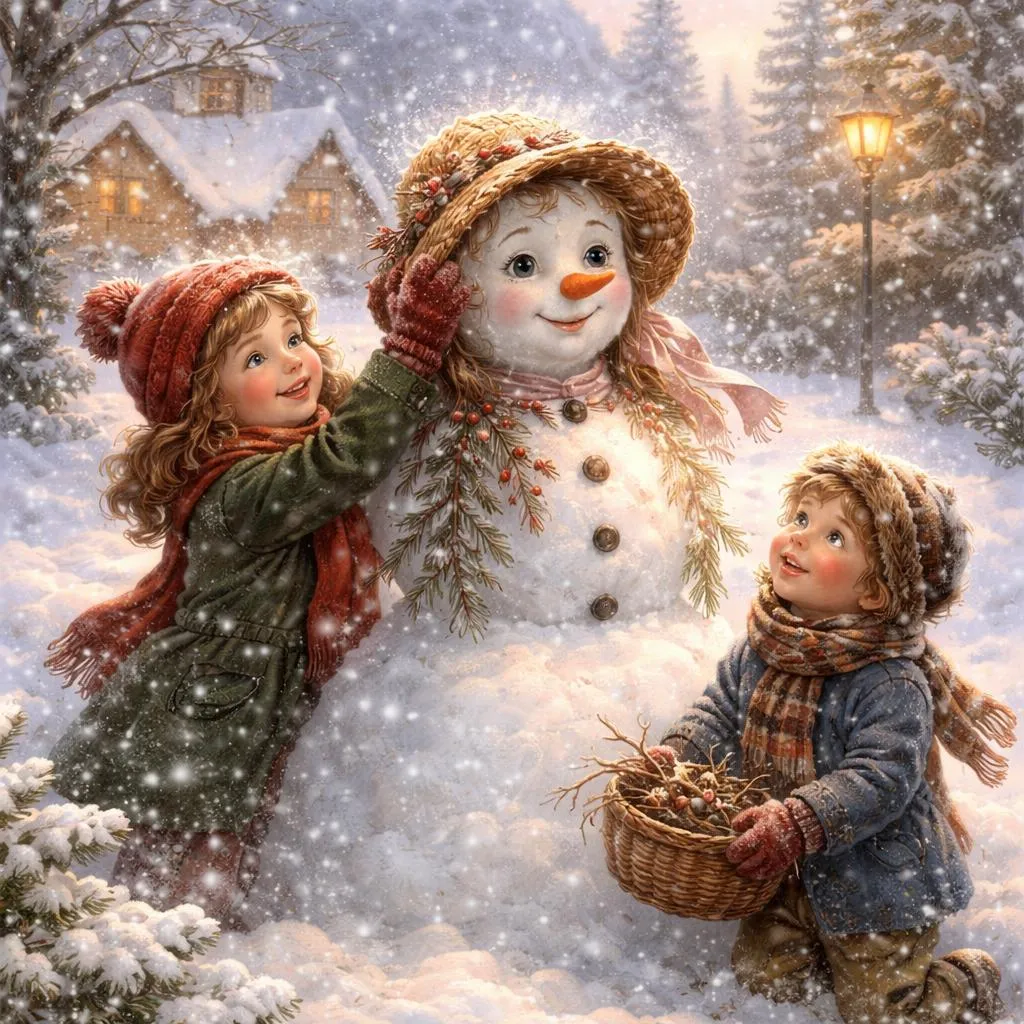

One chilly winter afternoon, after a long storm had passed, two children named Violet and Peony asked their mother if they could go outside and play in the freshly fallen snow. Violet, the elder sister, was gentle and modest, known for her beauty, while Peony, her younger brother, was cheerful and rosy-cheeked. Their father, Mr. Lindsey, was a practical man who dealt in hardware and viewed life through common sense. Their mother, however, had a poetic and imaginative spirit.
Bundled warmly by their mother, Violet and Peony eagerly ran into the garden, which was small and surrounded by leafless trees dusted with snow. They played happily, making snowballs and laughing. Inspired, Violet suggested they build a snow figure of a little girl to be their snow-sister, a playmate to keep them company throughout the winter. Peony agreed with excitement.
As they worked, their mother watched from the window, smiling at their earnestness and skill. The snow figure grew more beautiful with each addition—pure snow for the chest, delicate ringlets of snow from tree branches for hair, and shining bits of ice for eyes. Violet and Peony imagined their snow-sister alive, playing and laughing with them.
When they called their mother to see the snow-sister, she glimpsed a small white figure playing with the children. The figure appeared almost real, with rosy cheeks and golden curls, dancing lightly over the snow. The mother was puzzled but enchanted.
Their father came home and, seeing the snow figure, insisted on bringing her inside to warm up. Violet and Peony begged him not to, explaining that the snow-sister loved the cold and would melt in the warmth. Despite their pleas, Mr. Lindsey took the snow-sister indoors. As she stood near the stove, she began to droop and melt away, leaving only a puddle of water on the floor.
The story ends with the family realizing that sometimes common sense alone cannot explain or solve everything, and that imagination and faith have their own special place.
Background and Author Introduction
This story, often known as "The Snow Image," was written by Nathaniel Hawthorne, a renowned American author of the 19th century. Hawthorne is famous for his deep exploration of human nature, morality, and the supernatural. Born in 1804 in Salem, Massachusetts, Hawthorne's works often reflect themes of innocence, experience, and the tension between reality and imagination. "The Snow Image" is one of his many short stories that blend everyday life with a touch of the mystical, encouraging readers to see beyond the surface of things.
Detailed Interpretation and Significance
At its heart, "The Snow Image" is a tale about childhood innocence, imagination, and the contrast between the practical adult world and the magical world children inhabit. Violet and Peony's belief that they can create a living snow-sister symbolizes the purity and faith of childhood, where miracles seem possible and the boundaries between reality and fantasy blur.
The story also explores the tension between the father’s common-sense approach and the mother’s poetic sensibility. Mr. Lindsey represents the rational, materialistic worldview that values facts and practicality, while the mother and children embody imagination, wonder, and emotional depth. This contrast highlights how different perspectives shape our understanding of the world.
The snow-sister herself is a metaphor for fragile beauty and the ephemeral nature of childhood and innocence. Her melting in the warmth of the house reminds us that some things cannot survive in a harsh or overly pragmatic environment. The story gently warns against dismissing imagination and faith simply because they cannot be measured or explained by logic.
Lessons and Insights for Students
-
The Power of Imagination: Violet and Peony’s creative play shows how imagination enriches life. Students can learn to value their own creativity and see the world with wonder, which can inspire problem-solving and innovative thinking.
-
Balancing Logic and Emotion: The story encourages young readers to respect both reason and feeling. While it’s important to be practical, embracing emotions and dreams is equally vital for a fulfilling life.
-
Appreciating Childhood Innocence: The children’s pure belief in their snow-sister teaches us to cherish the simplicity and faith of childhood, reminding students to hold onto hope and kindness even as they grow older.
-
Understanding Different Perspectives: The contrasting views of the parents show that people may see the same situation differently. Learning empathy and open-mindedness helps students navigate social interactions and appreciate diverse opinions.
-
Respecting Nature and Fragility: The snow-sister’s delicate existence reflects the need to care for fragile things—whether relationships, feelings, or the environment. Students can learn responsibility and gentleness from this.
How to Apply These Lessons in Daily Life
-
In Learning: Encourage curiosity and creativity in studies. When facing challenges, think imaginatively about solutions instead of relying solely on standard methods.
-
In Social Situations: Practice empathy by considering others’ feelings and viewpoints, just as the mother listens with her heart to her children’s imaginative world.
-
In Emotional Growth: Allow yourself to dream and hope, even when reality seems tough. Balance this with practical actions to achieve goals.
-
In Play and Recreation: Value play as a way to develop social skills, teamwork, and emotional intelligence, just like Violet and Peony’s cooperative creation of the snow-sister.
-
In Caring for Others: Be gentle and considerate, recognizing that some people or situations are delicate and need kindness and understanding.
Cultivating Positive Spirit and Behavior
To nurture the positive qualities shown in the story, students can:
-
Practice Imaginative Play: Engage in creative activities like drawing, storytelling, or role-playing to develop imagination and emotional expression.
-
Show Kindness and Patience: Like Violet and Peony’s loving care for their snow-sister, treat friends and family with warmth and patience.
-
Balance Rational Thinking with Feelings: When making decisions, consider both facts and emotions to achieve wise and compassionate outcomes.
-
Respect Nature: Learn about the environment and how to protect it, inspired by the delicate snow-sister’s connection to the natural world.
-
Embrace Wonder: Take time to appreciate simple joys and beauty around you, keeping a childlike sense of awe alive.
Reflection and Appreciation
Reading "The Snow Image" invites students to reflect on the magic of childhood and the importance of holding onto imagination and kindness in a world that often values only logic and practicality. It reminds us that some truths are felt with the heart rather than proven by the mind.
This story encourages young readers to be open to wonder, to respect different perspectives, and to nurture the fragile beauty in themselves and others. It is a gentle lesson in balance—between belief and reason, warmth and cold, reality and fantasy—that enriches both personal growth and relationships.
By embracing the spirit of Violet and Peony, students can learn to approach life with joy, creativity, and compassion, qualities that will serve them well in school, friendships, and beyond.
