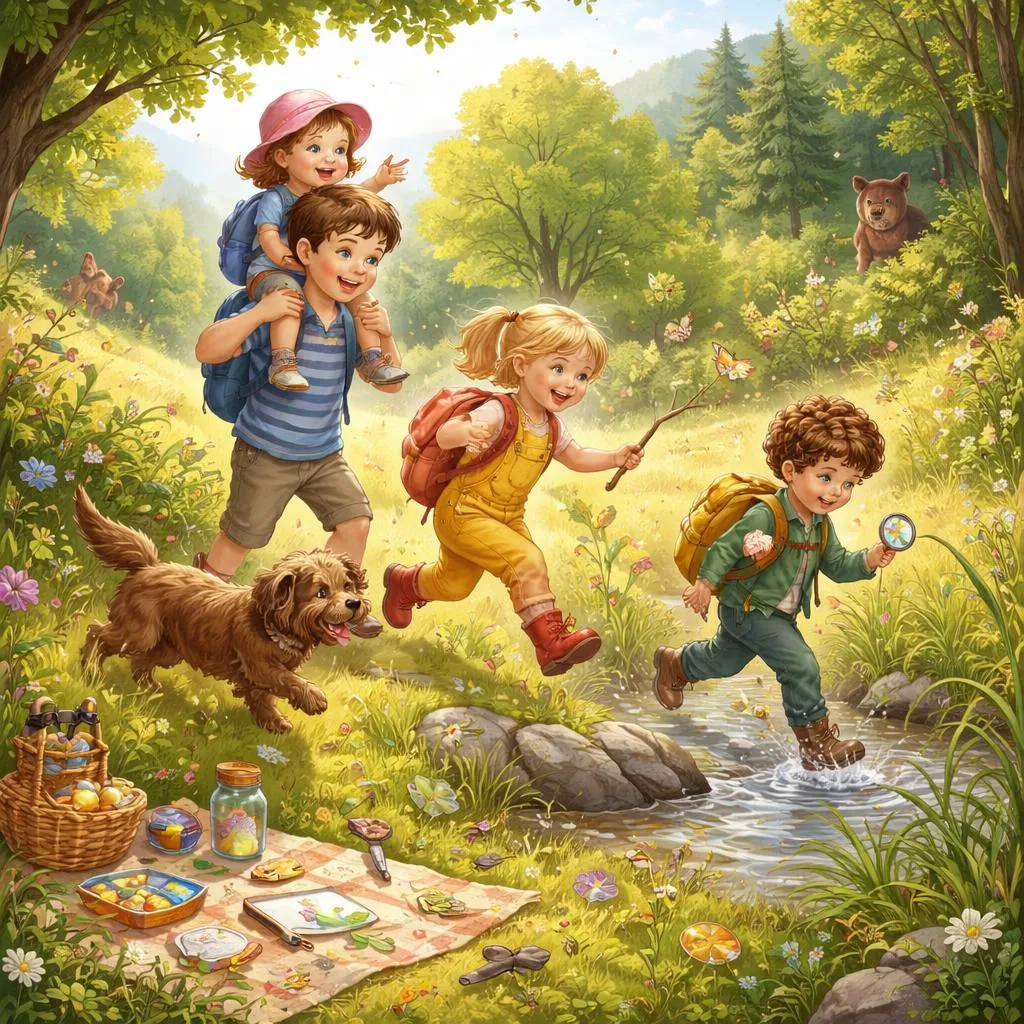

What is the Story?
Let's dive into an adventurous, participatory story chant: "We're Going on a Bear Hunt." When we look for the bear hunt lyrics, we find the words to a cumulative, interactive tale. It's not a song with a fixed melody, but a rhythmic, call-and-response story about a family journeying through various landscapes in search of a bear.
The magic of the bear hunt lyrics lies in their repetitive structure and immersive sound play. The leader chants a line, and everyone repeats it, building energy. For each obstacle—like long grass or a deep river—the group makes specific sounds and motions. This turns storytelling into a full-body experience that develops listening skills, memory, and a deep understanding of story sequence.
The Lyrics of the Story
The core bear hunt lyrics follow a thrilling, predictable pattern. The adventure begins:
We're going on a bear hunt.
We're going to catch a big one.
What a beautiful day!
We're not scared.
Then, for each obstacle, the pattern repeats:
Uh-oh! [Long wavy grass]!
We can't go over it.
We can't go under it.
Oh no! We've got to go through it!
(Sound effects: Swishy swashy! Swishy swashy!)
The journey includes a deep cold river (Splash splosh!), thick oozy mud (Squelch squerch!), a big dark forest (Stumble trip!), a swirling whirling snowstorm (Hooo wooo!), and finally, a narrow gloomy cave... where they find the bear! The lyrics then reverse at a frantic pace as everyone runs back home. This structure makes the story incredibly engaging and easy to follow.
Vocabulary Learning
The bear hunt lyrics are a treasure trove of rich, descriptive vocabulary. Key landscape nouns include grass, river, mud, forest, snowstorm, cave. Adjectives bring these places to life: long wavy, deep cold, thick oozy, big dark, swirling whirling, narrow gloomy.
The story is driven by fantastic onomatopoeic sound-effect verbs: swishy swashy, splash splosh, squelch squerch, stumble trip, hooo wooo, tiptoe. Learning these words builds a child's ability to describe environments and actions in a fun, memorable way, greatly expanding their descriptive language.
Phonics Points
This story is a masterpiece for playful phonics. The sound effects are pure auditory practice. The sw blend in "swishy swashy," the spl blend in "splash splosh," and the squ blend in "squelch squerch" are fantastic for clear articulation.
The repetition of the long 'o' sound in "go over it," "go under it," and the 'oo' sound in "gloomy" and "hooo wooo" are clear. Chanting the bear hunt lyrics with expression naturally highlights these sounds, building phonemic awareness—the ability to hear and play with sounds in words—through joyful repetition.
Grammar Patterns
The bear hunt lyrics provide excellent, repetitive exposure to key grammar structures. The continuous future tense frames the adventure: "We're going on a bear hunt." The modal verb "can't" expresses impossibility: "We can't go over it. We can't go under it."
The decisive phrase "We've got to go through it!" models the "have got to" structure for necessity. The use of descriptive adjective-noun pairs ("long wavy grass") is a perfect model for expanding simple nouns. These patterns are absorbed naturally through the rhythmic chant.
Learning Activities
The ultimate activity is a full dramatic reenactment. Clear a space and act out the journey. Swish through the grass, swim across the river, trudge through the mud, tiptoe into the cave, then run wildly back through each setting. This builds narrative understanding and coordination.
Try "Map the Adventure." After the story, have children draw a story map. They illustrate each obstacle in order. Then, use yarn or a marker to trace the journey to the cave and back home. This visual representation solidifies narrative sequencing and vocabulary.
Printable Materials
A highly effective printable is a "Story Sequencing Card" set. It includes cards for each major story beat: 1. Starting the hunt, 2. The grass, 3. The river, 4. The mud, 5. The forest, 6. The snowstorm, 7. The cave/bear, 8. Running home. Children can color, cut, and arrange them in order, retelling the story.
Create a "Sensory Word Wall" poster. Divide it into columns for Sight, Sound, and Feeling. After chanting, brainstorm words from the bear hunt lyrics for each column (Sight: dark forest; Sound: squelch; Feeling: scared). This helps categorize vocabulary and deepens understanding.
Educational Games
Play "Obstacle Charades." Write the obstacles and sound effects on cards. A player picks a card and acts it out silently. Others must guess the setting and say the correct sound effect. This combines drama, vocabulary, and memory.
Try the "Sound Journey Circle." Sit in a circle. The leader starts the bear hunt lyrics. Go around, with each person adding just one line or sound effect in sequence. This requires careful listening and turn-taking to build the whole story together, piece by piece.
The bear hunt lyrics do more than tell a story. They create an immersive language experience that teaches narrative, vocabulary, and phonics through sheer joy and participation. By chanting, moving, and imagining together, children don't just hear a story—they live it, building foundational literacy skills and a lifelong love for the power of words.