
What is the Rhyme?
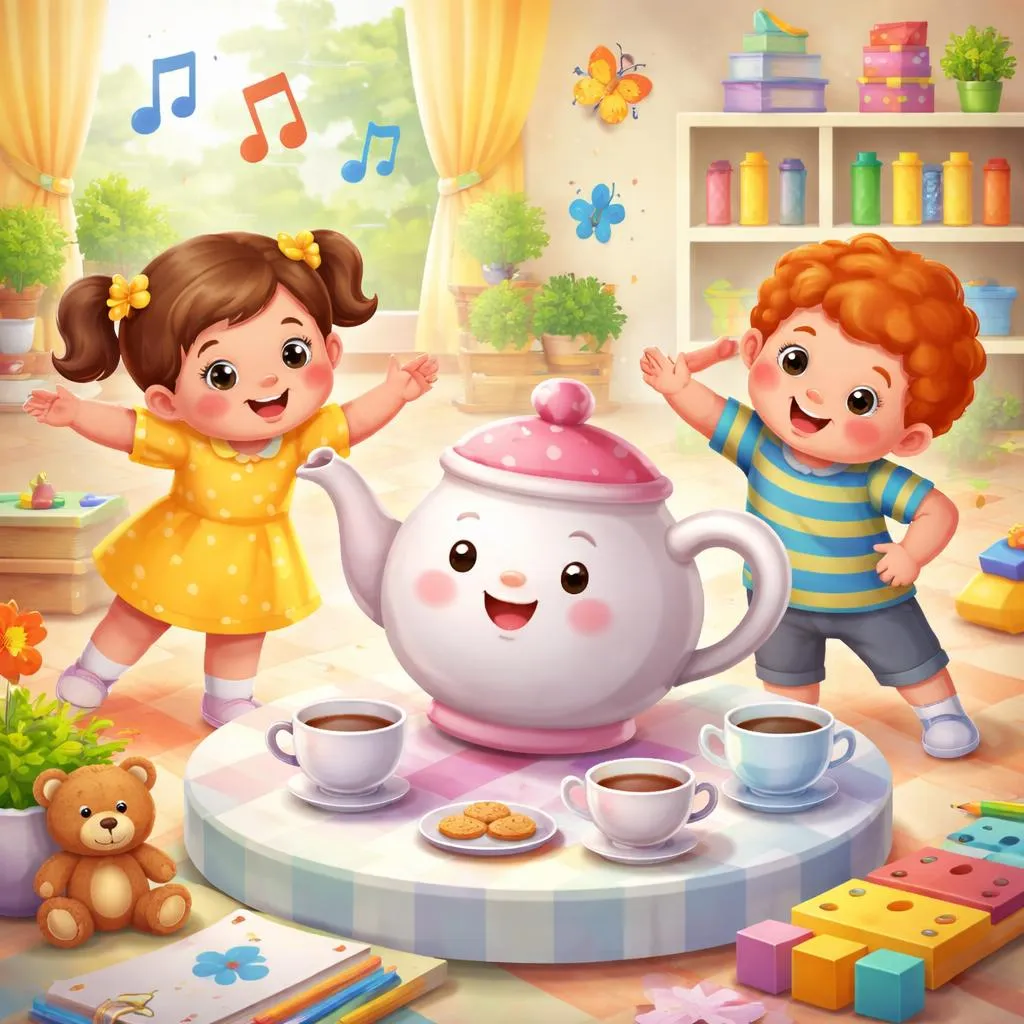
Let's explore a classic action rhyme loved by generations, "I'm a Little Teapot." This is not just a song to sing. It is a whole-body learning experience. The rhyme uses simple, memorable lyrics to describe the shape and function of a teapot. Children become the teapot through specific, charming movements.
The magic of the I'm a Little Teapot lyrics lies in this perfect pairing of words and actions. The song teaches coordination, rhythm, and body awareness in a playful way. It also introduces everyday vocabulary through a fun, imaginative scenario. We often use it as a joyful movement break that builds listening skills and memory.
The Lyrics of the Nursery Rhyme
The standard I'm a Little Teapot lyrics follow a clear, two-part structure. The first verse focuses on the teapot's form:
I'm a little teapot, short and stout.
Here is my handle, here is my spout.
When I get all steamed up, hear me shout:
"Tip me over and pour me out!"
Many versions include a delightful second verse that adds a twist:
I'm a clever teapot, yes it's true.
Here's an example of what I can do.
I can change my handle and my spout.
Just tip me over and pour me out!
The words are rhythmic and descriptive. The rhyming pairs like "stout/out/spout" and "true/do/out" make the I'm a Little Teapot lyrics easy to remember and chant.
Vocabulary Learning
The I'm a Little Teapot lyrics are excellent for building concrete vocabulary. Key nouns like "teapot," "handle," and "spout" name specific parts of an object. We can point to a real teapot or a picture to solidify these terms. Adjectives bring description: "little" describes size, and "short and stout" builds a vivid image.
Action verbs drive the song. "Tip me over" and "pour me out" describe precise movements. We can demonstrate these actions with a toy pitcher or cup. The phrase "steamed up" introduces a fun concept related to heat and water. Exploring these words through the song and its actions creates a strong, multi-sensory understanding.
Phonics Points
This rhyme offers wonderful practice for several key phonics sounds. Listen for the strong /t/ sound at the beginning of words: "teapot," "tip," "true." The /st/ blend appears clearly in "stout." We can emphasize these crisp sounds as we sing.
The rhyming words provide a perfect study in the /out/ rime family: "stout," "spout," "out." We can list other words that sound like "out," such as "shout," "trout," and "snout." The I'm a Little Teapot lyrics also feature the long 'i' sound in "I'm" and the /l/ sound in "little" and "handle." Clapping on each syllable helps segment the words.
Grammar Patterns
We can find several useful grammar structures within the I'm a Little Teapot lyrics. The first line, "I'm a little teapot," is a perfect example of a subject + verb 'to be' + article + adjective + noun sentence. This is a foundational English sentence pattern.
The imperative mood is used for giving playful commands: "Tip me over and pour me out!" This shows how verbs can start sentences to give instructions. The line "When I get all steamed up" introduces a simple adverb clause of time. While we don't need the technical term, we can practice the "When I..." pattern with other actions.
Learning Activities
The best activity is, of course, performing the actions together. Practice standing "short and stout." Place one hand on the hip for the "handle." Stretch the other arm out as the "spout." On "tip me over," lean carefully to the side of the "spout." This develops motor planning and coordination.
Try a "Vocabulary Charades" game. Write key words from the I'm a Little Teapot lyrics on cards: "pour," "steamed up," "stout," "handle." A player picks a card and acts it out without speaking. The others guess the word. This reinforces comprehension in a fun, physical way and encourages creativity.
Printable Materials
A great printable is a "Label the Teapot" sheet. It features a large picture of a teapot with blank lines pointing to the handle, spout, lid, and body. Children can write or trace the vocabulary words from the I'm a Little Teapot lyrics in the correct spots. This links the song's words directly to a visual diagram.
Consider creating a "Sequence the Song" comic strip. Provide four blank boxes. In each box, children draw the corresponding part of the song: 1. A short, stout teapot. 2. Pointing to handle and spout. 3. Looking "steamed up." 4. Tipping over. This activity boosts narrative sequencing skills and comprehension.
Educational Games
Let's play "Teapot Statues." Play the song or sing it. Everyone dances like a teapot. When the music suddenly stops, call out a word from the lyrics, like "HANDLE!" or "SPOUT!" Everyone must freeze in a pose that represents that word. This game combines listening, vocabulary recall, and creative movement.
Another engaging game is "Rhyming Pour." Gather a small toy teapot and some object cards. Some cards should rhyme with words from the I'm a Little Teapot lyrics (e.g., a card with a trout for "spout," a shout cloud for "out"). As a child "pours" from the teapot, they pick a card and say, "I pour out a word that rhymes with spout... it's trout!" This sharpens phonological awareness.
The enduring charm of the I'm a Little Teapot lyrics comes from their active, engaging simplicity. They turn abstract vocabulary and grammatical patterns into a playful, physical story. By singing, moving, and playing with these words, we do more than teach a song—we build foundational language skills through joy and movement. So, strike a pose, sing out loud, and let the learning flow as freely as tea from a spout.