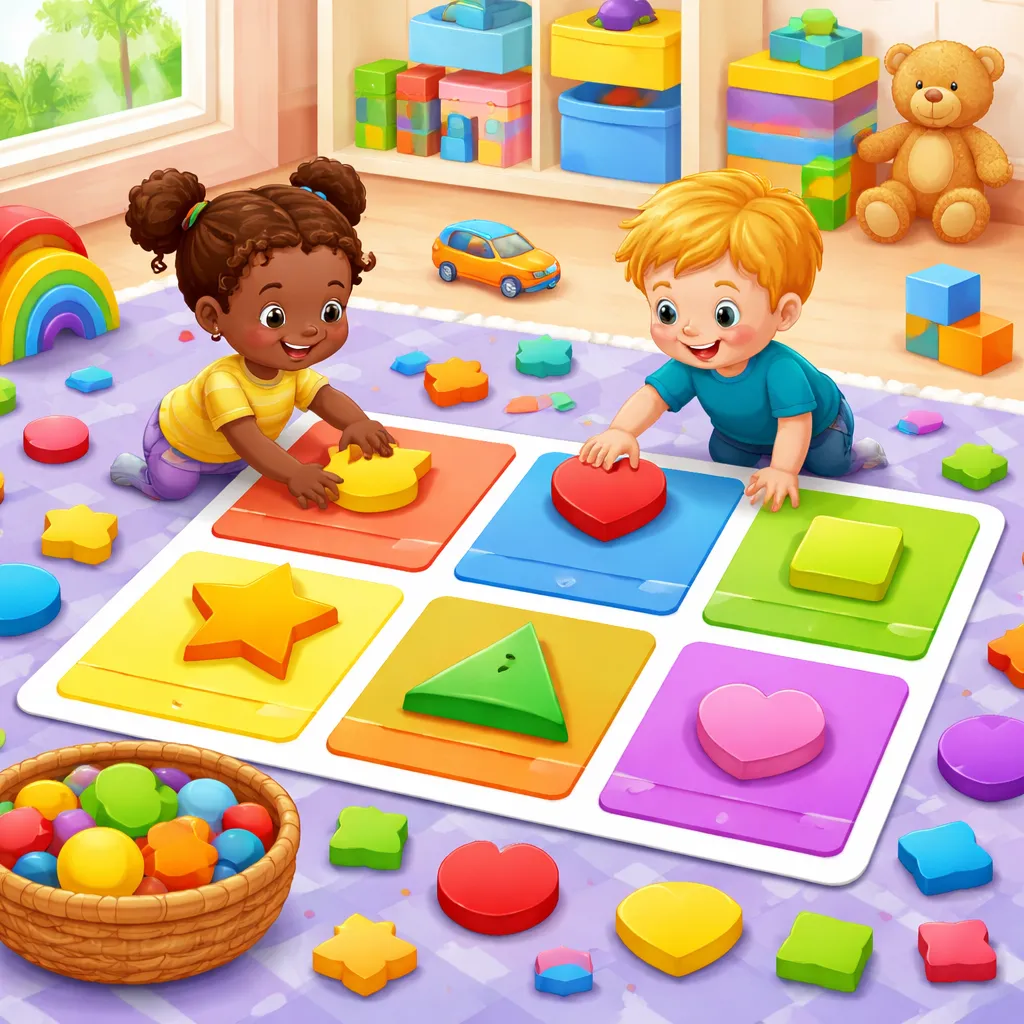

It’s a sunny afternoon, and you’re surrounded by colorful blocks, buttons, and toy cars on the floor. Mom says: “Can you put all the round toys together?” You pick up a ball and a circular button, but then you hesitate—“Is this a circle or an oval?” You mix up the shapes and giggle. Just then, mom pulls out a stack of colorful paper mats: “These are shape sorting mats printable free—we’ll sort toys by shape, learn their names in English, and have fun!” Your hands reach for the mats. What shapes will you discover? How will these mats make sorting easy? Let’s dive into the world of free printable shape sorting mats—where sorting becomes a playful English adventure!
Core Knowledge Explanation
First, let’s talk about shape sorting mats printable free. They are downloadable, no-cost mats that you can print at home or school. Each mat has a large shape (like a circle or square) and often a label with the shape’s name in English. They’re designed to help you sort small objects (toys, buttons, stationery) by their shape, turning hands-on play into a chance to learn English shape words, recognize shapes, and build sorting skills. These mats are perfect for 6-10 year olds because they’re simple, visual, and interactive—you learn by doing, not just memorizing.
Shapes are everywhere in daily life, and knowing their English names helps you describe the world around you. Let’s start with the core shapes that every shape sorting mats printable free includes. For each shape, we’ll learn its name (with phonics), key features (so you can recognize it), and real-life examples (to connect it to your world):
-
Circle /ˈsɜːkl/ : A round shape with no straight sides or corners. Every point on the edge is the same distance from the center.
Features: Round, no sides, no corners.
Real-life examples: The sun, a ball, a clock face, a cookie, a button.
English sentence: “The cookie is a circle.” “I have a round ball.” -
Square /skweə(r)/ : A shape with four equal straight sides and four square corners (right angles). All sides are the same length.
Features: 4 equal sides, 4 square corners.
Real-life examples: A book cover, a cube toy, a post-it note, a window pane, a dice.
English sentence: “The book is a square.” “The dice has six square faces.” -
Triangle /ˈtraɪæŋɡl/ : A shape with three straight sides and three corners. The sides can be the same length (equilateral) or different (scalene).
Features: 3 sides, 3 corners.
Real-life examples: A slice of pizza, a traffic sign, a pyramid’s face, a roof, a musical triangle.
English sentence: “The pizza slice is a triangle.” “The traffic sign is red and triangular.” -
Rectangle /ˈrektæŋɡl/ : A shape with four straight sides and four square corners. Opposite sides are equal in length (longer than the other two sides).
Features: 4 sides (2 long, 2 short), 4 square corners.
Real-life examples: A door, a smartphone screen, a pencil case, a tabletop, a magazine.
English sentence: “The door is a rectangle.” “My pencil case is long and rectangular.” -
Oval /ˈəʊvl/ : A shape like a stretched circle—rounded with no corners, but longer than it is wide.
Features: Rounded, no corners, longer than wide.
Real-life examples: An egg, a football (soccer ball), a grape, a leaf, a mirror.
English sentence: “The egg is an oval.” “The football is oval-shaped.” -
Heart /hɑːt/ : A shape with two rounded tops and a pointed bottom—often associated with love.
Features: Two rounded curves, one pointed end.
Real-life examples: A Valentine’s Day card, a candy heart, a flower petal, a sticker.
English sentence: “The card has a red heart.” “I drew a heart for my friend.” -
Star /stɑː(r)/ : A shape with multiple pointed ends (usually five) coming from a center.
Features: 5 (or more) pointed ends, straight sides between points.
Real-life examples: The stars in the sky, a star sticker, a Christmas tree ornament, a superhero’s logo.
English sentence: “The sky has bright stars.” “My sticker is a yellow star.” -
Diamond /ˈdaɪəmənd/ : A shape with four equal straight sides, but the corners are not square—like a tilted square. Also called a rhombus.
Features: 4 equal sides, tilted corners.
Real-life examples: A kite, a diamond ring, a playing card diamond, a window lattice.
English sentence: “The kite is a diamond.” “The playing card has a red diamond.”
Next, let’s learn shape-related vocabulary that pairs perfectly with your shape sorting mats printable free. These words help you describe shapes in more detail and talk about sorting:
Side /saɪd/: “The square has four sides.”
Corner /ˈkɔːnə(r)/: “The triangle has three corners.”
Round /raʊnd/: “The circle is round.”
Straight /streɪt/: “The square has straight sides.”
Pointed /ˈpɔɪntɪd/: “The star has pointed ends.”
Tilted /ˈtɪltɪd/: “The diamond is tilted.”
Sort /sɔːt/: “Sort the toys by shape.”
Match /mætʃ/: “Match the object to the shape on the mat.”
Group /ɡruːp/: “Group all the circle objects together.”
Identify /aɪˈdentɪfaɪ/: “Identify the square objects.”
Now, let’s master 5+ core shape句型 (sentence patterns) that you can use with your shape sorting mats printable free. These sentences are simple, easy to remember, and perfect for talking about shapes and sorting:
- “What shape is this? It’s a [shape].” (What shape is this? It’s a circle.)
- “This [object] is a [shape].” (This book is a square.)
- “Sort the [shape] objects on the mat.” (Sort the triangle objects on the mat.)
- “How many [shape] objects can you find?” (How many heart objects can you find?)
- “This object is not a [shape]—it’s a [different shape].” (This object is not a circle—it’s an oval.)
- “Match the [object] to the correct shape mat.” (Match the button to the correct shape mat.)
Shape sorting mats printable free also teach key sorting rules to help you organize objects correctly:
Rule 1: Look at the object’s outline—ignore color or size. A big red circle and a small blue circle both go on the circle mat.
Rule 2: Focus on the main shape. A cookie is a circle, even if it has chocolate chips on top.
Rule 3: If an object is a combination of shapes (like a toy car with square body and round wheels), sort it by its main shape (square mat for the car body).
Common Mistake 1: Mixing up squares and rectangles. Fix: Remember—squares have 4 equal sides; rectangles have 2 long and 2 short sides!
Common Mistake 2: Confusing circles and ovals. Fix: Circles are perfectly round; ovals are longer than they are wide (like an egg vs. a cookie)!
Common Mistake 3: Forgetting that diamonds are tilted squares. Fix: Look for 4 equal sides—if it’s tilted, it’s a diamond!
These mats make practicing these rules fun. You can pick up an object, look at its shape, and decide which mat it belongs to—all while saying the English words aloud.
Fun Interactive Learning
Let’s start with how to use your shape sorting mats printable free —follow these simple steps to sort like a pro and learn English along the way:
Step 1: Print and prepare the mats. Ask an adult to help print the free mats (one for each shape: circle, square, triangle, etc.). Cut them out if needed, and lay them flat on a table or floor.
Step 2: Decorate the mats (optional). Color the shape on each mat with bright markers—color the circle mat red, square mat blue, triangle mat yellow. Add stickers or draw small objects of that shape around the edge (e.g., draw cookies on the circle mat) to make it more fun!
Step 3: Gather sorting objects. Collect small items from around the house: buttons, blocks, toy cars, stationery (pencils, erasers), fruit (grapes, apple slices), or craft supplies (pom-poms, pipe cleaners). You’ll need 5-10 objects per shape.
Step 4: Sort the objects. Pick up one object (e.g., a button) and say its shape in English: “This is a circle.” Then place it on the circle mat. Repeat with another object (e.g., a book): “This is a square.” Place it on the square mat.
Step 5: Check your sorting. Once all objects are sorted, go through each mat and say the shape and objects aloud: “Circle mat: button, ball, cookie. Square mat: book, dice, post-it note.” Ask a friend or family member if you sorted correctly.
Step 6: Play a sorting challenge. Set a timer for 2 minutes and see how fast you can sort all the objects. Say the shape name for each object as you place it—this helps you practice English quickly!
Example sorted mats:
Circle mat: button, small ball, grape, cookie, circular eraser
Square mat: book, dice, post-it note, square block, window charm
Triangle mat: pizza slice (toy), traffic sign sticker, triangular block, roof-shaped toy
Oval mat: egg (plastic), football toy, oval button, leaf
Next, let’s play “Shape Treasure Hunt” —a fun game that gets you moving and using your shape sorting mats printable free:
Game Setup:
Hide 15-20 small objects of different shapes around the room (e.g., a circular button under a pillow, a square block on a shelf, a triangular eraser in a drawer).
Lay out your shape sorting mats on the floor as the “sorting station.”
Game Rules:
- Players take turns being the “treasure hunter” and the “shape checker.”
- The treasure hunter has 3 minutes to find as many hidden objects as possible.
- For each object found, the hunter says its shape in English: “This is a triangle.”
- The hunter then places the object on the correct shape mat.
- After the timer ends, the shape checker reviews the mats. For each correctly sorted object, the hunter gets 1 point.
- Switch roles and play again. The player with the most points wins a “Shape Master” sticker!
Example Play:
Hunter finds a circular pom-pom → says: “This is a circle” → places on circle mat → gets 1 point.
Hunter finds a rectangular pencil case → says: “This is a rectangle” → places on rectangle mat → gets 1 point.
Hunter mixes up an oval and a circle → shape checker helps: “That’s an oval, not a circle—let’s move it!” → no point, but learns from the mistake.
Let’s practice shape sorting role-plays —3+ fun dialogues to play with friends or family, using the and vocabulary we learned:
Dialogue 1: Kid and Mom (Sorting Toys)
Mom: “Let’s use our shape sorting mats printable free to sort your blocks!”
Kid: “Great! What shape is this big block?”
Mom: “Look at its sides—four equal sides and square corners. What shape is it?”
Kid: “It’s a square! I’ll put it on the square mat.”
Mom: “Good job! What about this round block?”
Kid: “It’s a circle! It goes on the circle mat.”
Mom: “How many triangle blocks can you find?”
Kid: “I found three! They all go on the triangle mat.”
Mom: “Perfect—you sorted all the blocks correctly!”
Dialogue 2: Kid and Friend (Shape Store)
Friend: “Let’s play ‘Shape Store’! I’m the shopkeeper—you’re the customer. Buy only circle objects!”
Kid: “Okay! Do you have any circle toys?”
Friend: “Yes! We have a circle ball, a circular cookie toy, and an oval egg—wait, is the egg a circle?”
Kid: “No! The egg is an oval. I only want circle objects. Can I have the ball and cookie?”
Friend: “Sure! Here you go. Let’s check the circle mat—did you pick the right shapes?”
Kid: “Yes! They’re both circles. Thanks for the toys!”
Dialogue 3: Kid and Teacher (Class Activity)
Teacher: “Class, we have shape sorting mats printable free on your desks. Let’s sort the stationery!”
Kid: “Teacher, what shape is my eraser?”
Teacher: “It has three sides and three corners. What shape is that?”
Kid: “It’s a triangle! I’ll put it on the triangle mat.”
Teacher: “Excellent. What about your pencil case?”
Kid: “It’s a rectangle—two long sides and two short sides. It goes on the rectangle mat.”
Teacher: “Very good! Now, who can tell me one object that’s a heart?”
Kid: “My sticker is a heart! It goes on the heart mat.”
Teacher: “Perfect—you’re all shape experts!”
Another fun activity: “Shape Matching Game” —use two sets of shape sorting mats printable free to practice matching shapes and objects:
Game Setup:
Print one set of mats with shape names (e.g., “Circle,” “Square”) and another set with pictures of objects (e.g., cookie, book).
Cut out the object pictures into small cards.
Game Rules:
- Spread the shape name mats on the table.
- Shuffle the object picture cards and place them in a pile.
- Take turns picking a card (e.g., cookie picture).
- Say the object and its shape: “This is a cookie—it’s a circle.”
- Match the card to the correct shape name mat (place the cookie card on the “Circle” mat).
- The player who matches all their cards first wins!
Expanded Learning
Let’s learn about shapes in different cultures —shapes have special meanings around the world, and your shape sorting mats printable free can help you explore them!
In many Western countries, circles represent unity and completeness (like wedding rings).
Squares symbolize stability and strength in Chinese culture (many traditional buildings have square bases).
Triangles are often associated with mountains and nature in Japanese art.
Hearts are a universal symbol of love, but they were first used in ancient Greece to represent emotion.
You can add these cultural facts to your mats—draw a small wedding ring on the circle mat, a traditional Chinese building on the square mat. Learning about shapes in different cultures makes English learning more interesting and helps you understand the world!
Let’s sing a “Shape Song” to remember the core shapes, their features, and English names. Tune: “Twinkle, Twinkle, Little Star”
Twinkle, twinkle, little shape,
What’s your name and what’s your shape?
Round and smooth with no sharp corners,
That’s a circle—let’s all chorus! (clap hands)
Twinkle, twinkle, little shape,
What’s your name and what’s your shape?
Four straight sides, all equal length,
That’s a square—let’s give it strength! (stomp feet)
Twinkle, twinkle, little shape,
What’s your name and what’s your shape?
Three straight sides and three sharp corners,
That’s a triangle—let’s all warn us! (point to corners)
Twinkle, twinkle, little shape,
What’s your name and what’s your shape?
Long and smooth, not quite a circle,
That’s an oval—let’s all circle! (spin around)
Let’s expand our shape vocabulary with more complex shapes that you can add to your shape sorting mats printable free. These are great for kids who want to learn beyond the basics:
Pentagon /ˈpentəɡɒn/: A shape with five straight sides and five corners (e.g., a traffic sign, a pentagon toy).
Hexagon /ˈheksəɡɒn/: A shape with six straight sides and six corners (e.g., a honeycomb, a hexagon block).
Octagon /ˈɒktəɡɒn/: A shape with eight straight sides and eight corners (e.g., a stop sign, an octagon cookie cutter).
Crescent /ˈkresənt/: A curved shape that looks like a moon (e.g., a crescent moon, a crescent roll).
Practice these with your mats: Print a hexagon mat and find objects like a honeycomb picture or hexagon block. Say: “This honeycomb is a hexagon—it has six sides.” Adding these shapes makes your sorting game more challenging and fun!
Let’s connect shapes to art and creativity . Use your shape sorting mats printable free as inspiration to create a shape collage:
Cut out shapes from colored paper (circles, squares, triangles).
Glue them onto a piece of cardboard to make a picture (e.g., a house with a square body, triangle roof, and circular windows).
Label each shape in English: “Square (house body), Triangle (roof), Circle (windows).”
Hang your collage on the wall next to your shape mats—you’ll have a creative reminder of your shape and English skills!
What You Will Learn
From your shape sorting mats printable free, you will learn so many valuable skills and English tools! First, you’ll master 12+ shape vocabulary words —from basic ones like circle, square, and triangle to more complex ones like hexagon and crescent. You’ll be able to say, spell, and recognize these shapes with confidence.
You’ll learn shape-related vocabulary like side, corner, round, and straight. These words help you describe shapes in detail, making your English more precise. You’ll also master 6+ core that let you ask about shapes, describe objects, and talk about sorting—sentences like “What shape is this?” and “Sort the circle objects” are easy to use in daily life.
Your sorting and organization skills will improve. You’ll learn to group objects by a common feature (shape), which helps you in many areas—from organizing your toys and school supplies to solving math problems. Sorting also teaches you to focus on details (like sides and corners) and make decisions.
Your visual and spatial thinking skills will develop. Recognizing shapes and matching objects to mats helps you understand how objects fit into the world around you. This skill is important for math, science, art, and even sports!
You’ll practice English speaking and listening . Saying shape names and sentences aloud improves your pronunciation and confidence. Listening to friends or family correct your sorting helps you learn from mistakes and communicate better.
You’ll build creativity and hands-on learning skills . Decorating your mats, creating shape collages, and playing sorting games make learning interactive. You’ll remember shape words and concepts better because you’re using your hands and imagination.
You’ll learn to connect shapes to daily life . By sorting real objects (toys, stationery, food), you’ll see that shapes are everywhere. You’ll be able to describe the world around you in English—from the round sun to the square book on your desk.
Using What You Learned in Life
You can use your shape sorting mats printable free every day to practice and apply your skills! Start by sorting your toys at home. After playing, use the mats to organize blocks, dolls, or cars: “All the round toys go on the circle mat; square toys on the square mat.” You’ll keep your room tidy and practice English at the same time.
At school, use your shape skills in class activities. If your teacher asks you to sort stationery, say: “This pencil case is a rectangle—it goes here. This eraser is a circle—it goes there.” During art class, describe your drawings in English: “My picture has a triangle roof and square walls.” Your teacher will be impressed by your clear English and shape recognition.
Go on a “shape walk” with your family. As you walk around your neighborhood, point out shapes and say their English names: “That stop sign is an octagon. That pizza shop sign is a circle. That window is a square.” You’ll turn a simple walk into a fun English practice session.
Use your mats to help with homework. If you have a math problem about shapes, get out your mats and use them to visualize: “The problem says ‘count the square objects’—let’s sort them on the square mat to count!” This makes math easier and connects it to your English learning.
Plan a “shape party” with friends. Ask everyone to bring a toy or snack of a specific shape (e.g., circle cookies, square crackers, triangle sandwiches). Use your shape sorting mats printable free to display the food: “Circle snacks on the circle mat, square snacks on the square mat.” Say sentences like “I brought circle cookies—they go here!” You’ll have fun with friends and practice English together.
Create a “shape journal.” Draw or glue pictures of shapes you see each day (a leaf, a coin, a kite) and write their English names next to them. Add a sentence: “I saw a crescent moon tonight.” Your journal will be a great way to track your learning and remember shape words.
Closing Encouragement
Wow! You’ve turned sorting into a fun English journey with your shape sorting mats printable free. You can recognize shapes, say their names in English, describe objects, and organize things—you’re a shape and English star!
Every time you sorted an object, said a shape name, or played a game, you got better at English and sorting skills. It’s okay if you mixed up a shape or forgot a word at first—what matters is you kept trying and having fun.
Keep using your shape sorting mats printable free. Add new shapes (like hexagons and octagons), decorate the mats for holidays, or make a new set for a friend. The more you practice, the more confident you’ll feel, and the easier it will be to describe the world around you in English.
Remember, shapes are everywhere—from the toys you play with to the buildings you see. With your English shape skills, you can communicate clearly, express your creativity, and learn new things every day. Shapes are not just for sorting—they’re for exploring, creating, and connecting with the world.
You’re a curious, creative, and hardworking learner. We’re so proud of how you’ve turned a simple printable mat into a powerful learning tool. Keep sorting, keep learning, and keep loving English—your ability to recognize and talk about shapes in English will open so many doors. Happy sorting and learning