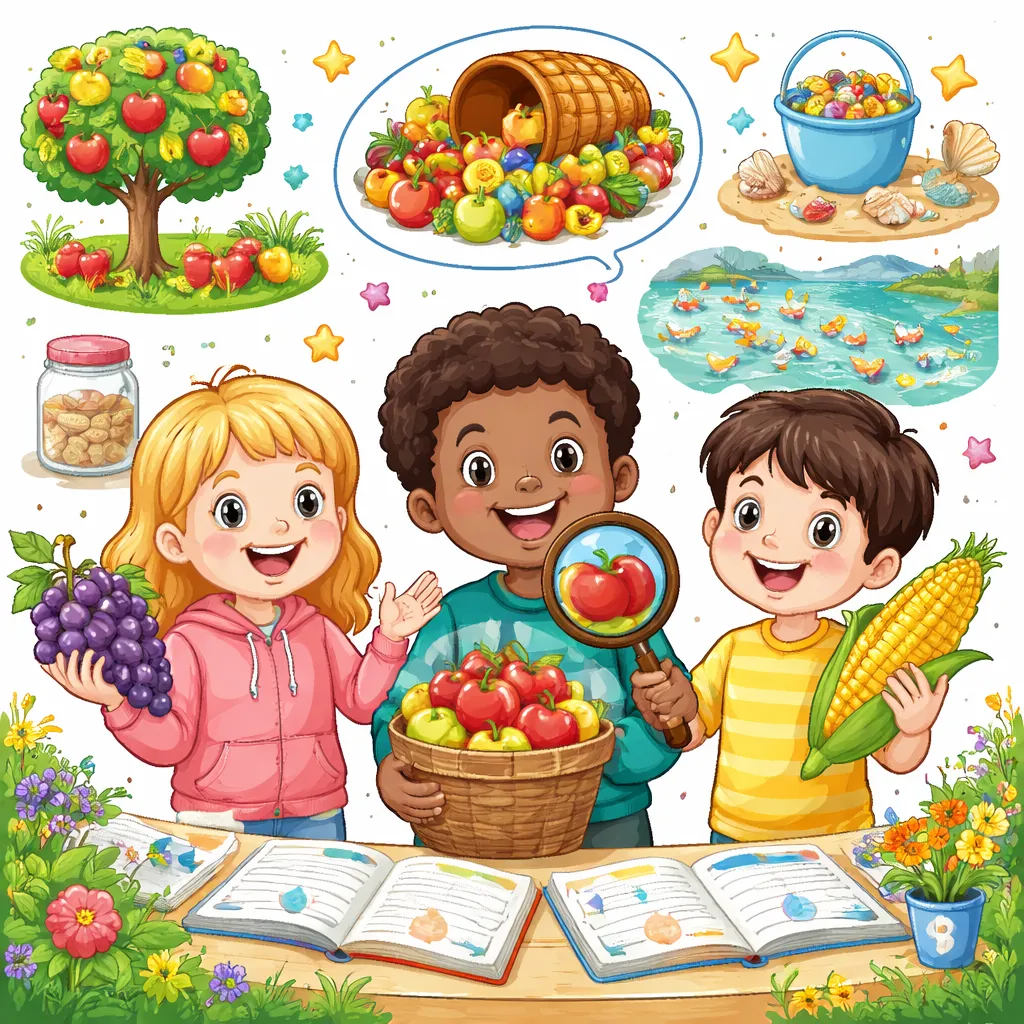

Are Similar Words Really Interchangeable?
English includes many words that share similar meanings. These words can confuse young learners. “Plenty and abundant” is a helpful pair to explore.
Both words describe a large amount of something. They suggest more than enough. At first, they seem easy to swap.
However, small differences exist. These differences affect tone, grammar, and context. Children benefit from learning these details early.
When children understand such pairs, they express ideas more clearly. They also develop stronger reading and writing skills over time.
Set 1: plenty vs abundant — Which One Is More Common?
“Plenty” appears very often in daily English. Children hear it at home, in school, and in stories.
For example: “We have plenty of time.” “There are plenty of apples.”
“Abundant” appears less often in conversation. It sounds more formal and descriptive.
For example: “The forest has abundant wildlife.” “Resources are abundant in this region.”
Children usually learn “plenty” first. It feels natural and easy. “Abundant” comes later through reading and study.
Set 2: plenty vs abundant — Same Meaning, Different Contexts
Both words describe large amounts. But they appear in different situations.
“Plenty” works well in casual and everyday contexts. It often appears in friendly conversation.
Example: “There is plenty of food.” “We have plenty of space.”
“Abundant” works better in descriptive or academic contexts. It often appears in books, reports, and nature writing.
Example: “The river supports abundant fish.” “This area has abundant natural resources.”
Children can learn to match the word with the situation. Casual speech uses “plenty.” Careful description uses “abundant.”
Set 3: plenty vs abundant — Which Word Is “Bigger” or More Emphatic?
“Plenty” suggests more than enough. It feels relaxed and friendly.
Example: “We have plenty of snacks.”
“Abundant” feels stronger. It suggests a rich and overflowing amount. It adds emphasis and detail.
Example: “The garden has abundant flowers.”
In many cases, “abundant” sounds more vivid. It paints a clearer picture.
Children can think of “abundant” as a stronger and more descriptive version of “plenty.”
Set 4: plenty vs abundant — Concrete vs Abstract
“Plenty” often connects to everyday, concrete items. These are easy to see or count.
Example: “We have plenty of chairs.” “There is plenty of juice.”
“Abundant” often connects to both concrete and abstract ideas. It works well in descriptive language.
Example: “The region has abundant sunlight.” “She has abundant energy.”
“Abundant” adds richness to both physical and abstract ideas. It helps children describe the world in more detail.
Set 5: plenty vs abundant — Verb or Noun? First Understand the Role
“Plenty” often acts as a pronoun or determiner. It usually appears with “of.”
Example: “plenty of water” “plenty of books”
It can also stand alone: “That is plenty.”
“Abundant” is an adjective. It describes nouns and appears before them.
Example: “abundant resources” “abundant opportunities”
Children should remember this pattern: Use “plenty of” before nouns. Use “abundant” before nouns without “of.”
This rule helps avoid common mistakes.
Set 6: plenty vs abundant — American English vs British English
Both words appear in American and British English. There is no spelling difference.
“Plenty” appears often in both regions. It is common in speech and informal writing.
“Abundant” appears more in formal writing and descriptive texts in both regions.
Children do not need to worry about regional differences here. They can focus on meaning and usage first.
As they read more, they will see how writers choose words for style and tone.
Set 7: plenty vs abundant — Which Fits Formal Situations?
“Plenty” works best in informal settings. It suits conversation and simple writing.
Example: “We have plenty of ideas.”
“Abundant” fits formal and academic contexts. It appears in essays, reports, and scientific descriptions.
Example: “The study found abundant evidence.”
When children begin formal writing, “abundant” becomes useful. It makes their language sound more precise and mature.
Parents can guide children to think about context. Formal writing often needs more descriptive vocabulary.
Set 8: plenty vs abundant — Which One Is Easier for Kids to Remember?
“Plenty” is short and simple. Children learn it quickly. It appears often in daily speech.
It also has a clear structure: “plenty of.” This makes it easy to practice.
“Abundant” is longer and less familiar. It may take more time to learn. But it becomes easier through reading and repetition.
A helpful approach works well: Teach “plenty” first with real-life examples. Introduce “abundant” through stories and descriptions.
Connecting the two words helps memory. Both mean “a lot,” but they feel different in use.
Mini Exercise: Can You Spot the Differences Between These Similar Words?
Try these short exercises together.
Choose the correct word: “We have ______ of time.” Answer: plenty Choose the correct word: “The forest has ______ wildlife.” Answer: abundant Fill in the blank: “There are ______ of toys in the room.” Answer: plenty Correct the sentence: “We have abundant of food.” Better answer: We have plenty of food. Choose the better option for a report: “There is plenty of evidence.” or “There is abundant evidence.” Answer: There is abundant evidence.
These exercises help children notice patterns. They support confident word choice.
Parent Tips: How to Help Kids Learn and Remember Similar Words
Use daily conversation to introduce “plenty.” This helps children feel comfortable with the word.
For example: “We have plenty of time before dinner.”
Read books that include descriptive language. Point out “abundant” when it appears.
Create simple comparison charts. Write “plenty” and “abundant” with examples under each.
Encourage children to describe their surroundings. Ask them to use both words in different sentences.
Keep explanations short and clear. Focus on one difference at a time.
Offer gentle corrections. Guide children toward the correct form without pressure.
Celebrate small improvements. Each correct sentence builds confidence.
Over time, children begin to choose words more carefully. They learn that “plenty and abundant” both describe large amounts, but each word has its own place.
This understanding helps children express ideas with clarity and richness. It supports both everyday communication and academic growth.