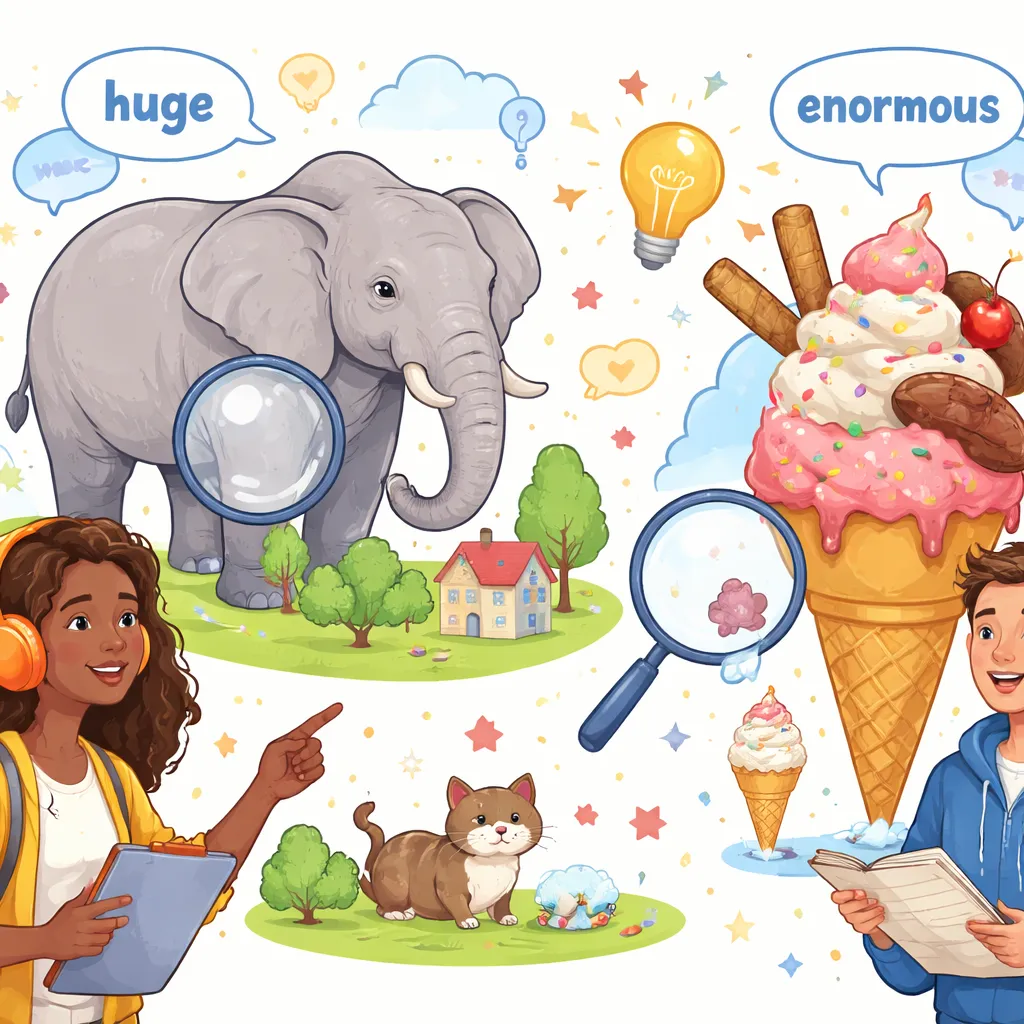

Are Similar Words Really Interchangeable?
English offers many words that seem very close in meaning. This can make learning both interesting and challenging. “Huge and enormous” is a good example.
Both words describe something very big. They go beyond “big” or “large.” They suggest a much greater size or degree.
At first, they appear interchangeable. However, small differences in tone and usage exist.
When children understand these differences, they express ideas more clearly. They also make their language more vivid and engaging.
Set 1: huge vs enormous — Which One Is More Common?
“Huge” appears often in everyday English. Children hear it in conversations, stories, and media.
For example: “That is a huge dog.” “We saw a huge building.”
“Enormous” appears less often in daily speech. It sounds more formal and descriptive.
For example: “The whale is enormous.” “They faced an enormous challenge.”
Children usually learn “huge” first. It is simple and expressive. “Enormous” becomes more familiar through reading and advanced learning.
Set 2: huge vs enormous — Same Meaning, Different Contexts
Both words describe something very large. But they fit slightly different contexts.
“Huge” works well in casual and emotional situations. It often expresses surprise or excitement.
Example: “That cake is huge!” “I have a huge problem.”
“Enormous” works better in descriptive or formal contexts. It often appears in writing or careful speech.
Example: “The elephant is enormous.” “The project requires enormous effort.”
Children can learn to match the word with the situation. Use “huge” in daily speech. Use “enormous” in descriptive or formal writing.
Set 3: huge vs enormous — Which Word Is “Bigger” or More Emphatic?
Both words suggest a very large size. However, “enormous” often feels slightly stronger.
Example: “The mountain is enormous.”
This sentence sounds more dramatic and powerful.
“Huge” is also strong, but it feels more casual.
Example: “The mountain is huge.”
Children can think of “enormous” as a more intense version of “huge.” It adds extra emphasis and depth.
Set 4: huge vs enormous — Concrete vs Abstract
“Huge” often connects to both physical objects and abstract ideas. It is very flexible.
Example: “A huge house” “A huge success”
“Enormous” also works with both, but it often appears in more descriptive or formal contexts.
Example: “An enormous building” “An enormous amount of work”
Both words can describe size and degree. However, “enormous” often adds a more serious or detailed tone.
This helps children choose the right word for different situations.
Set 5: huge vs enormous — Verb or Noun? First Understand the Role
Both “huge” and “enormous” are adjectives. They describe nouns.
Example: “huge tree” “enormous tree”
They do not change form or act as verbs. Their role is simple and clear.
However, their usage differs in tone.
“Huge” appears in many everyday expressions.
Example: “huge mistake” “huge fun”
“Enormous” appears more in formal or descriptive phrases.
Example: “enormous effort” “enormous impact”
Children should focus on tone and context when choosing between them.
Set 6: huge vs enormous — American English vs British English
Both words appear in American and British English. There is no spelling difference.
“Huge” is very common in both regions. It appears often in speech and informal writing.
“Enormous” also appears in both regions. It is more common in formal or descriptive writing.
There is no major regional difference. Children can focus on meaning and tone instead.
Reading a variety of texts will help them notice patterns naturally.
Set 7: huge vs enormous — Which Fits Formal Situations?
“Huge” works well in informal contexts. It feels natural and friendly.
Example: “That was a huge success.”
“Enormous” fits formal and academic contexts better. It sounds more precise and polished.
Example: “The study required enormous resources.”
When children begin formal writing, “enormous” can improve their language. It adds depth and clarity.
Parents can guide children to think about context. Formal writing often benefits from more descriptive vocabulary.
Set 8: huge vs enormous — Which One Is Easier for Kids to Remember?
“Huge” is short and easy to pronounce. Children learn it quickly. It appears often in daily life.
“Enormous” is longer and may feel more difficult at first. However, its strong meaning makes it memorable.
A helpful approach works well: Teach “huge” first with simple examples. Introduce “enormous” through reading and storytelling.
Linking the two words helps memory. Both mean “very big,” but they differ in tone and strength.
Mini Exercise: Can You Spot the Differences Between These Similar Words?
Try these simple exercises together.
Choose the correct word: “That elephant is ______.” Answer: enormous Choose the correct word: “I made a ______ mistake!” Answer: huge Fill in the blank: “They need an ______ amount of time.” Answer: enormous Correct the sentence: “That is an enormous fun game.” Better answer: That is a huge fun game. Choose the better option for formal writing: “A huge amount of data” or “An enormous amount of data” Answer: An enormous amount of data
These exercises help children recognize patterns. They build confidence in word choice.
Parent Tips: How to Help Kids Learn and Remember Similar Words
Start with everyday language. Use “huge” in daily conversation.
For example: “That is a huge balloon.”
Introduce “enormous” through books and stories. These often use richer vocabulary.
Create simple comparison charts. Write “huge” and “enormous” with examples.
Encourage children to describe objects and experiences. Ask them to try both words in sentences.
Keep explanations short and clear. Focus on one difference at a time.
Offer gentle correction when needed. Guide children step by step.
Celebrate progress. Each correct use builds confidence.
Over time, children understand that “huge and enormous” both describe very large size, but they serve different purposes.
This awareness helps children express ideas with more power and clarity. It supports strong communication skills in both everyday life and academic learning.