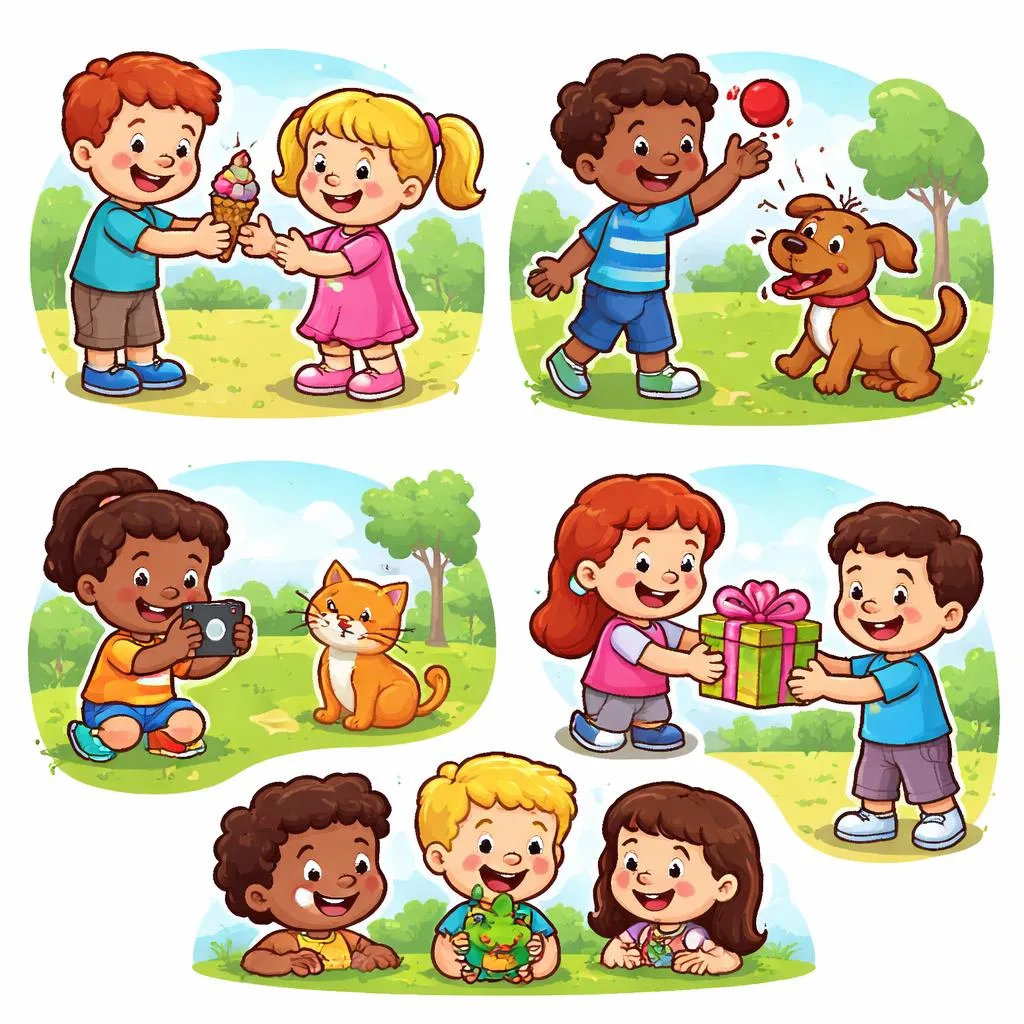

What is objective pronouns?
Hello, word wizards. Today, we are going to learn about a very helpful group of little words. We are going to learn about objective pronouns. Pronouns are words that take the place of a noun. A noun is a person, place, or thing. So, a pronoun is a word we use instead of saying the name again and again.
There are different types of pronouns. Subjective pronouns are the stars of the sentence, like "I" or "they." But what about the words that receive the action. Those are the objective pronouns. Think of a sentence like a relay race. The subject pronoun (like "I") is the runner who starts. The verb (like "see") is the act of passing the baton. The objective pronoun is the teammate who catches the baton. "I see him." The word "him" is the objective pronoun catching the action of seeing. Let's learn all about these word catchers.
Meaning and explanation
So, what exactly does an objective pronoun do. Its main job is to receive the action in a sentence. It comes after the action verb. It tells us who or what is receiving the action. It can also come after a small word like "to," "for," "with," or "at."
Let's look at the subjective pronouns first, so we can see their objective partners. The subjective pronoun "I" changes to the objective pronoun "me." "You" stays as "you." "He" changes to "him." "She" changes to "her." "It" stays as "it." "We" changes to "us." "They" changes to "them."
The objective pronouns are: me, you, him, her, it, us, them. We use them when someone or something is having the action done to them. "My mom helps me." "I like you." "She sees him." The action flows from the subject to the objective pronoun.
Categories or lists
Let's look at our list of objective pronouns and match them with their subject pronoun friends. This is the most important part to remember.
The Singular Objective Pronouns (for one person or thing): I ➔ me. (I like dogs. Dogs like me.)
You ➔ you. (You are funny. I see you.)
He ➔ him. (He is my brother. I play with him.)
She ➔ her. (She is a teacher. We listen to her.)
It ➔ it. (It is a ball. I kick it.)
The Plural Objective Pronouns (for more than one person or thing): We ➔ us. (We are happy. She smiles at us.)
You ➔ you. (You are my friends. I will call you.)
They ➔ them. (They are birds. Look at them fly!)
Remember, the pronoun "you" is the same for both subject and object, whether it is one person or many people. That makes it easy. The word "it" also stays the same.
Daily life examples
You use objective pronouns all day long without even thinking. Let's listen in on three everyday scenes and find the examples of objective pronouns.
At the Breakfast Table: Your dad puts a plate in front of you. He says, "I made this for you." The word "you" is the objective pronoun receiving the action of "made for." You take a bite and say, "Mmm, I love it!" The word "it" is the objective pronoun receiving the action of "love." You see your little sister. You say, "Mom, can you help her pour the juice?" The word "her" is the objective pronoun receiving the action of "help."
On the Playground with Friends: You see your friend Leo on the swings. You call, "Hey, wait for us!" The word "us" is the objective pronoun after the word "for." You throw a ball. It goes to Sam. You shout, "Catch it, Sam!" The word "it" receives the action "catch." Later, you tell the teacher, "Leo and Sam are over there. Can you see them?" The word "them" receives the action "see."
During a Family Game Night: Your mom is handing out cards. She says, "I will deal the cards to you." You get your cards and say, "I can't believe it! I have a great hand!" You look at your sister's sad face. You whisper to your dad, "Maybe we should let her win this time." The word "her" is the objective pronoun receiving the idea of "let win."
Printable flashcards
Printable flashcards are a super way to practice matching subjective and objective pronouns. You can create a "Pronoun Partner" matching game.
Make one set of cards with big, friendly pictures of people. A picture of a single boy with the word "HE" below it. A picture of a group of kids with the word "THEY" below it. A picture of the child holding the card with the word "ME" below it.
Make a second set of cards with the corresponding objective pronouns: HIM, THEM, ME. The game is to match the subject picture card to its objective pronoun partner. This creates a strong visual link.
You can also make "Sentence Builder" cards. Create three piles. Pile 1: Subject cards (I, You, He, She, We, They). Pile 2: Verb cards (see, like, help, call, play with). Pile 3: Object cards (me, you, him, her, us, them). Kids pick one card from each pile to build a sentence. "She helps him." "They see us." This hands-on activity makes grammar concrete and fun.
Learning activities or games
Let's play some active games to learn our objective pronouns. First, play "Pronoun Toss." Get a soft ball. Stand in a circle. The teacher or a student starts by saying a sentence with a subjective pronoun and a verb. "I see..." Then they toss the ball to another student and say an objective pronoun. "I see you!" The catcher then makes their own sentence. "You threw the ball to me!" Then they toss it to someone new. "I will throw it to her!" This game combines physical action with quick grammar thinking.
Try the "Sentence Doctor" game. Write some simple sentences on a board or cards, but use the wrong pronoun. "The gift is for I." "Can you help we?" "She gave the book to he." Give each child or team a "doctor's kit" (a whiteboard and marker, or a piece of paper). Their job is to diagnose the sick sentence and fix it with the correct objective pronoun. "The gift is for me." "Can you help us?" "She gave the book to him." This corrective activity reinforces the right form in a playful way.
Create an "Objective Pronoun Story Circle." Sit in a circle. Start a simple story. "One day, I saw a magic frog. The frog looked at me." The next person continues, but must use an objective pronoun in their sentence. "Then, the frog hopped towards us." The next person adds, "We were scared of it!" Keep the story going, with each person adding a sentence that includes one of our objective pronouns (me, you, him, her, it, us, them). The story will get wonderfully silly, and everyone will get plenty of practice hearing and using these important little words.