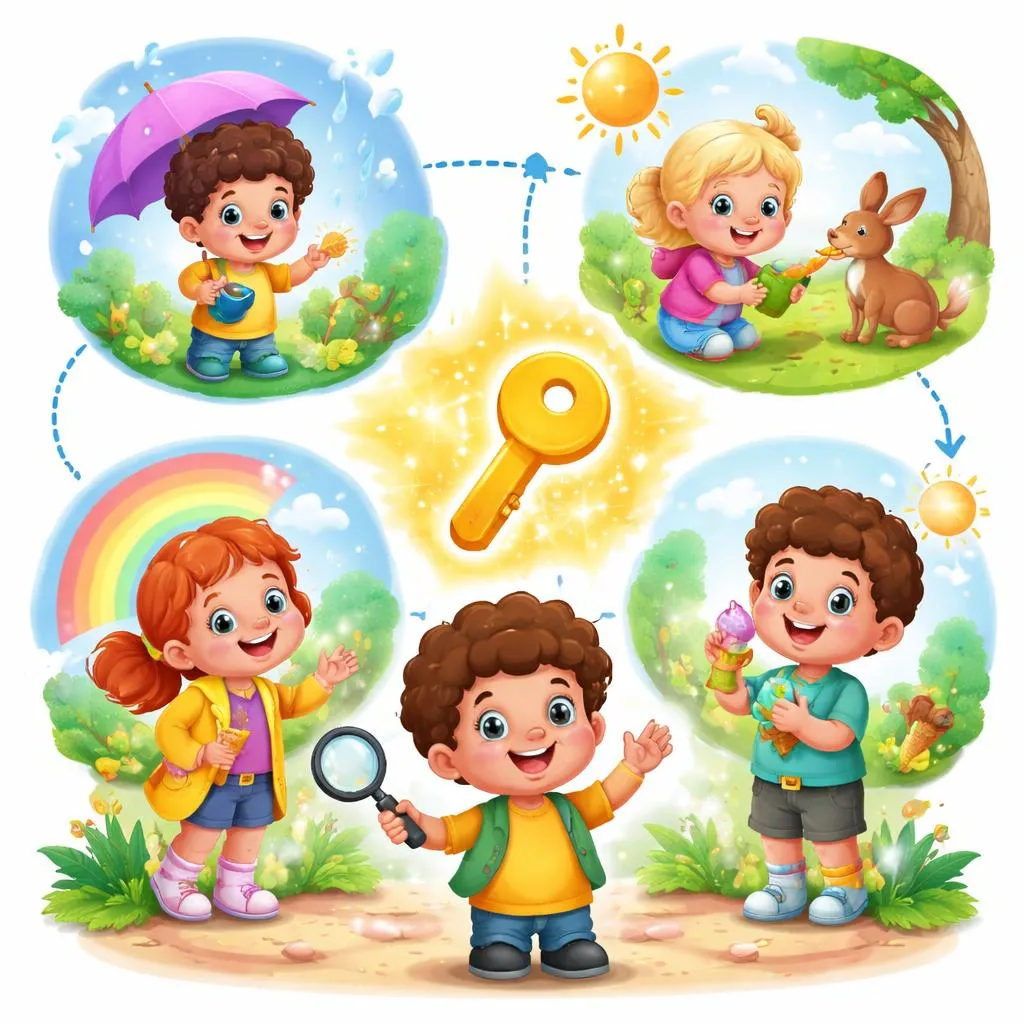

Hello, little word magician! Do you know about a magic key? A magic key can open a special treasure chest. But only if you use the key! Words have a magic key too. It is the word "if". A conditional sentence is like a magic key. It has two parts. The "if" part is the key. The "then" part is the treasure. It tells us what might happen. Today, we will use forty magic if-keys to open treasure chests of ideas. Our guide is Key the Kangaroo. Key has a pouch full of magic if-keys! He will show us conditional sentences at home, the playground, school, and in the outback. Let's find some treasure!
What Is a Conditional Sentence? A conditional sentence is a magic if-key. It is a sentence that talks about what could happen. It has two parts. The first part starts with "if". This is the condition. It is the key. The second part is the result. It is the treasure. The "if" part sets a rule. The result part tells what happens when we follow the rule. At home, you might say "If you are hungry, you can eat." The key is "if you are hungry". The treasure is "you can eat". At the playground, you say "If it rains, we go inside." At school, you say "If you share, your friend will be happy." In nature, Key says "If I hop, I move fast." "Key knows that if he finds water, he will drink." Learning these must-know conditional sentences helps you talk about possibilities and rules.
Why Do We Need Magic If-Keys? Conditional sentences are your cause-and-effect tools! They help your ears listen. You can understand the rules and what will happen next. They help your mouth speak. You can explain what you want to happen. "If I finish my peas, can I have dessert?" They help your eyes read. You will see them in stories about choices and consequences. They help your hand write. You can write about plans and promises. Magic if-keys help you make sense of the world. They connect an action to a result.
What Are the Simple Types of If-Keys? We have a few simple types of if-keys. They are for different kinds of magic.
First, the real and likely key. This is for things that are true or often happen. It uses the present tense in both parts. "If you touch fire, it burns." This is a fact. "If I see my friend, I say hello." This is a habit.
Next, the possible future key. This is for things that might happen later. It uses the present tense after "if" and "will" in the result. "If it is sunny tomorrow, we will go to the park."
We also have the imaginative key. This is for pretend or unlikely things. It uses "if" with the past tense and "would". This is harder. "If I were a bird, I would fly." For 3-year-olds, we will start with the first two types. They are the most useful.
How Can You Spot a Magic If-Key? Spotting a conditional sentence is a seek-and-find game! Look for the word "if". Then, see if the sentence has two parts. One part starting with "if" sets the condition. The other part gives the result. The two parts can be in any order. Look at Key's sentence. "If you jump in a puddle, you will get wet." The key is "if you jump in a puddle". The treasure is "you will get wet". You found a conditional sentence! Another trick: You can often start the sentence with the result part. "You will get wet if you jump in a puddle."
How Do We Use Our Magic If-Key? Using a conditional sentence is about putting the two parts together. You can put the "if" part first or the result part first. If the "if" part comes first, use a comma after it. The formula is: If + condition, + result. "If you are tired, go to sleep." If the result comes first, you do not need a comma. The formula is: Result + if + condition. "Go to sleep if you are tired." Key shows us. "If I eat this grass, I will be full." Or: "I will be full if I eat this grass." Start with simple, real conditions about your day.
Let's Fix Some Broken Keys. Sometimes our if-keys get a little mixed up. Let's fix them. A common mix-up is forgetting the comma when the "if" part is first. A child might say "If you eat you can play." This runs together. Use a comma: "If you eat, you can play." Another mix-up is using "will" in the "if" part. We usually do not use "will" after "if". We say "If you eat your vegetables, you can have ice cream." Not "If you will eat your vegetables " Also, make sure both parts are complete thoughts. "If hungry." is not a sentence. "If you are hungry, eat a snack." is a sentence.
Can You Be a Word Magician? You are a great magician! Let's play a game. The "If-Key Match" game. I will give you the "if" part. You give me the result. "If you are cold " You say: " put on a sweater." Great! "If you spill your milk " You say: " clean it up." Here is a harder challenge. Think of a rule at home. Can you say it as a conditional sentence? "If I make a mess, I clean it up." You are using must-know conditional sentences.
Your Treasure Chest of 40 Must-Know Conditional Sentences. Ready to open the treasure chest? Here are forty wonderful conditional sentences. Key the Kangaroo has collected them. They are grouped by the scene. Remember, these are simple, real conditionals for everyday use.
Home Treasure Rules. If you are hungry, eat a snack. If you are thirsty, drink some water. If you are tired, take a nap. If your hands are dirty, wash them. If the phone rings, answer it. If the door is open, close it. If you finish your milk, you can have more. If you see a mess, please clean it. If you are good, you get a sticker. If you are cold, put on a sweater.
Playground and Fun Treasures. If it is sunny, we play outside. If it rains, we go inside. If you want to swing, I will push you. If you climb high, hold on tight. If you fall down, get back up. If you see a friend, say hello. If the ball rolls away, run and get it. If you are hot, sit in the shade. If you are having fun, smile big. If the slide is wet, do not use it.
School and Learning Treasures. If you listen, you will learn. If you have a question, raise your hand. If you finish your work, you may draw. If you are kind, others will be kind too. If you need help, ask the teacher. If you share a toy, your friend will be happy. If you are quiet, you can hear the story. If you try hard, you can do it. If you make a mistake, that is okay. If you see someone sad, give a hug.
Nature and Animal Treasures. If you water a plant, it will grow. If you are quiet, you might see a bird. If you drop food, an ant might find it. If the sun shines, the flower opens. If the wind blows, the leaves fall. If a bee comes near, stay still. If you are kind to animals, they might be your friend. If you look up, you will see the sky. If you plant a seed, a flower may grow. If you walk in the grass, you might get wet.
Health and Safety Treasures. If you are sick, stay in bed. If you cough, cover your mouth. If you see a red light, stop. If you cross the street, hold a hand. If something is hot, do not touch it. If you are lost, stay where you are. If you see fire, tell a grown-up. If you are hurt, say "ouch". If you are scared, find a hug. If you need to sneeze, use a tissue.
These forty sentences are your must-know conditional sentences. They are your magic if-keys. Use them to talk about rules, possibilities, and what happens next.
Unlocking Possibilities with Your Words. You did it! You are now a conditional sentence expert. You know a conditional sentence is a magic if-key. It has an "if" part (condition) and a result part. You know how to put them together with or without a comma. Key the Kangaroo uses conditional sentences to talk about what might happen in the outback. Now you can too! You can talk about cause and effect. You can explain rules and what you hope will happen. Your sentences will be full of interesting possibilities.
Here is what you can learn from our magic adventure. You will know what a conditional sentence is. You will understand the two-part structure. You can identify the condition and the result. You can form simple conditional sentences about real situations. You have a treasure chest of forty essential conditional sentences.
Now, let's do some life practice! Your mission is today. Use your magic if-keys. Say three conditional sentences about your day. Tell your grown-up: "If I put away my toys, we can read a story. If I eat my dinner, I can have fruit. If I brush my teeth, I will have a bright smile." You just used three conditional sentences! Keep using your magic if-keys to unlock new ideas. Have fun, little magician!