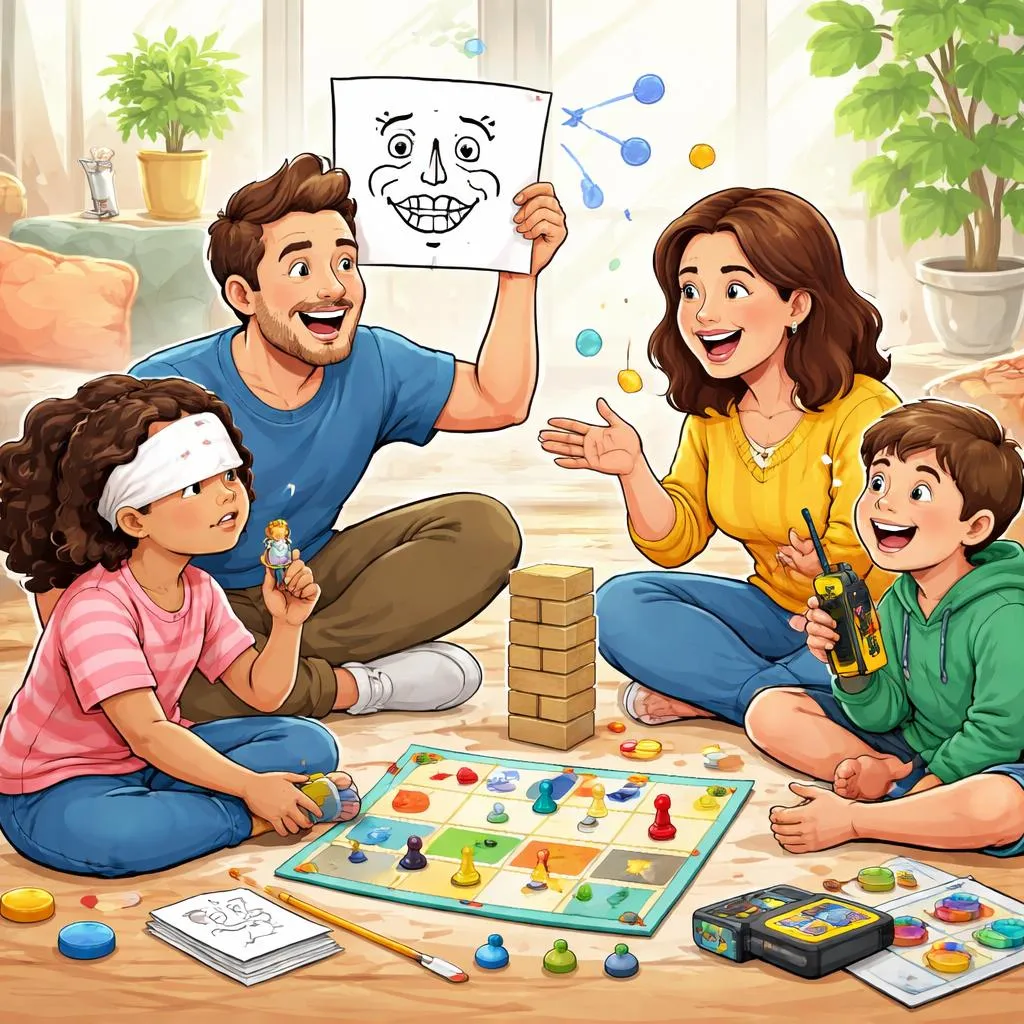

Hello, families and learners! Welcome to our special lesson about connecting with each other. Today we explore communication games for families. These activities help family members talk, listen, and understand each other better.
Good communication is important in families. It helps everyone feel heard and valued. It builds strong relationships. Playing games together makes learning communication skills fun and natural.
Let us gather around the table. Let us discover games that bring families closer. By the end of this lesson, families will have many new ways to connect and communicate.
What are Communication Games? Communication games for families are activities that help family members practice talking and listening. They create opportunities for conversation in a fun, relaxed way.
These games can be simple. They might involve asking questions, telling stories, or working together. The goal is not to win, but to connect and understand each other.
Some games help with listening skills. Family members learn to pay attention to what others say. Some games help with speaking skills. Everyone gets a chance to share thoughts and feelings.
Playing these games regularly strengthens family bonds. Children learn that their voices matter. Parents learn more about their children's inner worlds. Everyone has fun together.
Meaning and Explanation When we talk about communication games for families, we mean activities designed to improve how family members interact. These games focus on both speaking and listening.
Speaking is about expressing thoughts and feelings clearly. Games that encourage speaking help children find the right words. They build confidence in sharing ideas.
Listening is about paying attention to what others say. Games that require listening help family members really hear each other. They learn to understand different perspectives.
Good communication also involves body language and tone. Some games help family members notice these non-verbal cues. They learn to read facial expressions and gestures.
The best part is that these games feel like play, not work. Families laugh together while learning important life skills.
Categories or Lists Let us look at different types of communication games for families organized by category.
Question Games These games use questions to start conversations. Question Jar - family members take turns drawing questions from a jar and answering them Would You Rather - players choose between two options and explain why This or That - similar to Would You Rather with simpler choices Interview Time - one person is interviewed by other family members Story Starters - one person starts a story, others add sentences
Listening Games These games focus on hearing and understanding. Simon Says - players follow commands only when "Simon says" is said Telephone - one person whispers a message, it passes around and changes Sound Memory - make sounds and remember the order Follow the Directions - give instructions for drawing or building something What Did You Say? - repeat back what someone just said to show understanding
Storytelling Games These games involve creating and sharing stories. Story Circle - one person starts, next adds a sentence, continue around Picture Prompts - look at a picture and tell a story about it Story Dice - roll dice with pictures and make up a story using them Once Upon a Time - take turns adding to a fairy tale Family Memory - share memories of special family moments
Feeling Games These games help express and understand emotions. Feeling Charades - act out an emotion without speaking, others guess Emotion Cards - draw a card with an emotion and share a time you felt that way How Would You Feel? - describe a situation and ask how each person would feel Gratitude Circle - each person shares something they are grateful for Compliment Chain - give a compliment to the person next to you
Cooperation Games These games require working together. Build Together - work as a team to build something with blocks Complete the Picture - one person starts a drawing, next adds to it Problem Solve - work together to solve a simple problem Treasure Hunt - follow clues together to find a treasure Obstacle Course - guide a blindfolded family member through an obstacle course
Non-Verbal Games These games focus on communication without words. Charades - act out words or phrases without speaking Pictionary - draw pictures so others can guess the word Facial Expression Game - make faces showing emotions, others guess Body Language Detective - guess how someone is feeling from their body Silent Movie - act out a scene without any words
Daily Life Examples Let us see how communication games for families work in real life. These examples show families playing together.
On a rainy afternoon, a family sits around the kitchen table. They play the Question Jar game. Each person draws a question and answers it. "What was the best part of your week?" "If you could travel anywhere, where would you go?" Everyone learns something new about each other.
At dinner time, a family plays Would You Rather. "Would you rather be able to fly or be invisible?" Each person explains their choice. Laughter fills the room as they imagine flying to school or playing tricks while invisible.
Before bed, a family plays Gratitude Circle. Each person shares one thing they were grateful for that day. "I am grateful for the sunny weather." "I am grateful for my friend helping me with homework." "I am grateful for this time together." Hearts feel warm and connected.
On a car trip, a family plays Story Circle. One person starts a story. "Once upon a time, there was a magical forest." The next person adds a sentence. "In the forest lived a tiny dragon." The story grows and changes as everyone contributes.
Printable Materials We can make printable materials for communication games for families. These are sheets to print at home.
Question Jar Cards Print cards with different questions. What is your favorite food? What makes you happy? If you had superpowers, what would they be? Cut them out and put in a jar.
Would You Rather Cards Print cards with two choices. Would you rather play inside or outside? Would you rather have a pet dog or a pet cat? Would you rather eat pizza or ice cream? Take turns choosing and explaining.
Emotion Cards Print cards with emotion words and faces. Happy, sad, angry, scared, surprised, excited, tired, silly. Use them for feeling games.
Story Starter Cards Print cards with story beginnings. Once upon a time... In a faraway land... One dark and stormy night... The mysterious package arrived... Use them to start stories.
Feeling Situation Cards Print cards with situations. You lose your favorite toy. You get a surprise gift. Your friend moves away. You win a race. Talk about how each situation would feel.
Learning Activities or Games Here are detailed communication games for families to play together.
Game 1: Question Jar Decorate a jar together. Fill it with question cards. Each day at dinner, take turns drawing a question and answering. Everyone gets a turn. No wrong answers. Just sharing.
Game 2: Story Circle Sit in a circle. One person starts a story with one sentence. The next person adds a sentence. Continue around the circle. The story can go anywhere. It often becomes very funny.
Game 3: Feeling Charades One person picks an emotion card and acts out that feeling without speaking. They can use face and body. Others guess the emotion. Talk about times when people feel that way.
Game 4: Telephone One person thinks of a short message. They whisper it to the next person. That person whispers what they heard to the next. Continue around. The last person says the message aloud. Compare to the original. Laugh at how it changed.
Game 5: Compliment Chain Sit in a circle. The first person gives a compliment to the person on their right. That person says thank you and gives a compliment to the next. Continue around. Everyone receives and gives compliments.
Game 6: Build Together Give the family a pile of blocks or LEGOs. Work together to build something. Everyone adds pieces. Talk about what you are building. Make decisions together. Celebrate the finished creation.
Game 7: Follow the Directions One person gives directions for drawing something without saying what it is. "Draw a circle. Draw two small circles inside. Draw a triangle on top." Others follow directions. Compare drawings at the end.
Game 8: Family Memory Game Take turns sharing a favorite family memory. It can be a vacation, a holiday, or a special moment. Describe what happened and why it was special. Others can ask questions.
Game 9: How Would You Feel? Read a situation card. Each person shares how they would feel in that situation. Talk about why feelings might be different. Learn that people can feel differently about the same thing.
Game 10: Silent Movie Choose a simple scene to act out without words. A family having dinner. A trip to the grocery store. Getting ready for bed. Others guess what is happening. Use only body language and expressions.
Game 11: Picture Prompts Find an interesting picture in a magazine or book. Show it to everyone. Each person takes a turn telling a story about what is happening in the picture. Stories can be very different.
Game 12: Sound Memory Make a sequence of sounds. Clap twice, snap once, tap the table. Everyone tries to remember and repeat the sequence. Take turns making new sound sequences.
Game 13: This or That Call out two options. Pizza or ice cream? Beach or mountains? Books or movies? Each person chooses and explains why. Learn about each other's preferences.
Game 14: Interview Time One person sits in the "hot seat." Others take turns asking questions. What is your favorite color? What do you like to do for fun? Who is your best friend? The person answers. Then someone else takes a turn.
Game 15: Obstacle Course Set up a simple obstacle course with pillows and chairs. One person is blindfolded. Another gives verbal directions to guide them through. "Step forward. Turn left. Duck down." Switch roles.
Game 16: Story Dice Make or buy dice with pictures on them. Roll the dice. Use the pictures that come up to create a story. Each person adds a sentence using one of the pictures.
Game 17: Pictionary One person draws a picture while others guess what it is. No speaking or writing letters. The drawer can nod or shake head for guesses. Take turns drawing.
Game 18: Emotion Detective One person shows an emotion with their face and body. Others guess what emotion it is. Then talk about what might cause that emotion. When do people feel happy? What makes people feel sad?
Game 19: Finish the Sentence Start a sentence and let each person finish it. "I feel happy when..." "I feel scared when..." "My favorite thing about our family is..." Everyone gets a turn to share.
Game 20: Treasure Hunt Hide a small treasure somewhere in the house. Write clues that lead from one place to another. Work together to read and follow the clues. Celebrate when the treasure is found.
Game 21: Role Play Act out different situations. Going to the doctor. Ordering food at a restaurant. Asking a teacher for help. Practice using words and manners. Switch roles.
Game 22: Feelings Check-In At dinner, go around and share how everyone is feeling today. Use feeling words. "I feel tired because I didn't sleep well." "I feel excited about the weekend." Everyone listens and learns.
Game 23: Cooperative Drawing One person starts a drawing with one line. The next person adds one line. Continue until the drawing is complete. Talk about what it became. No planning, just creating together.
Game 24: Listening Pairs Pair up. One person talks for one minute about any topic. Their favorite game, a recent movie, something that happened at school. The other person listens without interrupting. Then the listener summarizes what they heard. Switch roles.
Game 25: Family Newspaper Create a family newspaper together. Include articles about what happened this week. Interviews with family members. Drawings and comics. Work together to write and illustrate. Read it together at the end.
Communication games for families build stronger relationships. They create regular times for talking and listening. They help family members understand each other better.
Every family can find games that work for them. Some families love storytelling. Others prefer question games. Some enjoy acting and moving. The important thing is to play together regularly.
Children learn that their thoughts and feelings matter. Parents learn more about their children's inner worlds. Everyone practices speaking clearly and listening carefully.
Make time for communication games every week. Dinner time, car rides, or lazy Sunday afternoons are perfect. The laughter and connection will become family treasures.
Keep playing and talking. Keep listening and sharing. Strong families communicate well.
Happy playing and connecting, everyone