
What is the Concept?
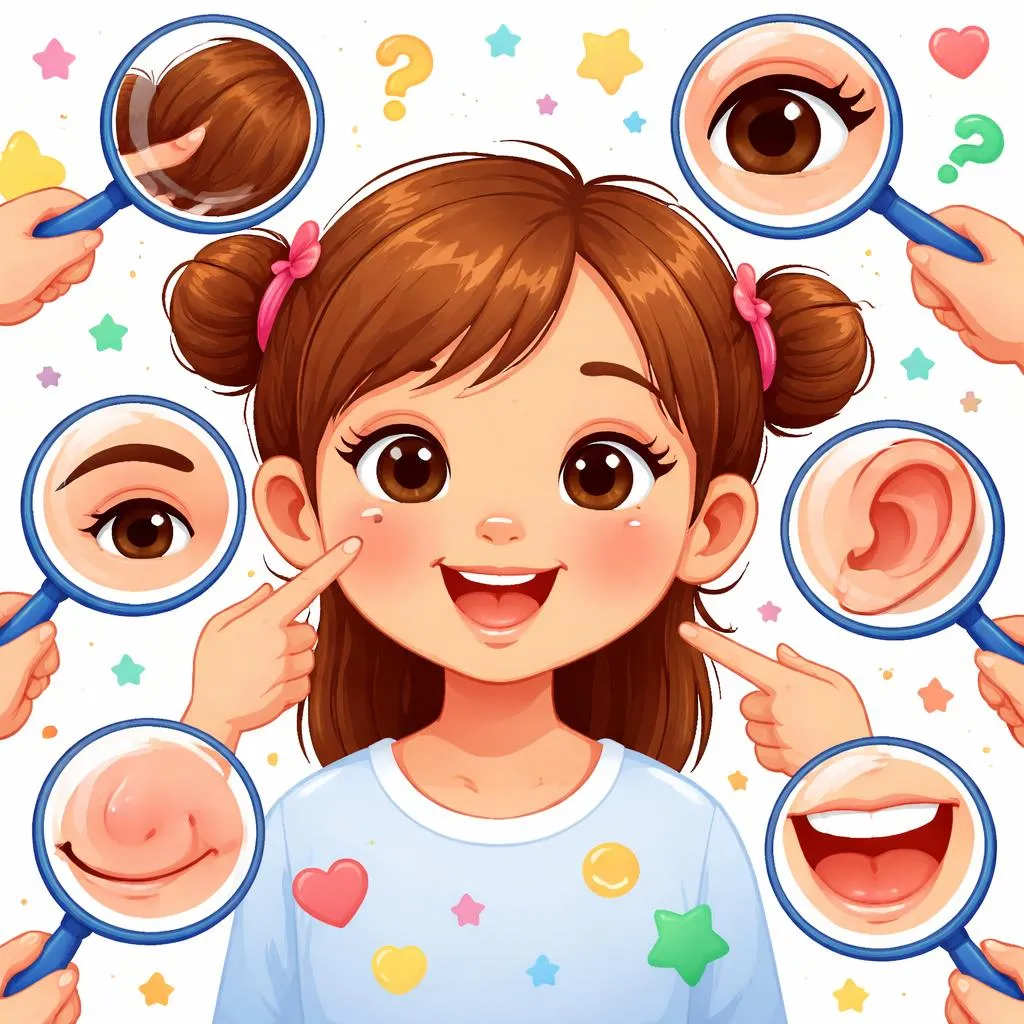
Let's explore a foundational and personal vocabulary set: face parts. This concept refers to the names of the different features on our face, such as eyes, nose, mouth, and ears. Learning the face parts is one of the first steps in body vocabulary. It helps children describe themselves and others, express feelings, and follow instructions related to self-care.
Understanding face parts connects language directly to a child's own body. It answers the question "What is this?" when pointing to a mirror. This knowledge is essential for building self-awareness, social interaction, and the ability to give clear descriptions. It's a practical vocabulary that children use every single day.
Meaning and Explanation
Each of the face parts has a specific name and function. The meaning of the word is tied to what that part does. Eyes are for seeing. Ears are for hearing. The nose is for smelling and breathing. The mouth is for eating, drinking, and speaking.
Learning this vocabulary involves more than memorization. It's about connecting the word (e.g., "eyebrow"), its location on the face, and its purpose (it helps protect the eye). This three-way link—name, place, and function—makes the vocabulary meaningful and useful for communication and understanding the world.
Categories or Lists
We can list the basic face parts in a simple, logical order. A core list for young learners includes:
Eyes
Ears
Nose
Mouth
Hair
Cheeks
Chin
Eyebrows
Eyelashes
Teeth (inside the mouth)
Tongue (inside the mouth)
We can also group them for easier learning:
Senses: Eyes (see), Ears (hear), Nose (smell), Mouth/Tongue (taste).
Pairs: Eyes, Ears, Eyebrows, Eyelashes, Cheeks.
Singular: Nose, Mouth, Chin.
This categorization helps organize the information in a child-friendly way.
Daily Life Examples
We use the names of face parts constantly in daily life. We use them during routines: "Let's wash your face. Brush your teeth." We give gentle instructions: "Blow your nose. Look with your eyes."
We describe expressions and feelings: "You are smiling with your mouth!" "Your eyes look happy." We sing songs like "Head, Shoulders, Knees and Toes" that include face parts. We read stories that describe characters: "He has big blue eyes." Pointing to your own or a doll's face while naming each part is the most direct and effective practice.
Printable Flashcards
Excellent printable flashcards for face parts should have a clear, friendly drawing of a face on one side, with an arrow pointing to one feature. The other side should have the word in large print (e.g., "EAR") and a simple sentence ("I hear with my ears.").
A highly engaging printable is a "Blank Face" coloring sheet. It shows the outline of a head and hair. Children can draw in the face parts—eyes, nose, mouth, etc.—and then label them. This creative activity reinforces both the vocabulary and its spatial placement.
Learning Activities and Games
A perfect activity is "Mirror Play." Sit with a child in front of a mirror. Point to a face part on your own face and say its name. Then, help them point to the same part on their face and say the word. This personal connection is powerful for memory.
Play "Simon Says: Face Version." Give commands like "Simon says, touch your nose!" "Simon says, blink your eyes!" This game is active, fun, and practices listening comprehension along with rapid vocabulary recall.
Another fantastic game is "Feely Bag Mystery." Place a small, safe toy or object in a bag. A child feels it without looking. Ask them to describe it using face parts: "Does it have eyes? Does it have a big mouth?" Then, they guess what it is. This encourages descriptive language.
Learning Tips
A great tip is to use a consistent, catchy song. The classic "Head, Shoulders, Knees and Toes" is perfect, as it includes eyes, ears, mouth, and nose. Sing it slowly at first, touching each part. The combination of music, touch, and words creates strong neural pathways.
Use daily routines as learning moments. During face washing or tooth brushing, name each part you are cleaning: "Now let's wash your cheeks... and your chin." This repetition in a meaningful context helps the vocabulary stick naturally.
Mastering the names of face parts gives children the fundamental language to talk about themselves and interact with others. It builds the foundation for describing emotions, following health routines, and engaging in creative play. By linking these words to playful games, personal reflection in the mirror, and daily care, we turn simple vocabulary into a tool for self-expression and connection. This knowledge helps children navigate their world with greater confidence and clarity, one smile at a time.