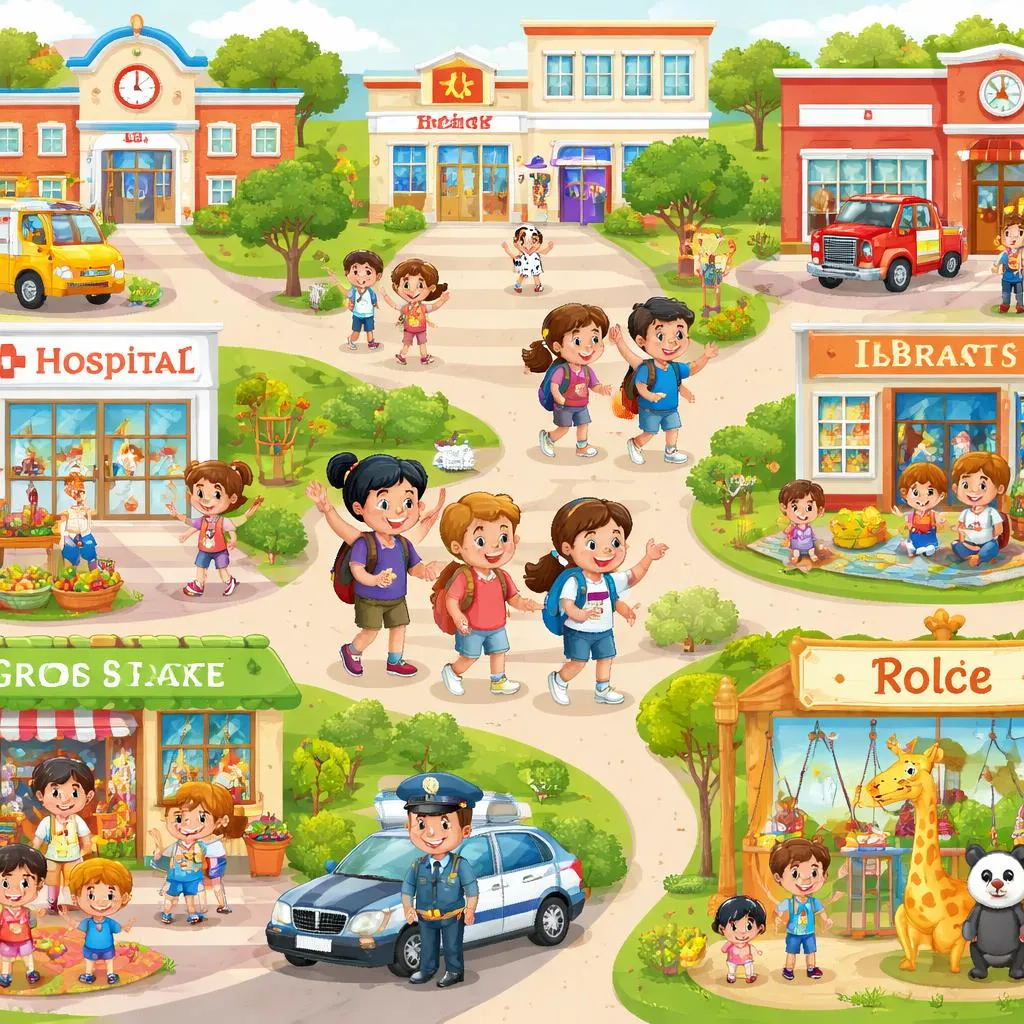

Hello, young explorers! Welcome to our special lesson about communities. Today we take a walk through a town. We discover different town places. These are the buildings and locations we visit every day.
A town has many different places. Some are for shopping. Some are for learning. Some are for playing. Some are for getting help. Knowing their names helps children talk about their community.
Let us put on our walking shoes. Let us explore the town together. By the end of this lesson, naming town places will feel natural and easy.
What are Town Places? Town places are the different locations you can find in a town or city. They include buildings, parks, and other spots where people go for different reasons.
Every town has places where people live, work, learn, shop, and have fun. These places make up a community. People use them every day.
Some places are for everyone. Parks are for playing and relaxing. Libraries are for reading and learning. Shops are for buying things we need.
Learning the names of town places helps children describe where they are going. They can say "I am going to the park" or "We are at the library." These sentences are useful every day.
Meaning and Explanation When we talk about town places, we mean all the different locations in a community. Each place has a name and a purpose.
Some places provide services. The hospital helps sick people. The fire station keeps us safe from fires. The police station protects the community.
Some places are for shopping. The supermarket sells food. The bakery sells bread and cakes. The clothing store sells shirts and pants.
Some places are for learning and fun. The school is where children learn. The library has books to borrow. The park has swings and slides.
Knowing these names helps children understand their world. They learn what each place is for. They can talk about where they need to go.
Categories or Lists Let us look at different town places organized by category. This makes them easier to remember.
Places for Shopping Supermarket - a large store that sells food and household items Bakery - a shop that sells bread, cakes, and pastries Bookstore - a shop that sells books Clothing store - a shop that sells clothes Toy store - a shop that sells toys Pharmacy - a shop that sells medicine Market - an outdoor place where people sell food and goods Mall - a large building with many different shops Grocery store - a store that sells food Butcher shop - a shop that sells meat
Places for Learning School - where children go to learn Library - a place with books to borrow and read Museum - a place where you can see interesting objects from history or science Art gallery - a place where you can look at paintings and art Kindergarten - a school for young children before first grade University - a school for older students after high school
Places for Health and Safety Hospital - a place where doctors and nurses help sick people Doctor's office - a place where you visit a doctor Dentist - a place where you get your teeth checked Fire station - where firefighters work and keep fire trucks Police station - where police officers work to keep people safe Clinic - a small place for medical care Veterinarian - a doctor for animals
Places for Fun and Recreation Park - an outdoor area with grass, trees, and playgrounds Playground - a place with swings, slides, and climbing equipment Zoo - a place where you can see different animals Movie theater - a place where you watch movies on a big screen Swimming pool - a place where you can swim Sports center - a place for playing sports and exercise Amusement park - a place with rides and games Beach - a sandy area by the water where people swim and play
Places for Food and Drink Restaurant - a place where you buy and eat meals Cafe - a place where you can buy coffee and light snacks Ice cream shop - a place that sells ice cream Pizza place - a restaurant that sells pizza Fast food restaurant - a place that serves food quickly
Places of Worship Church - a building where Christians go to pray Mosque - a building where Muslims go to pray Temple - a building where Hindus, Buddhists, or other groups pray Synagogue - a building where Jewish people go to pray
Places for Transportation Bus stop - a place where buses stop for people to get on and off Train station - a place where trains stop Airport - a place where airplanes take off and land Taxi stand - a place where taxis wait for passengers Gas station - a place where cars get fuel
Places for Services Post office - a place where you mail letters and packages Bank - a place where you keep money Hair salon - a place where you get your hair cut Barber shop - a place where men and boys get haircuts Laundromat - a place where you wash clothes Pet store - a store that sells pet supplies and sometimes animals
Daily Life Examples Let us see how town places appear in daily life. These examples show real moments.
In the morning, a family goes to the bakery to buy fresh bread for breakfast. They say hello to the baker. They pay for the bread.
After breakfast, a child goes to school. They walk past the park. They see children playing on the swings. They wave to their friends.
During the day, someone needs medicine. They go to the pharmacy. The pharmacist helps them find what they need.
In the afternoon, a family goes to the library. They return old books and borrow new ones. The librarian helps them find stories.
On the way home, they stop at the supermarket. They buy food for dinner. Milk, bread, vegetables, and fruit.
On Saturday, children go to the park. They play on the slides and swings. They run on the grass. They have a picnic with their family.
If someone gets sick, they go to the doctor's office or the hospital. Doctors and nurses help them feel better.
When it is time for a haircut, people go to the hair salon or barber shop. They leave with fresh new hair.
Printable Flashcards Flashcards are a wonderful way to learn town places. Here are ideas for making them.
Make a card for each place. On one side, write the name. School, library, park, hospital, supermarket, fire station.
On the other side, draw a simple picture. For school, draw a building with a flag. For park, draw trees and a slide. For hospital, draw a building with a red cross.
Make another set of cards with categories. Shopping, Learning, Health, Fun, Food, Transportation. Children sort place cards into the correct category.
Make cards with people who work in each place. Teacher, librarian, doctor, firefighter, police officer, baker. Match the worker to the place where they work.
Use these cards for practice. Look at the picture and say the place name. Look at the word and imagine what happens there. Practice until you know them all.
Learning Activities or Games Let us play some games to learn about town places. These activities make vocabulary stick in memory.
Activity 1: Build a Town Give children a large piece of paper. They draw a map of a town. They include different places. School, park, supermarket, fire station, library. Label each place. This builds creativity and vocabulary.
Activity 2: Where Am I? Game Describe a place without naming it. "I am a place where you can borrow books. I am quiet. People read here. Where am I?" Children guess library. Take turns giving clues.
Activity 3: Town Bingo Make bingo cards with pictures of town places. Call out the names. Players cover the matching picture. The first to cover a row shouts "Town!" This builds listening and recognition.
Activity 4: Place Sort Make signs for different categories. Shopping, Learning, Health, Fun, Food. Give children place cards. They sort each card into the correct category. Supermarket goes with Shopping. School goes with Learning.
Activity 5: Community Helpers Match Make cards with community helpers. Teacher, doctor, firefighter, police officer, librarian, baker. Make cards with places where they work. Children match each helper to their workplace.
Activity 6: Town Scavenger Hunt Take a walk around the neighborhood or look at pictures. Find different town places. Point to them and say the name. Check them off a list.
Activity 7: Memory Match Make pairs of cards with town place pictures. Lay them face down. Players take turns flipping two cards. If they match, they keep the pair and say the place name.
Activity 8: What's Missing? Place several town place cards on a tray. Let children look for one minute. Cover and remove one. Uncover and ask what place is missing. This builds memory.
Activity 9: Town Charades Act out going to a town place without speaking. Pretend to read a book for library. Pretend to swing for park. Pretend to buy food for supermarket. Others guess the place.
Activity 10: Town Pictionary One child draws a town place on the board. Others guess what it is. The drawer cannot speak or write words.
Activity 11: Town Alphabet Game Go through the alphabet and name a town place for each letter. A is for airport. B is for bank. C is for church. See how many letters the class can complete.
Activity 12: Town Story Time Make up a story about a child visiting different town places. "First Sam went to the library. Then he went to the park. After that, he went to the supermarket with his mom." Children add ideas.
Activity 13: Town Map Game Draw a simple town map on the board. Give directions. "Start at the school. Go to the library. Then go to the park." Children follow the directions with their fingers.
Activity 14: Town Questions Practice asking and answering questions about town places. "Where do you go to borrow books?" "I go to the library." "Where do you go when you are sick?" "I go to the doctor."
Activity 15: Town Craft Give children paper and art supplies. They create a shoebox diorama of a town place. A library with tiny books. A park with small trees. A supermarket with tiny food.
Activity 16: Town Bingo with Descriptions Call out descriptions instead of names. "You go here to see animals." Players cover zoo. "You go here to watch movies." Players cover movie theater.
Activity 17: Town Hop Place town place cards on the floor. Call out a place. Children hop to that card. This combines movement with learning.
Activity 18: Town Pattern Game Create patterns with town place pictures. School, park, school, park. What comes next? Children continue the pattern.
Activity 19: Town I Spy Play I Spy using town places. "I spy a place with many books." Children look around the room for library card. "I spy a place with swings." Children find park card.
Activity 20: Town Song Sing a simple song about town places to a familiar tune. "In our town there is a school, is a school, is a school. In our town there is a school, where we learn each day." Add verses for each place.
Activity 21: Town Journal Children draw or write about a trip to a town place. "I went to the park. I played on the swings. I had fun." This builds writing skills.
Activity 22: Town Dice Game Make a dice with different town places on each side. Roll the dice. Whatever place comes up, children must say a sentence about it. "I go to the library to read books."
Activity 23: Town Word Search Create a word search with town place names hidden in a grid. Children find and circle the words. This builds reading and spelling skills.
Activity 24: Town Puzzle Print pictures of town places and cut them into puzzle pieces. Children put them together and name the place.
Activity 25: Town Questions Game Ask questions about town places. "What can you do at the park?" "Who works at the fire station?" "What do you buy at the bakery?" Children answer.
Learning about town places helps children understand their community. They learn where to go for different needs. They learn the names of buildings and locations they see every day.
Every town has places that make life better. Schools help us learn. Hospitals keep us healthy. Parks give us fun. Shops provide what we need.
Knowing these names helps children talk about where they live. They can give directions. They can describe their neighborhood. They can ask for help finding places.
Keep exploring your town. Keep learning the names of places. Your community is full of wonderful locations to discover.
Happy town exploring, everyone