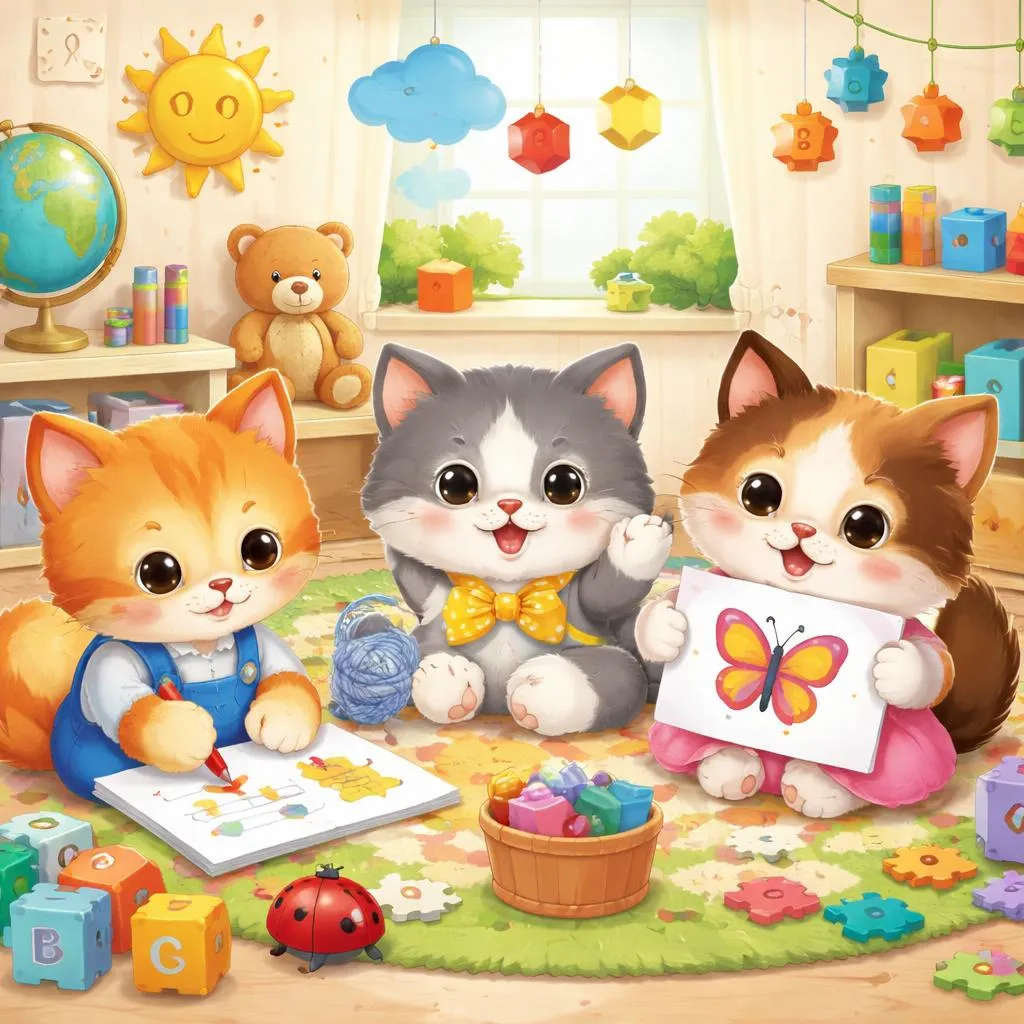

Hello, dear teachers and parents! Today brings a wonderful opportunity to explore a classic nursery rhyme. This beloved tale has entertained children for generations. It tells the story of some mischievous kittens and their lost mittens. The "Three Little Kittens" rhyme offers so much more than a cute story. It teaches responsibility, consequences, and family love. The simple words carry rich language learning potential. Let us discover together why this rhyme remains a favorite in classrooms everywhere.
What Is the "Three Little Kittens" Nursery Rhyme? The "Three Little Kittens" is a traditional English nursery rhyme. It dates back to the 19th century. The rhyme tells the story of three playful kittens. These kittens lose their mittens. Their mother becomes upset. She threatens to withhold their pie as punishment. The kittens find their mittens and receive their treat. But then they soil their mittens while eating. The cycle continues with washing and drying.
The rhyme follows a clear pattern. Each verse presents a problem. The kittens respond. The mother reacts. The resolution comes through action. This pattern makes the story predictable and satisfying. Children learn to anticipate what comes next.
What makes this rhyme special is its relatable theme. Every child has lost something important. Every child understands getting into trouble. Every child knows the joy of being forgiven. The kittens' experience mirrors children's own lives. This connection makes the rhyme meaningful and memorable.
The "Three Little Kittens" also teaches through repetition. Key phrases repeat throughout the rhyme. "Lost your mittens" appears multiple times. "What?" expresses surprise and disappointment. "Found my mittens" brings relief and joy. This repetition builds language confidence. Children join in with increasing enthusiasm.
The Lyrics of the "Three Little Kittens" Nursery Rhyme Let us look closely at the words of this wonderful rhyme. The full version contains several verses. Each verse advances the story.
The first verse introduces the problem:
Three little kittens, they lost their mittens, And they began to cry, "Oh, mother dear, we sadly fear, Our mittens we have lost!" "Lost your mittens? You naughty kittens! Then you shall have no pie." "Mee-ow, mee-ow, mee-ow." "No, you shall have no pie."
The second verse brings relief:
The three little kittens, they found their mittens, And they began to cry, "Oh, mother dear, see here, see here, Our mittens we have found!" "Found your mittens? You darling kittens! Then you shall have some pie." "Mee-ow, mee-ow, mee-ow." "Yes, you shall have some pie."
The third verse introduces a new problem:
The three little kittens put on their mittens, And soon ate up the pie, "Oh, mother dear, we greatly fear, Our mittens we have soiled!" "Soiled your mittens? You naughty kittens!" Then they began to sigh, "Mee-ow, mee-ow, mee-ow."
The final verse resolves everything:
The three little kittens, they washed their mittens, And hung them out to dry, "Oh, mother dear, look here, look here, Our mittens we have washed!" "Washed your mittens? You darling kittens! But I smell a rat close by!" "Mee-ow, mee-ow, mee-ow." "Yes, I smell a rat close by!"
The repeated "mee-ow" throughout gives children a fun part to sing. The mother's changing tone shows her emotions. From anger to joy to frustration to pride, the range of feelings teaches emotional vocabulary.
Vocabulary Learning from the Three Little Kittens The "Three Little Kittens" rhyme introduces wonderful new words. Young learners encounter clothing vocabulary first. Mittens appear throughout the story. These special gloves keep hands warm. Some children may not know this word. The rhyme provides perfect context.
Family words appear naturally. Mother kitten plays a central role. Her relationship to the kittens drives the story. Children understand family dynamics through her actions. They see a mother who loves her children but expects responsibility.
Emotion words enrich the vocabulary learning. The kittens cry when sad. They fear punishment. They feel joy when finding their mittens. They sigh when in trouble. Mother feels upset, then darling, then suspicious. This emotional range builds feeling vocabulary.
Food words add tasty vocabulary. Pie motivates the kittens' actions. They want it badly. They lose it as punishment. They earn it back. They eat it messily. The pie drives the entire plot. Children connect strongly with food motivation.
Action words fill every verse. Lost, found, put on, ate, soiled, washed, and hung all describe important actions. Children learn that different situations require different verbs. The story context makes each word meaningful.
Animal words extend beyond kittens and mother. The final line mentions a rat. This surprise ending adds humor. It also introduces another animal name. Children wonder what the rat is doing nearby. This curiosity extends learning beyond the immediate story.
Phonics Points in the Three Little Kittens Phonics learning happens naturally with this rhyme. The rhythm and rhyme draw attention to word patterns. Children hear specific sounds again and again.
The short "i" sound appears frequently. Kittens, mittens, and begin share this sound. Children hear the pattern clearly. They start to notice that rhyming words often share spelling patterns. This builds foundational reading skills.
The long "i" sound appears in cry, pie, and dry. These words rhyme perfectly. Children feel the satisfaction of matching sounds. They learn that different spellings can make the same sound. "I" at the end of cry makes the same sound as "ie" in pie and "y" in dry.
The "ow" sound appears in found and now. This diphthong requires mouth movement. Children practice forming this sound through repetition. They feel their lips round and tongue move. This physical practice builds articulation skills.
Consonant blends appear throughout. Lost begins with "l" but contains the "st" blend at the end. Found begins with "f" and ends with the "nd" blend. These combinations appear naturally in context. Children absorb them without conscious effort.
Word families emerge from the rhyme. The "-itten" family includes kittens and mittens. Children learn that changing the first sound creates new words. This understanding supports decoding skills for reading.
Grammar Patterns Emerging from the Rhyme Grammar teaching becomes effortless with this rhyme. The natural language provides perfect models. Children absorb correct structures without formal lessons.
Past tense verbs appear throughout. Lost, found, put on, ate, soiled, washed, and hung all show completed actions. Children learn that adding "-ed" often creates past tense. They also encounter irregular forms like ate and hung. This variety builds flexible grammar understanding.
Questions drive the mother's responses. "Lost your mittens?" expresses surprise and inquiry. "Soiled your mittens?" shows disappointment and questioning. Children learn that rising intonation can create questions. They also see that word order sometimes stays the same for questions in spoken English.
Exclamations show strong emotion. "You naughty kittens!" expresses anger. "You darling kittens!" shows love. Children learn that exclamation marks signal strong feelings. They understand that word choice changes with emotion.
Pronouns appear in natural context. "They" refers to the kittens. "We" shows the kittens speaking together. "You" addresses the kittens directly. "I" represents the mother speaking. Children see how pronouns shift depending on who speaks and who is addressed.
Conjunctions connect ideas. "And" links actions in sequence. They lost their mittens AND began to cry. "But" introduces contrast. They washed their mittens BUT mother smells a rat. These connecting words build sentence complexity.
Learning Activities for the Three Little Kittens The "Three Little Kittens" rhyme inspires countless learning activities. These ideas extend the rhyme into deeper language practice. Each activity builds different skills while maintaining the fun.
Mitten matching games build visual discrimination. Create pairs of paper mittens in different colors and patterns. Mix them up. Children find matching pairs. This simple game builds observation skills. Add vocabulary by naming colors and patterns during play.
Sequencing activities check comprehension. Print pictures showing each story event. Kittens lose mittens. Kittens cry. Mother scolds. Kittens find mittens. Kittens eat pie. Kittens soil mittens. Kittens wash mittens. Mother smells a rat. Children arrange these in correct order. This builds narrative understanding.
Mitten washing dramatic play brings the story to life. Set up a washing station with a basin, mild soap, and small cloth mittens. Children wash the mittens just like the kittens. They hang them to dry on a small clothesline. This hands-on experience makes the story real. Vocabulary like wash, scrub, rinse, and dry gain meaning through action.
Feelings discussion extends emotional learning. After hearing the rhyme, discuss how characters felt at each point. When did the kittens feel sad? When did they feel happy? When did mother feel angry? When did she feel proud? Children connect their own feelings to the story. This builds emotional intelligence along with vocabulary.
Rhyme completion challenges listening skills. Recite the rhyme but pause before key rhyming words. Children supply the missing word. "Three little kittens, they lost their..." Children shout "mittens!" This builds phonemic awareness and prediction skills.
Printable Materials for the Three Little Kittens Printable materials support learning at home and school. These resources give children something to hold and use. They extend the rhyme into independent practice.
Mitten templates provide creative opportunities. Print simple mitten outlines on heavy paper. Children decorate their mittens with patterns and colors. Cut them out for display or puppets. Add yarn to hang them on a classroom clothesline. This connects art to literacy.
Story sequencing cards offer hands-on practice. Print small cards showing each story event. Children arrange them in order. Store them in envelopes for repeated use. Laminating extends their life. These cards work for individual practice or partner work.
Puppet templates bring characters to life. Print kitten and mother cat outlines. Children color and cut them out. Attach to craft sticks for simple puppets. Children retell the story using their puppets. This builds oral language skills through dramatic play.
Mini books let children own the story. Create a simple folded book with pages for each story part. Simple text and pictures guide retelling. Children color the illustrations. They practice reading their books to family members. This builds pride and reading confidence.
Word cards focus on key vocabulary. Print each important word separately. Kittens, mittens, mother, pie, lost, found, washed, soiled appear on cards. Children match words to pictures. They arrange words in story order. They use cards for spelling practice. Multiple uses from one simple resource.
Educational Games Based on the Rhyme Games turn learning into pure joy. These game ideas use the "Three Little Kittens" rhyme as their foundation. Children practice language skills while having fun.
Mitten Hunt brings excitement to vocabulary practice. Hide paper mittens around the classroom. Each mitten has a word from the rhyme written on it. Children search for mittens. When they find one, they read the word. They must find all the words to complete the story. This combines movement with reading practice.
Mother Cat Says builds listening skills. Play like Simon Says but with the mother cat character. "Mother Cat says wash your mittens." Children pretend to wash. "Mother Cat says dry your mittens." Children pretend to hang clothes. If Mother Cat does not say the phrase, children freeze. This builds attention and following directions.
Rhyme Bingo reinforces word families. Create bingo cards with pictures of words from the rhyme. Kittens, mittens, pie, cry, dry, found, around appear. Call out words. Children cover matching pictures. The first to cover a row wins. This builds vocabulary recognition.
Feelings Charades explores emotional vocabulary. One child chooses a feeling from the story. Sad kittens, worried kittens, happy kittens, angry mother, proud mother. They act out the feeling without words. Others guess which feeling they show. This builds emotional recognition and expression.
Story Retell Relay gets everyone moving. Divide children into teams. Place picture cards at one end of the room. Give each team a list of story events in order. One child runs to the cards, finds the first event picture, and brings it back. The next child finds the second event. Continue through the whole story. The first team to collect all pictures in order wins. This reinforces story sequence while burning energy.
The "Three Little Kittens" rhyme continues teaching long after the final "mee-ow." Its simple story carries rich language learning potential. Clothing vocabulary becomes concrete through mittens. Emotion words gain meaning through the kittens' experiences. Rhyming patterns build phonemic awareness. Story structure teaches narrative comprehension. Every child connects to the universal themes of loss, responsibility, and forgiveness. Through this beloved rhyme, children learn English through delight rather than drill. The kittens' adventures become their adventures. The language sticks because the story delights. That is the lasting magic of nursery rhymes in language teaching.