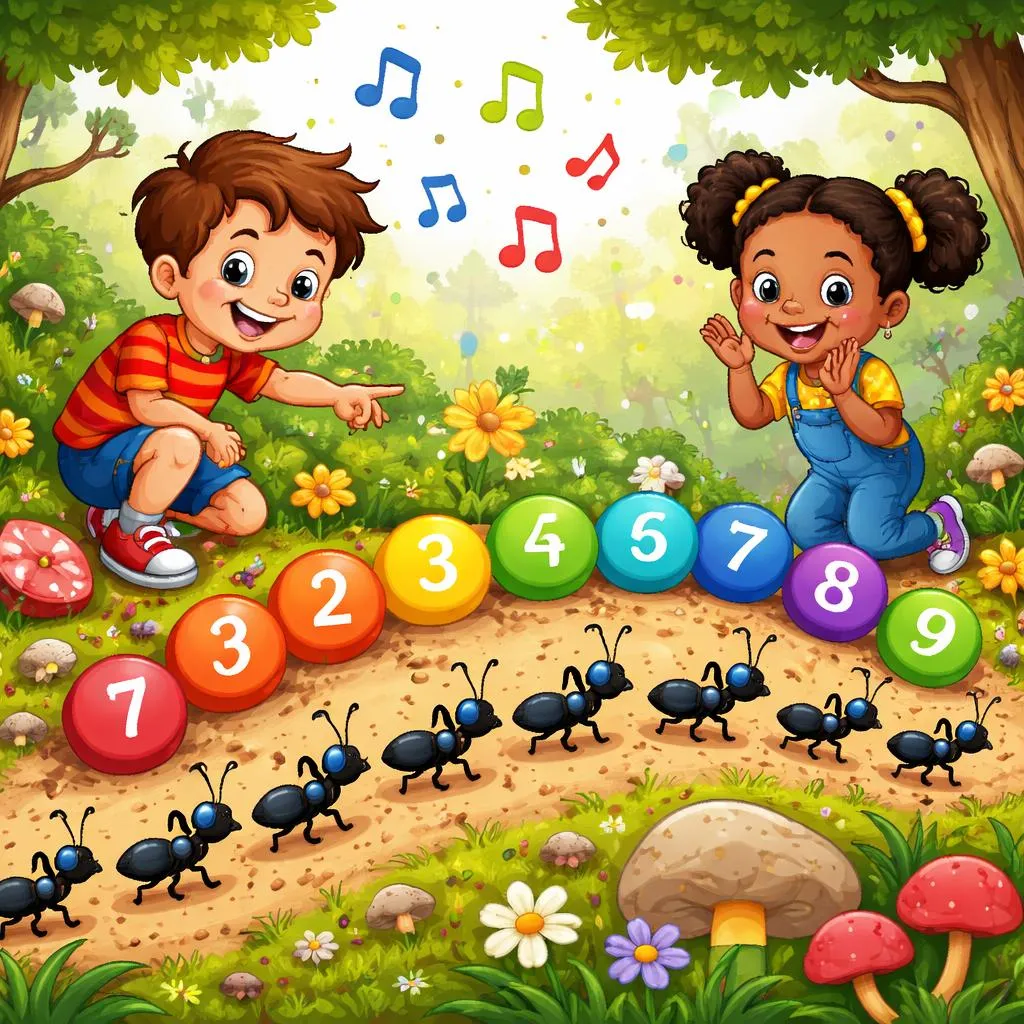

Welcome, everyone, to a fun and energetic counting lesson! Today, we are going to march along with a classic song. We will explore the "ants go marching lyrics". This is a cumulative counting song that is full of action and rhythm. It helps us practice numbers, rhyming words, and verbs in a joyful way. Let's get ready to march and learn together.
What is the rhyme?
The rhyme we are learning is a popular children's counting song, often called "The Ants Go Marching One by One" or "When the Ants Go Marching In." It is based on the melody of the American Civil War song "When Johnny Comes Marching Home." This song is a cumulative counting rhyme. It tells the story of a line of ants marching into a hole in the ground to escape the rain. Each verse adds one more ant and a new, silly action that the smallest ant performs. The repetitive and growing structure makes it excellent for memory and sequencing.
The lyrics of nursery rhymes
Let's look at the structure of the ants go marching lyrics. The pattern is clear and repeats with increasing numbers.
The ants go marching one by one, hurrah, hurrah!
The ants go marching one by one, hurrah, hurrah!
The ants go marching one by one,
The little one stops to suck his thumb,
And they all go marching down to the ground,
To get out of the rain, BOOM! BOOM! BOOM!
The second verse changes to "two by two" and the little one stops "to tie his shoe." This pattern continues, usually up to ten. Each verse introduces a new number and a new rhyming action for the smallest ant.
Vocabulary learning
This song is a treasure trove of action verbs, body parts, and clothing vocabulary.
The core verbs are go marching and stops. The idea of marching introduces movement and rhythm.
We learn the numbers one through ten in sequence.
Each verse introduces a new action, often involving a body part or clothing: suck his thumb, tie his shoe, climb a tree, shut the door, take a dive, pick up sticks, go to heaven, shut the gate, check the time.
We also learn weather vocabulary: rain, and the phrase get out of the rain. The exclamations hurrah and the sound BOOM! add fun and expression.
Phonics points
The song is fantastic for practicing clear enunciation and rhyme patterns.
The consistent /m/ sound in "marching," the /b/ in "BOOM," and the /g/ in "go" and "ground" provide good consonant practice.
The true magic lies in the rhyming pairs in each verse, which teach word families:
one/thumb
two/shoe
three/tree
four/door
five/dive
six/sticks
seven/heaven
eight/gate
nine/time
ten/again
Clapping or marching to the strong beat helps children internalize the rhythm of the language.
Grammar patterns
This song beautifully illustrates several key grammar concepts.
It uses the present simple tense to describe a habitual or ongoing action: "The ants go marching." This is the tense we use for routines.
The structure "stops to [verb]" is important. It shows an interruption of the main action (marching) for a secondary action (sucking his thumb). This teaches the infinitive of purpose.
The repeated line "And they all go marching down..." uses the pronoun "they" to refer back to the ants, teaching pronoun reference.
The cumulative listing of numbers and actions reinforces sequencing and coordination in language.
Learning activities
We can extend the marching fun with these engaging activities.
-
"Ant March" Parade: Give children ant headbands or number cards. As you sing, have them march in a line. When you sing "the little one stops...," the child with the matching number card performs the action. This connects numbers, words, and physical movement.
-
Rhyming Action Match: Create two sets of cards: one with numbers (1, 2, 3) and one with the rhyming actions (thumb, shoe, tree). Mix them up and have children match the number to its correct rhyming action from the song.
-
Create a New Verse: What does the ant do for number eleven? Brainstorm as a class. "The ants go marching eleven by eleven... the little one stops to play with seven...?" This encourages creative thinking about numbers and rhymes.
-
"Before and After" Number Game: Using number cards from 1-10, ask questions. "Who marches before four?" (Three). "Who marches after six?" (Seven). This strengthens number order within the song's context.
Printable materials
Printable resources can make this song a lasting learning tool.
Create a "My Counting Ants Book". Each page has a verse for tracing ("The ants go marching two by two") and a space to draw two ants and a shoe.
Design story sequence cards. Cards illustrate key parts: ants marching, the little ant stopping (doing the specific action), ants going into the hole. Children can put them in order for each number.
A "Rhyming Word Wall" poster is perfect. List the numbers 1-10 down one side. Children can draw or paste a picture of the rhyming word next to each number (a thumb next to 1, a shoe next to 2).
Provide a lyrics sheet with missing words, where children fill in the number or the rhyming action word, turning singing into a reading activity.
Educational games
Turn the song's mechanics into focused learning games.
-
"Ant Colony" Counting Game: Set up a simple board game path. Players roll a dice and move their "ant" token. On certain spaces, they draw a card that says, "The little one stops to tie his shoe! Move ahead 2 spaces if you're on space #2!" This links number recognition to game progress.
-
"Stop and Go" Listening Game: Play a version of "Red Light, Green Light." When the leader sings "The ants go marching," everyone marches. When the leader sings the "stops to..." line and performs an action, everyone must freeze and copy the action. This hones listening skills and vocabulary recall.
-
Number Line Hopscotch: Draw a number line from 1 to 10 with chalk. Call out a verse: "Four by four!" The child hops to number 4 and must say or perform the rhyming action ("shut the door"). This combines physical activity with number and word practice.
The "ants go marching lyrics" offer a perfect package of learning: numbers, vocabulary, rhythm, and grammar, all wrapped in a fun, repetitive song that children love. By marching, rhyming, and acting, children absorb the patterns of English naturally. So keep marching those numbers, finding those rhymes, and celebrating each little ant's silly stop. You're building a strong foundation in counting and language, one marching verse at a time.