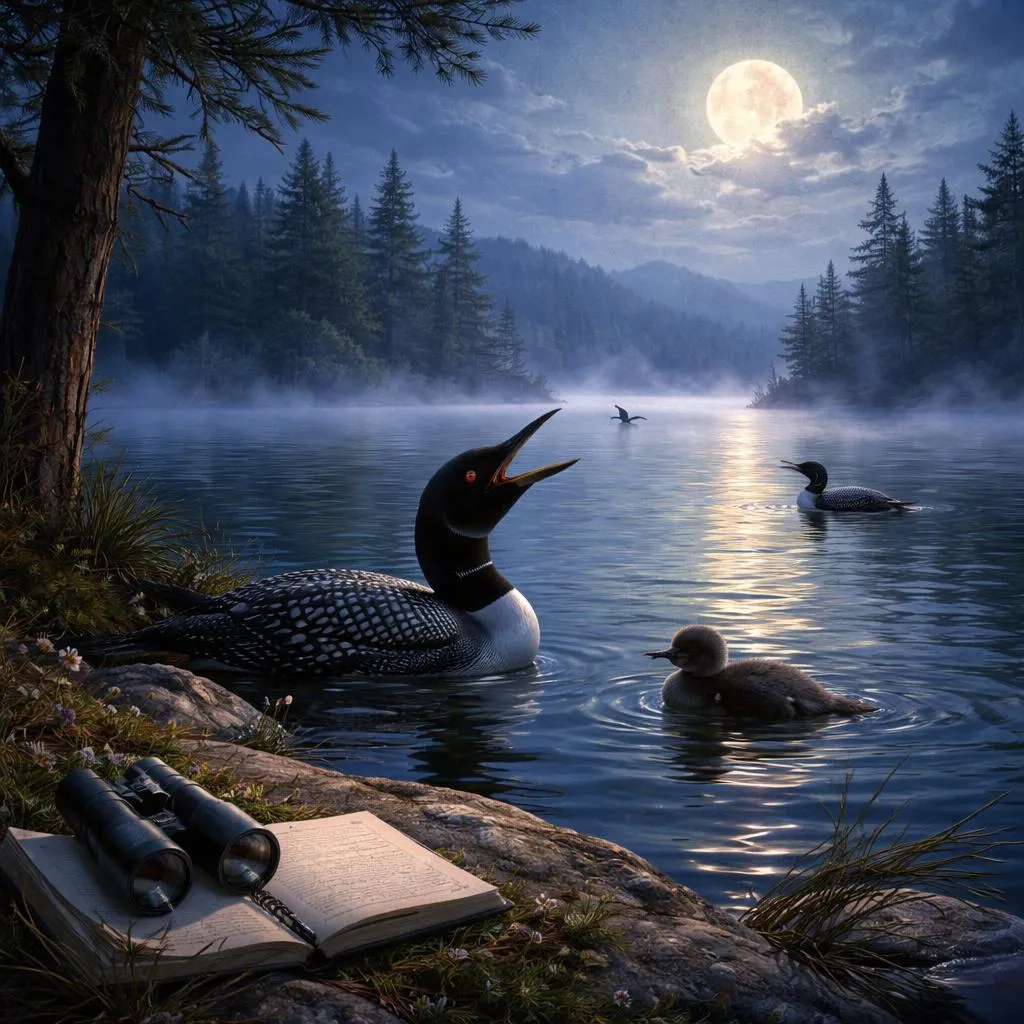

What Is This Animal?
A loon is a large water bird with a black-and-white checkered back and a long, pointed beak. In summer, its head is black with a green or purple sheen. It has red eyes. Loons are built for diving. Their legs are placed far back on their bodies. This makes them excellent swimmers but clumsy on land.
Loons live on northern lakes in North America, Europe, and Asia. They spend summers on freshwater lakes. They migrate to coastal waters in winter. They are symbols of northern wilderness. Their calls echo across lakes.
These birds are famous for their voices. They make four distinct calls. The wail, the tremolo, the yodel, and the hoot. Each call has a different meaning. The tremolo sounds like crazy laughter. It is sometimes called the laughing call.
For children, loons are magical. Their calls and diving skills make them unforgettable. Learning about loons teaches children about northern lakes, bird adaptations, and the wild places where these birds live.
English Learning About This Animal
Let us learn the English word loon. We say it like this: /luːn/. The loo sounds like “loo.” The n sounds like “n.” Put them together: loon. Say it three times. Loon. Loon. Loon.
Now let us learn words about a loon’s body. The beak is long, black, and pointed. The eyes are red. The feet are webbed and placed far back. The plumage is black and white in summer. The chicks are baby loons.
There is a beautiful saying about loons. People say, “The loon’s call is the voice of the wilderness.” This describes their haunting sound. Another saying is, “Where loons nest, the water is pure.” This connects them to clean lakes.
These English words help children understand loon anatomy. When they say feet, they learn why loons are good swimmers. When they say chicks, they know the babies. Parents can practice these words while looking at pictures. Point to the parts. Say the words together.
Animal Facts and Science Knowledge
Loons belong to the family Gaviidae. There are five loon species. The common loon is found in North America and Europe. The yellow-billed loon is the largest. Loons are ancient birds. They have existed for millions of years. They are related to penguins.
Loons live on northern lakes. They need clear, clean water. They nest on the shore. They build nests close to water. They return to the same lake each year. They are territorial. They defend their nesting area.
Loons are carnivores. They eat fish. They dive underwater to hunt. They can stay submerged for up to five minutes. They swim with their feet. They catch fish with their sharp beaks. They swallow fish headfirst.
Loons have special abilities. Their bones are solid, not hollow like other birds. This helps them dive deep. Their legs are far back. This makes them powerful swimmers. They can swim underwater at high speed. Their red eyes see clearly underwater.
Loons make four distinct calls. The wail is a long, sad sound. It calls to other loons. The tremolo sounds like laughter. It signals alarm. The yodel is made by males. It defends territory. The hoot is a soft call between parents and chicks.
How to Interact With This Animal Safely
Loons are wild birds. They are not pets. The best way to interact is to watch from a distance. If you are on a lake, stay far from loon nests. Loons will abandon their nests if disturbed. Use binoculars to watch.
Teach children to respect loons. Do not chase them in boats. Do not approach nests. Loons are protective parents. They may dive or call to distract intruders. Give them space.
If you hear a loon call, listen. Do not try to imitate it. Loons may leave their nests if they think another loon is nearby. Enjoy the sound from a distance.
Loons need clean lakes. Pollution harms them. Lead fishing tackle is deadly. Loons swallow it and die. Use non-lead tackle. Keep lakes clean.
Loons are protected in many places. Disturbing them is against the law. Learning about them helps us protect them.
What Can We Learn From This Animal
Loons teach us about wild places. They live on northern lakes. Children learn that wild places are special. Visiting nature, listening to sounds, and appreciating wildness are important.
Loons teach us about family. Parents raise chicks together. They carry chicks on their backs. Children learn that families care for each other. Protecting, feeding, and teaching are what families do.
Loons teach us about communication. They have different calls for different messages. Children learn that communicating clearly helps us. Using words, listening, and sharing feelings help us connect.
Loons teach us about adaptation. Their bodies are perfect for diving. Children learn that we all have strengths. Using what we are good at, learning new skills, and adapting to our world help us thrive.
Fun Learning Activities
Let us make learning about loon fun. One activity is the loon call game. Ask your child to make loon sounds. Practice the wail, tremolo, yodel, and hoot. Use a long sound for the wail. Use a laughing sound for the tremolo. Say “loon calls” and “loon sings to its family.”
Another activity is the loon dive game. Ask your child to pretend to dive underwater. Use feet to kick. Catch a fish. Come up. Shake off water. Say “loon dives” and “loon catches fish.”
Draw a loon. Look at pictures of loons. Notice the black-and-white pattern, red eyes, and pointed beak. Draw a loon on a northern lake. Add chicks on its back. Label the parts. Say the words aloud.
Create a story about a loon family. Ask your child what the loons do. Do they build a nest? Do they dive for fish? Do they carry chicks on their backs? Write a few sentences together. Let your child draw pictures. Read the story aloud.
Make a loon craft. Use black and white paper for the pattern. Add a long, pointed beak. Add red eyes. Add webbed feet. Move the craft loon. Practice saying “loon dives” and “loon calls across the lake.”
Learn about northern lakes. Talk about what makes a healthy lake. Discuss clean water, fish, and loons. Use words like “ecosystem,” “wilderness,” and “conservation.”
Learn about bird calls. Listen to recordings of loon calls. Identify the different sounds. Use words like “wail,” “tremolo,” “yodel,” and “hoot.”
These simple activities bring learning to life. Children build English vocabulary while playing. They learn science through understanding lake ecosystems. They develop appreciation through learning about northern wilderness. Learning about loon becomes a journey to clear, cold lakes. Each moment spent together strengthens language, curiosity, and a growing appreciation for the black-and-white birds that teach us that wild places, family, and the voices we share make the world a richer, more hauntingly beautiful place.