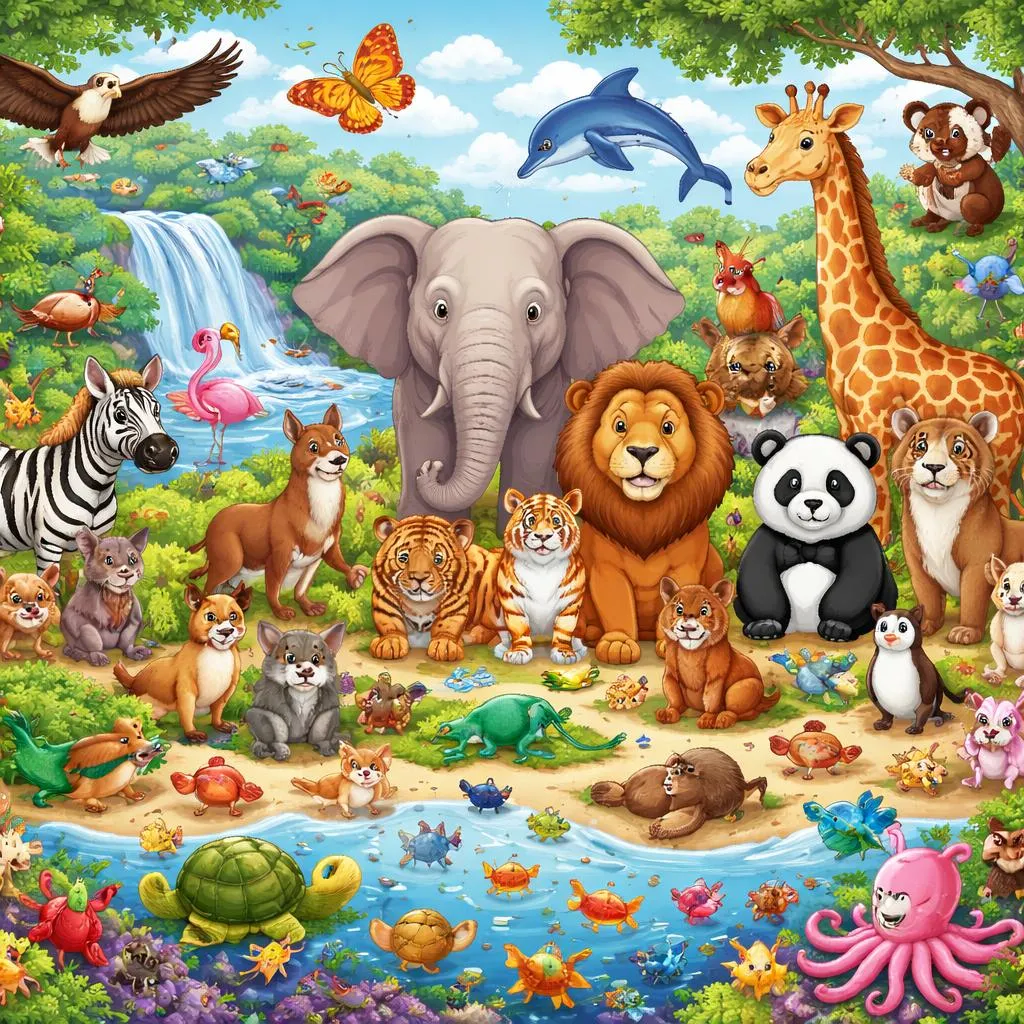

Wild Animals
lion tiger elephant giraffe zebra monkey bear wolf fox deer leopard cheetah hippopotamus rhinoceros kangaroo panda gorilla crocodile alligator snake
These animals usually live in forests, jungles, deserts, or grasslands.
Farm Animals
cow horse pig sheep goat chicken duck turkey donkey goose
Farm animals often live on farms.
They help people in different ways.
Pet Animals
dog cat rabbit hamster guinea pig parrot goldfish turtle
Pets live with people.
They provide companionship.
Sea Animals
shark whale dolphin octopus crab lobster seal sea lion starfish jellyfish
Sea animals live in oceans and seas.
Bird Names
eagle owl sparrow pigeon peacock flamingo penguin parrot crow swan
Birds have feathers and wings.
Most birds can fly.
Insects
ant bee butterfly mosquito spider grasshopper dragonfly beetle
Insects are small animals.
Most insects have six legs.
Long Vocabulary Sentence
The zoo displays a wide variety of animals, including lions, elephants, giraffes, penguins, dolphins, and crocodiles, allowing visitors to observe species from forests, deserts, oceans, and polar regions all in one place.
Learning animal names expands vocabulary.
It improves reading skills.
It strengthens descriptive writing.
Jungle Animals
Jaguar Panther Sloth Toucan Anaconda Chimpanzee Tapir Okapi Mandrill Capybara
Jungle animals often live in warm, wet climates.
Rainforests provide thick trees and heavy rain.
Many jungle animals climb.
Some move quietly through trees.
Desert Animals
Camel Fennec fox Meerkat Armadillo Coyote Scorpion Lizard Gecko Vulture Oryx
Desert animals survive in hot weather.
Water is limited.
Many desert animals are active at night.
Their bodies adapt to dry conditions.
Arctic Animals
Polar bear Arctic fox Walrus Reindeer Snowy owl Seal Narwhal Beluga whale
Arctic animals live in cold regions.
Thick fur or blubber keeps them warm.
Snow and ice shape their habitat.
Mountain Animals
Mountain goat Yak Lynx Cougar Ibex Alpaca Marmot Snow leopard
Mountain animals adapt to high altitude.
Strong legs help them climb.
Thick coats protect them from cold air.
Grassland Animals
Bison Antelope Gazelle Hyena Warthog Buffalo Ostrich Prairie dog
Grasslands provide open space.
Many animals run fast.
Speed helps survival.
Reptiles
Iguana Chameleon Komodo dragon Python Cobra Tortoise Skink Boa
Reptiles are cold-blooded.
Most lay eggs.
Scales cover their bodies.
Amphibians
Frog Toad Salamander Newt Tree frog Bullfrog
Amphibians live near water.
They often begin life in water.
Later they live on land.
More Birds
Hawk Falcon Woodpecker Robin Heron Pelican Canary Finch Seagull Kingfisher
Bird species vary in size and color.
Some migrate long distances.
Others stay in one region all year.
Large Ocean Animals
Blue whale Hammerhead shark Orca Manta ray Sperm whale
The Blue whale is the largest animal on Earth.
The African elephant is the largest land animal.
The Cheetah is one of the fastest land animals.
These animals show the diversity of life.
Small Mammals
Squirrel Chipmunk Hedgehog Mole Weasel Ferret Otter Badger
Small mammals live in forests, fields, and near water.
Some dig underground homes.
Others climb trees.
Extended Descriptive Sentence
Across forests, deserts, oceans, mountains, and polar regions, animals such as the blue whale, African elephant, snow leopard, polar bear, jaguar, camel, and penguin demonstrate the remarkable diversity of Earth’s ecosystems, showing how species adapt physically and behaviorally to survive in environments that range from freezing Arctic ice to scorching desert sands.
Learning animal names builds vocabulary.
It improves spelling.
It supports reading comprehension.
It strengthens descriptive writing skills.
Animal vocabulary also helps in science lessons.
Names connect to habitats.
Habitats connect to ecosystems.
Vocabulary supports understanding.
Nocturnal Animals
Bat Raccoon Owl Hedgehog Badger Porcupine Aardvark Kinkajou
Nocturnal animals are active at night.
They rest during the day.
Many have strong night vision.
Some have sharp hearing.
Darkness helps them hunt or hide.
Herbivores
Deer Rabbit Elephant Giraffe Horse Zebra Panda Koala
Herbivores eat plants.
They may eat leaves.
They may eat grass.
They may eat fruit.
Flat teeth help them chew.
Carnivores
Lion Tiger Wolf Leopard Crocodile Eagle Shark Hyena
Carnivores eat meat.
Sharp teeth help them tear food.
Strong claws help them hunt.
Some hunt alone.
Some hunt in groups.
Omnivores
Bear Pig Raccoon Fox Crow Chicken
Omnivores eat both plants and animals.
They adapt easily.
They survive in many habitats.
Endangered Animals
Amur leopard Black rhinoceros Sumatran tiger Mountain gorilla Sea turtle Red panda
Some animals are endangered.
Habitat loss causes danger.
Pollution creates risk.
Conservation protects species.
The World Wildlife Fund works to protect endangered animals.
Domestic Animals
Dog Cat Cow Horse Sheep Goat Donkey Camel
Domestic animals live with humans.
They may help with work.
They may provide food.
They may offer companionship.
Unique Animals
Platypus Echidna Axolotl Okapi Narwhal
The Platypus lays eggs but is a mammal.
The Axolotl can regrow body parts.
The Narwhal has a long tusk.
These animals are unusual.
They show nature’s variety.
Animals by Size
Tiny animals
Ant Bee Ladybug Mouse Frog
Medium-sized animals
Dog Goat Penguin Fox Beaver
Large animals
Elephant Whale Giraffe Rhinoceros Hippopotamus
Size changes habitat needs.
Large animals need more space.
Small animals hide easily.
Animals by Movement
Flying animals
Eagle Bat Butterfly Parrot
Swimming animals
Dolphin Shark Seal Otter
Climbing animals
Monkey Sloth Koala Squirrel
Running animals
Cheetah Horse Antelope Ostrich
Movement shapes survival.
Body structure supports movement.
Extended Descriptive Sentence
From tiny insects such as ants and bees to massive mammals such as elephants and whales, from desert camels that survive with little water to Arctic foxes that endure freezing temperatures, and from tree-climbing monkeys to deep-diving dolphins, the wide range of animal names reflects the extraordinary diversity of species that inhabit nearly every environment on Earth.
Animal vocabulary supports science learning.
It expands descriptive language.
It improves classification skills.
It connects language with nature.
Learning more animal names increases word knowledge.
Stronger vocabulary builds stronger communication.
Forest Animals
Moose Elk Boar Raccoon Skunk Woodchuck Opossum Wildcat Porcupine Red fox
Forests provide trees and shelter.
Many forest animals hide among leaves.
Some build nests in branches.
Others dig homes underground.
Thick fur protects them in winter.
Tropical Animals
Macaw Toucan Jaguar Sloth Poison dart frog Capuchin monkey Tapir Coati
Tropical regions are warm and humid.
Bright colors are common.
Some animals use color as warning.
Others use color for camouflage.
Rainfall shapes plant life.
Plant life supports animal life.
Wetland Animals
Alligator Heron Flamingo Frog Beaver Otter Caiman Stork
Wetlands mix land and water.
Reeds and grasses grow there.
Birds wade through shallow water.
Amphibians lay eggs in ponds.
Balance in wetlands is important.
Island Animals
Lemur Komodo dragon Iguana Kiwi Tamarin
Island animals often develop unique traits.
Isolation causes change.
Limited space shapes adaptation.
Some species exist only in one place.
The Komodo dragon lives on islands in Indonesia.
It is one of the largest lizards.
Animals in Africa
Lion Elephant Giraffe Zebra Cheetah Hyena Wildebeest Meerkat
The African elephant has large ears.
The Cheetah can run at very high speeds.
Savannas have grass and few trees.
Many animals migrate for food.
Animals in Asia
Panda Tiger Orangutan Yak Snow leopard Asian elephant
The Giant panda eats bamboo.
The Bengal tiger lives in forests and grasslands.
Asia has many climates.
Climate shapes species.
Animals in Australia
Kangaroo Koala Wallaby Wombat Dingo Platypus
Australia has many unique animals.
Isolation influenced evolution.
The Kangaroo moves by hopping.
The Koala eats eucalyptus leaves.
Prehistoric Animals
Tyrannosaurus Triceratops Stegosaurus Velociraptor Mammoth Saber-toothed tiger
These animals no longer live today.
They are studied through fossils.
Museums display skeletons.
History explains extinction.
Animals and Classification
Animals can be grouped as mammals, birds, reptiles, amphibians, fish, and insects, and each group shares physical characteristics such as body covering, method of reproduction, and temperature regulation, which allows scientists to organize species into clear categories that make biological study more structured and systematic.
Mammals have hair or fur.
Birds have feathers.
Reptiles have scales.
Amphibians live on land and in water.
Fish breathe through gills.
Insects have six legs.
Extended Integrative Sentence
Across continents including Africa, Asia, Australia, and remote island ecosystems, animals such as the African elephant, Bengal tiger, giant panda, kangaroo, and Komodo dragon demonstrate how geography, climate, isolation, and evolutionary history influence physical structure, behavior patterns, survival strategies, and species diversity within the global animal kingdom.
Learning a broad list of animal names expands vocabulary depth.
It strengthens spelling memory.
It improves reading comprehension.
It supports scientific classification skills.
Animal words connect language learning with knowledge of the natural world.