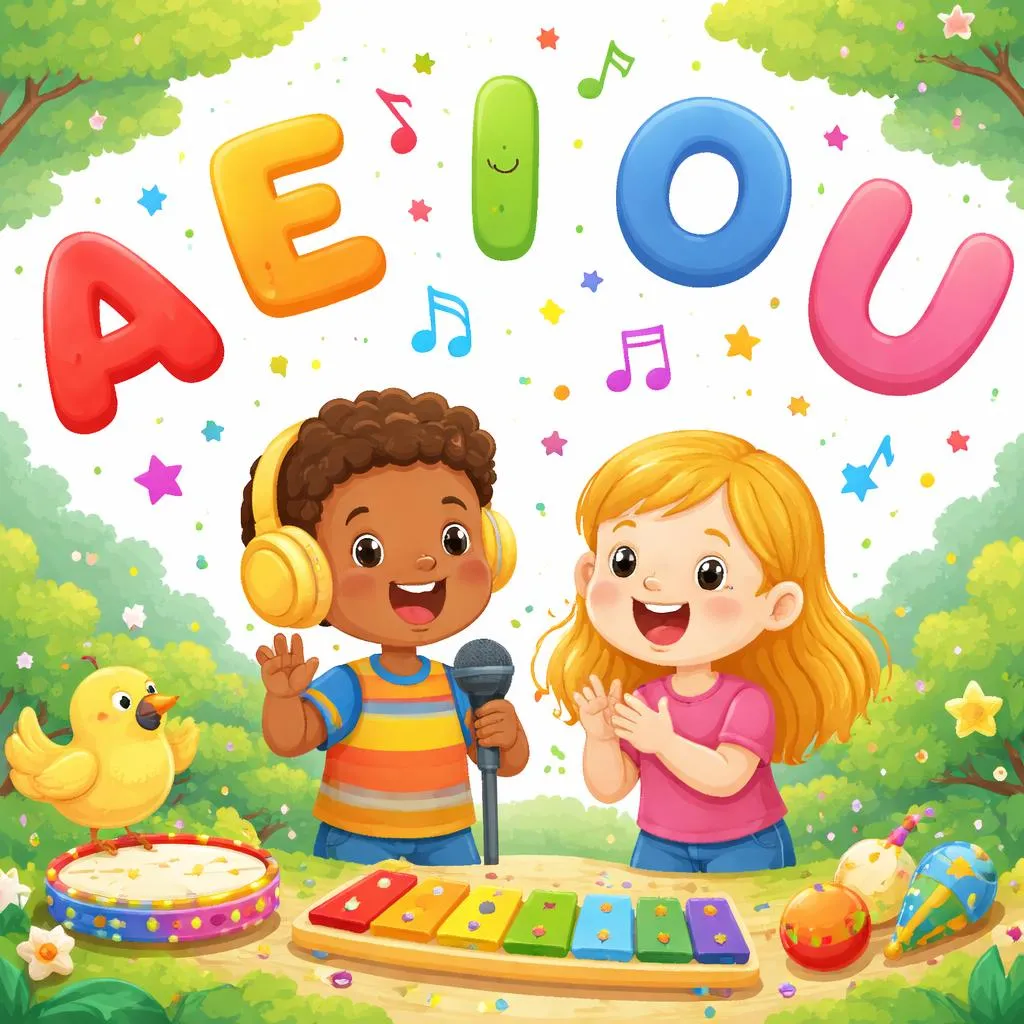

What is the Vowels Song? Let's talk about a wonderful learning tool, the vowels song. You have probably heard a catchy tune about the letters A, E, I, O, U, and sometimes Y. That is a vowels song. These songs are special melodies designed to teach one of the most important concepts in English. They turn abstract letters into memorable musical patterns. Our brains love music and rhythm. This makes a vowels song a powerful friend in the classroom and at home. It helps young learners remember these crucial letters in a joyful way.
Think of these songs as a fun introduction to the alphabet's core team. We have consonants, of course. But the vowels are the stars that give words their voice. A vowels song puts these stars in the spotlight. It helps children identify them quickly and confidently. We will explore how this simple song opens the door to reading.
The Lyrics of the Vowels Song Most vowels songs share a common and simple lyric structure. The classic version often goes like this: "A, E, I, O, U. I know my vowels, and so do you!" or "Every word has a vowel, A, E, I, O, U!" Another popular version spells it out clearly: "The vowels of the alphabet are A, E, I, O, U. These are the vowels, A, E, I, O, U." The beauty lies in its repetition.
Some songs add a verse about the letter Y. They might sing, "And sometimes Y, but that's another story!" This introduces an interesting rule in a gentle way. The melody is usually upbeat and easy to hum. The goal is not complex poetry. The goal is clear, repetitive, and engaging reinforcement. We sing it together, clap along, and let the letters sink in through melody.
Vocabulary Learning A vowels song is more than just letter names. It builds foundational vocabulary. First, it reinforces the word "vowel" itself. Children learn that this special category of letters has a name. They begin to understand the difference between a vowel and a consonant. This is a key piece of literacy terminology.
We can also build word families directly from the song. After singing about 'A', we list simple CVC (consonant-vowel-consonant) words like cat, hat, and map. For 'E', we explore words like pen, red, and net. The song acts as a launchpad. It organizes our vocabulary exploration. Each vowel becomes a heading for a new set of words. This systematic approach makes learning new words much easier.
Phonics Points This is where the vowels song truly shines for reading instruction. The song introduces the basic short vowel sounds, which are the first phonics sounds we teach. A strong vowels song will often pair the letter name with its most common sound. We might sing, "A says /a/ like in apple, E says /e/ like in elephant."
This direct connection is vital. It moves children from letter recognition to letter-sound correspondence. We call this phonemic awareness. The rhythm of the song helps children hear the distinct sound each vowel makes. We can emphasize the mouth shape for each sound as we sing. Show how your mouth opens wide for /a/, and how it stretches for /e/. Make it a physical activity, not just a listening one.
Grammar Patterns You might wonder how a song about letters connects to grammar. It builds an essential foundation. Understanding vowels helps children grasp word structure later. They learn that every syllable in English must have a vowel sound. This is a fundamental grammar rule.
When children start writing, they often omit vowels. A familiar vowels song reminds them to listen for that sound in every word. It provides a mental checklist. "Do I hear an A, E, I, O, or U sound here?" This awareness leads to more accurate invented spelling. It also helps them decode new words while reading. They look for the vowel pattern first. This song teaches them to listen for the core sound in every word they say or hear.
Learning Activities Let's make the vowels song come alive with some hands-on activities. First, try a "Vowel Hunt." After singing, give children a old magazine or a storybook. Ask them to circle every 'A' they can find on one page. Next time, hunt for 'E'. This builds letter recognition in context.
Another great activity is "Vowel Sort." Prepare a basket of small objects or picture cards. Think of a toy cat, a picture of a sun, a plastic egg. Create five boxes labeled A, E, I, O, U. Sing the song, then work together to sort the items by their middle vowel sound. Where does "cat" go? It goes in the 'A' box. This connects the sound to real-world objects. It makes the learning tangible and engaging.
Printable Materials Printable materials can extend the learning from the screen or classroom. A great first printable is a "Vowels Song Poster." It has the simple lyrics and a picture for each vowel sound. Children can color it and hang it where they practice. This visual reminder is very helpful.
Consider making "Vowel Sound Wheels." Create a wheel with a window. The outer wheel has pictures. The inner wheel has the letters A, E, I, O, U. Children spin the wheel to match the picture to its vowel. For example, they spin a picture of an "igloo" to line up with the letter 'I'. You can also find printable worksheets for tracing vowels. They can trace the letter 'O' while singing "O says /o/." This combines motor skills, visual learning, and auditory memory.
Educational Games Games turn practice into play. Let's play "Vowel Freeze Dance." Play some music and have everyone dance. When the music stops, hold up a vowel flashcard. Everyone must shout out the letter and its sound, like "/a/!" before the music starts again. It's energetic and fun.
Another classroom favorite is "Vowel Hopscotch." Draw a hopscotch grid on the floor with chalk or use mats. Write a vowel in each square instead of numbers. As children hop, they must say the letter and its sound. For an added challenge, ask them to say a word that uses that vowel sound before jumping to the next square. These games get the whole body involved. They cement the connection between the vowel song, the letter shape, and its sound through movement and joy.
The magic of a vowels song lies in its simplicity and repetition. It provides a stable, melodic framework upon which we can build so many skills. From phonics to vocabulary to spelling, this humble song is a cornerstone of early literacy. Keep singing it, playing with it, and watching as those five (or six) special letters become trusted friends on the journey to reading. The confidence it builds is the greatest gift of all.