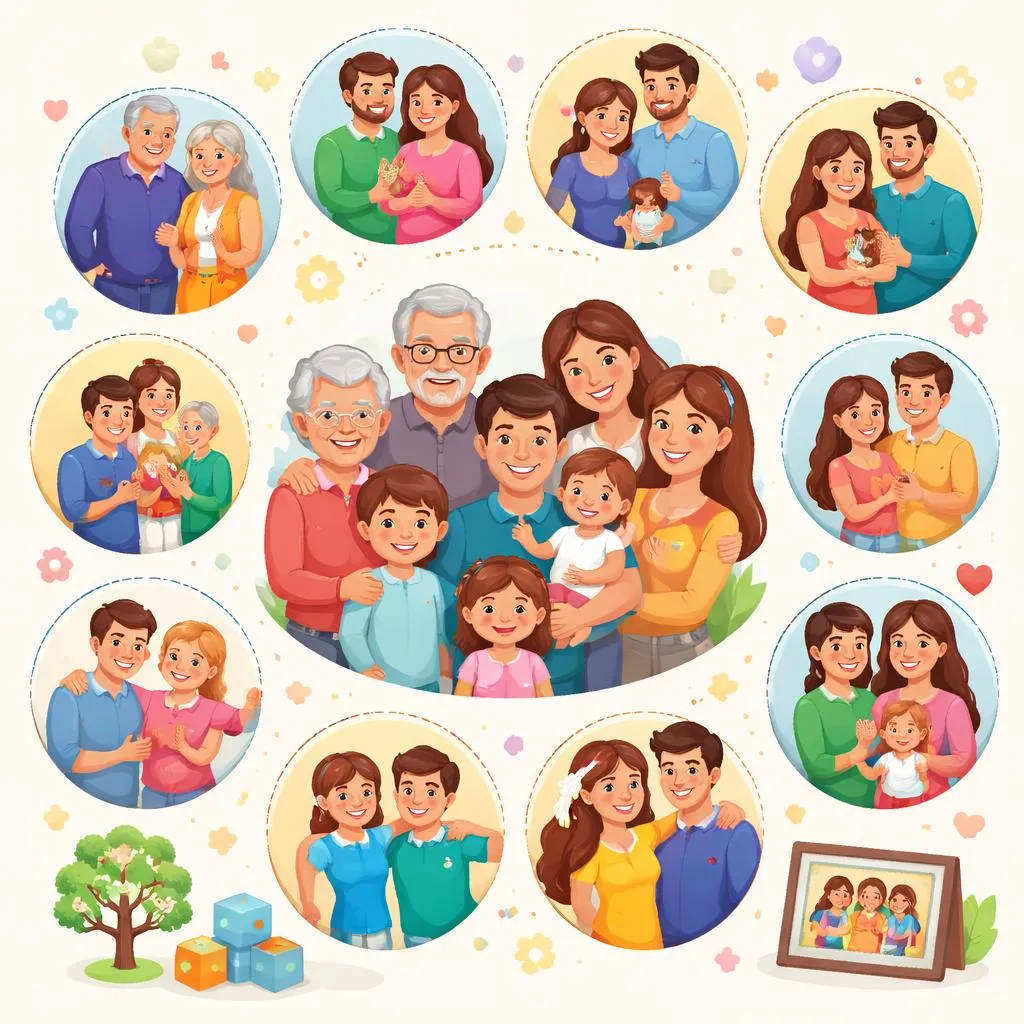

Family vocabulary includes the words used to describe family members and relationships. These words are important in daily conversation because people often talk about parents, siblings, grandparents, and relatives when introducing themselves or sharing personal stories.
Learning family vocabulary helps students speak naturally about their lives and understand others more clearly.
Immediate Family Members
Immediate family usually refers to the closest relatives in a household.
Father
Mother
Parents
Son
Daughter
Brother
Sister
Siblings
For example:
My father works in a hospital.
She has one brother and two sisters.
Their parents live in another city.
These words are common in introductions and simple conversations.
Extended Family Members
Extended family includes relatives outside the immediate household.
Grandfather
Grandmother
Grandparents
Uncle
Aunt
Cousin
Nephew
Niece
For example:
My grandparents visit us every summer.
Her uncle teaches at a university.
They have many cousins.
Understanding extended family vocabulary allows learners to describe larger family connections.
Marriage and Relationship Words
English also has specific vocabulary for family relationships created by marriage.
Husband
Wife
Spouse
Brother-in-law
Sister-in-law
Father-in-law
Mother-in-law
For example:
Her husband works abroad.
His sister-in-law is very friendly.
These terms are important when discussing adult family relationships.
Describing Family Relationships
Family vocabulary often appears with possessive adjectives.
My mother
Your brother
His cousin
Her aunt
Our grandparents
Their children
Using possessive adjectives correctly helps make sentences clear.
For example:
This is my sister.
Their son is very tall.
Words to Describe Family Size
Students can also use numbers and quantity words when talking about family.
I have two brothers.
She has a small family.
They come from a large family.
Describing family size is common in introductions.
Adjectives for Family Members
Family vocabulary becomes more expressive when combined with adjectives.
Kind mother
Supportive father
Younger brother
Older sister
Caring grandparents
For example:
She has a supportive family.
My younger sister loves music.
These combinations make communication richer and more detailed.
Why Family Vocabulary Is Important
Family vocabulary is one of the first topics taught in beginner English classes. It appears in textbooks, speaking exercises, and writing tasks. Because family is a universal topic, students can easily connect new words to their own experiences.
Building strong family vocabulary helps learners introduce themselves confidently, describe relationships clearly, and participate in everyday conversations naturally.
Talking About Family Structure
Family vocabulary also includes words that describe different family structures. Not every family looks the same, so English provides terms to describe various situations clearly and respectfully.
Nuclear family – parents and their children living together.
Extended family – includes grandparents, aunts, uncles, and cousins.
Single-parent family – one parent raising children.
Blended family – a family formed when two parents bring children from previous relationships.
For example:
She grew up in a large extended family.
He lives in a blended family with two stepbrothers.
Learning these expressions helps students discuss modern family life accurately.
Step and Half Relationships
English uses special prefixes to describe certain family relationships.
Stepfather – a man who marries your mother but is not your biological father.
Stepmother – a woman who marries your father but is not your biological mother.
Stepbrother / Stepsister – children from a parent’s new marriage.
Half-brother / Half-sister – siblings who share one biological parent.
For example:
She has one half-sister and one stepbrother.
These terms are common in everyday conversation and should be understood clearly.
Generations in a Family
Family vocabulary also includes words related to generations.
Child
Teenager
Adult
Parent
Grandparent
Great-grandparent
For example:
Her great-grandmother is ninety years old.
The youngest child in the family is five.
Talking about generations is useful when describing family history.
Describing Family Relationships
In addition to naming family members, English includes adjectives and phrases that describe relationships.
Close family
Supportive family
Loving parents
Strict father
Caring mother
Responsible brother
For example:
They come from a close and supportive family.
Her parents are very understanding.
These descriptive phrases help learners express feelings and attitudes toward family members.
Family Vocabulary in Daily Conversation
Family vocabulary appears frequently in introductions and small talk.
Do you have any siblings?
How many people are in your family?
What does your father do?
Where do your grandparents live?
Being comfortable with these questions improves communication skills in social situations.
Cultural Differences in Family Terms
Different cultures sometimes use family words differently. In some cultures, older people who are not related by blood may still be called “aunt” or “uncle” as a sign of respect. In English-speaking cultures, however, these terms usually refer to specific biological or marital relationships.
Understanding cultural differences helps avoid confusion and improves cross-cultural communication.
Family Idioms and Expressions
English also includes idioms related to family.
Like father, like son – children are similar to their parents.
Runs in the family – a trait shared by many family members.
Black sheep of the family – a person who is different from or causes problems for the family.
For example:
Artistic talent runs in the family.
He is considered the black sheep of the family.
Learning these expressions expands vocabulary beyond basic definitions.
Why Expanding Family Vocabulary Matters
Family vocabulary is foundational in English learning because it connects directly to personal identity and daily life. As learners expand beyond basic words such as mother and father to include extended relationships, generational terms, and descriptive phrases, their communication becomes more detailed and natural.
Strong knowledge of family vocabulary supports speaking, listening, reading, and writing skills. It allows students to introduce themselves confidently, share stories, and participate in conversations about relationships and personal experiences with clarity and accuracy.