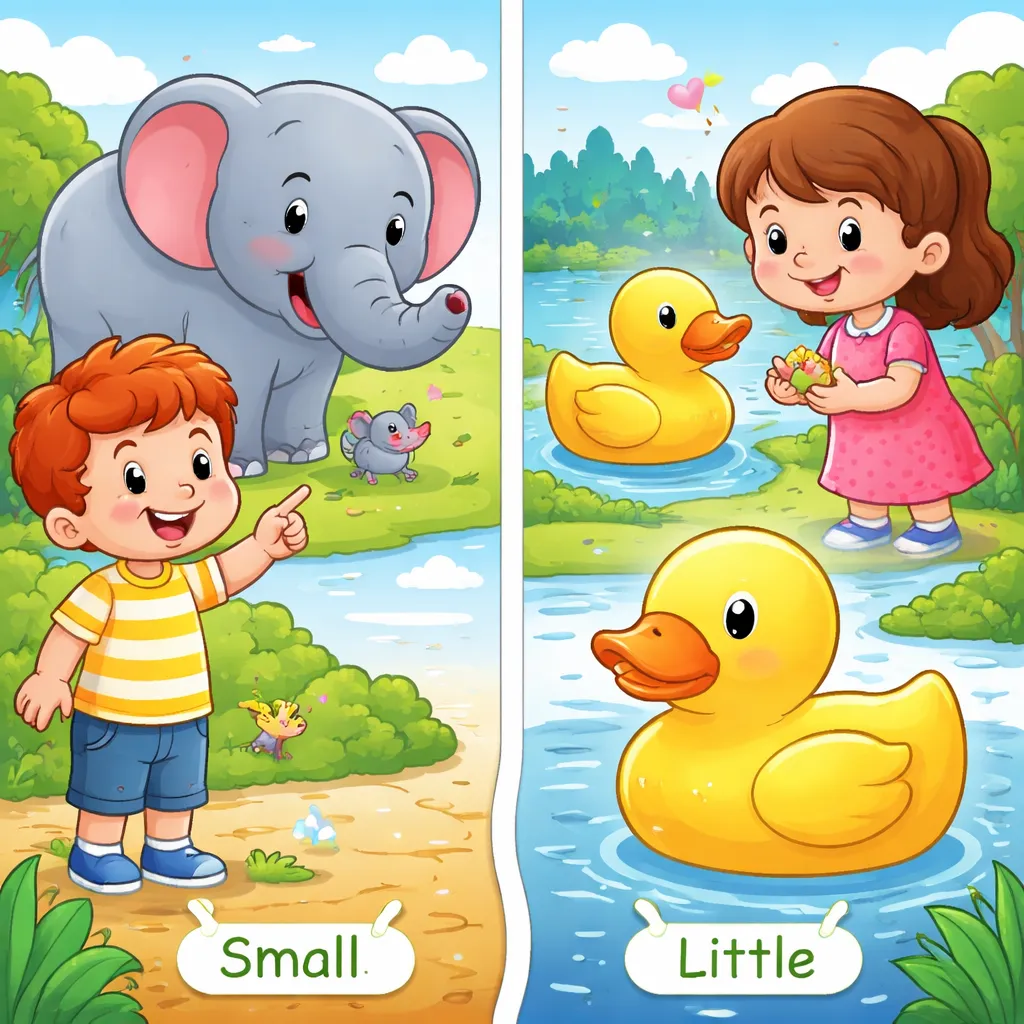

Hello, word explorer! Have you ever found a tiny seashell? Or seen a baby animal? How do you describe them? You might say, "It's so small!" or "It's so little!" They both mean the opposite of big. They seem like twin words. But are they exactly the same? Not really! Knowing their secret is a fun word superpower. It lets you paint perfect pictures with your words. Today, we are going on a tiny-word adventure! We will discover "small" and "little".
First, let's be Word Detectives. Put on your magnifying glass! We will listen at home. Here are two sentences. "I have a small scratch on my knee." "Look at the little kitten sleeping." They both talk about something not big. A scratch. A kitten. Do they sound identical? Or do they feel a tiny bit different? One feels more factual. One feels more sweet and cute. What do you think? Great observation! Now, let's look much closer.
Adventure! Inside the Tiny World of Words
Welcome to the tiny world! "Small" and "little" are two great brushes. They paint pictures of smallness. Think of "small" as a precise ruler. Think of "little" as a cute, colorful sticker. Both show something is not large. But they show it in different ways. Let's learn about each one.
The Factual Ruler vs. The Cute Sticker Think about the word "small". "Small" feels like a clear, factual ruler. It gives you information about size. It is neutral and descriptive. You wear a small shirt size. There is a small hole in your sock. It states a fact. Now, think about "little". "Little" feels like a cute, heart-shaped sticker. It often shows affection or feeling. It makes the thing sound sweet or endearing. You have a little sister. What a little puppy! "Small" measures the size. "Little" often adds a feeling of cuteness or tenderness. One is a measurement. The other is a hug in word form.
The General Word vs. The Specific Word Let's listen to how we use them. "Small" is the general, all-purpose word. It is great for comparisons and facts. An ant is smaller than a mouse. We live in a small town. It works in almost any situation. "Little" is more specific. It is very common in spoken English. It sounds more natural and friendly in conversation. Wait a little while. I have a little problem. Also, "little" can mean "young". My little brother is five. "Small" does not usually mean young. "Small" is for official size. "Little" is for friendly talk and young things.
Their Special Friends and Fixed Phrases Words have best friends. "Small" likes to team up with other factual words. It is used in many common phrases about amount or degree. It was a small mistake. We have a small problem. I feel a small amount of pain. "Little" has its own special teams. It is used in many fixed phrases, often about time or quantity. Wait a little bit. I have a little money. Just a little more, please. Also, "little" can mean "not much" when used with uncountable nouns. I have little hope. This is a more formal use. They are different teams for different games.
Let's visit a school scene. Your teacher says, "Please write your name in the small box on the paper." This is perfect. The teacher gives a clear, factual instruction about size. Now, you are drawing a picture. You add a tiny, smiling sun in the corner. You say, "I drew a little sun." This is also perfect. It shows the sun is cute and tiny in your drawing. Using "little" for the box is okay. But "small" is more precise for instructions. Using "small" for the sun is fine. But "little" adds more charm.
Now, let's go to the playground. You find a tiny, shiny pebble. You show your friend and say, "Look at this little rock!" This shows you think it is cute and special. Later, you try a new piece of equipment. It is for younger kids. It is not very high. You say, "That slide is pretty small." This is a factual observation about its size. The word "little" paints the cute pebble. The word "small" paints the factual slide size.
Our Little Discovery So, what did we discover? "Small" and "little" both mean "not big". But they often carry different feelings. "Small" is more factual, neutral, and comparative. It is the word of measurement and general description. "Little" is more affectionate, cute, and conversational. It often adds a feeling of sweetness or tenderness. "Little" can also mean young. "Small" is great for all situations. "Little" is perfect for friendly talk and cute things. Knowing this lets you choose the right tiny word.
Challenge! Become a Tiny Word Expert
Ready for a challenge? Let's test your new skills!
"The Best Choice" Challenge Let's imagine a nature scene. You see a newborn fawn in the forest. It has spots. Its legs are wobbly. It is very young and adorable. You whisper, "Look at that... what?" Is it a small deer or a little deer? You say, "Look at that little deer!" This shows its cuteness and young age. Now, a park ranger tells you a fact. She says, "Some deer live in small families." This is a factual statement about group size. "Little" wins for the cute, young fawn. "Small" is the champion for the factual family size.
"My Sentence Show" Your turn to create! Here is your scene: A garden with flowers. Can you make two sentences? Use "small" in one. Use "little" in the other. Try it! Here is an example: "The small red flowers grow by the fence." This is a neutral description. "I love those little blue flowers!" This shows you find them especially cute. Your sentences will have different feelings!
"Eagle Eyes" Search Look at this sentence. Can you find the word that could be better? Let's check a home context. "She poured a little milk into the recipe, just 250 milliliters." Hmm. The sentence gives an exact measurement (250 ml). The word "small" often fits better with precise amounts. "She poured a small amount of milk... just 250 milliliters." sounds more factual. "Little" is fine, but "small" matches the number better. Did you spot it? Excellent word work!
Harvest and Action! Turn Knowledge Into Your Superpower
Great exploring! We started thinking "small" and "little" were identical. Now we know they are close friends with different personalities. We can use the factual ruler of "small". We can use the cute sticker of "little". You can now choose the perfect word to match your feeling. This makes your speaking and writing more colorful.
What you can learn from this article: You can now feel that "small" is the factual, measuring word for general size and comparisons. You can feel that "little" is the affectionate, cute word for sweet, young, or charming things. You know that saying "a little sister" often means a younger sister. Saying "a small sister" talks more about her physical size. You learned to match the word to your meaning: "small" for facts, "little" for feelings.
Life practice application: Try your new skill today! Look at your pet or a toy. Is it small (a fact about its size)? Or is it little (a feeling about its cuteness)? Tell a family member one small fact about your room. Then tell them about one little thing you love. Listen to songs or stories. Hear how they use "little" to make things sound sweet. You are now a master of tiny words!