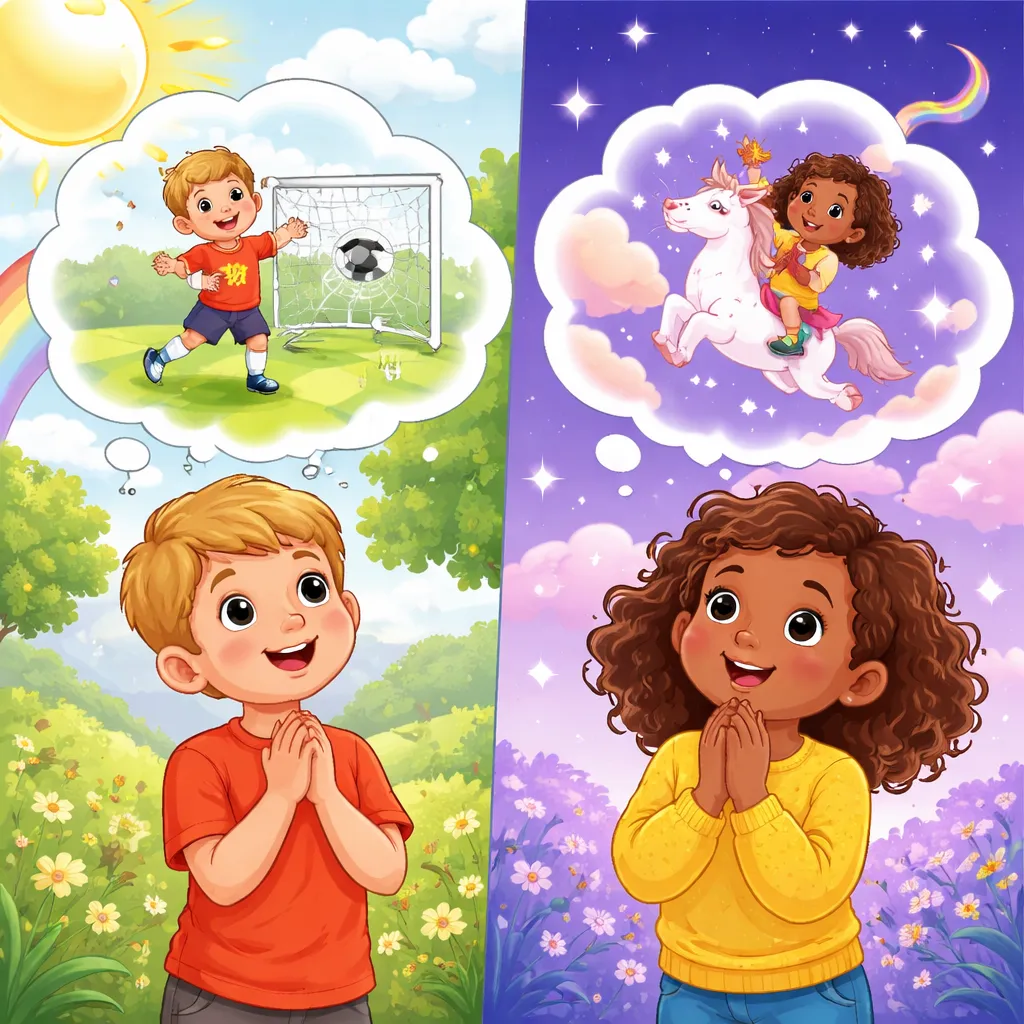

Hello, word explorer! Have you ever looked forward to something? Maybe a sunny day for a picnic. Or dreamed of something magical? Like having a unicorn for a pet. How do you talk about that? Do you hope for sun? Or do you wish for a unicorn? They both seem to mean wanting something. But are they the same? They are like two different paths to the future. One is a sturdy, reliable bridge. One is a magical, sparkling shooting star. Let's find out! Today, we explore the word friends "hope" and "wish". Knowing their secret is a superpower. It makes you a master of your dreams and plans. Let's start our future adventure!
First, let's be Future Detectives. Listen at home. Here are two sentences. "I hope we have pizza for dinner tonight because it's my favorite." "I wish I could fly like a bird, just for one day." They both talk about wanting something. Pizza. Flying. Do they sound the same? One feels possible and likely. One feels magical and impossible. Can you sense it? Great observation! Now, let's look at the path ahead.
Adventure! On the Path to the Future
Welcome to the path to the future! "Hope" and "wish" are two different guides. Think of "hope" as a sturdy, reliable bridge. It crosses to a future that is possible and real. Think of "wish" as a magical, sparkling shooting star. It flies to a future that is a dream, often unreal. Both are about the future. But they lead to different kinds of futures. Let's learn about each guide.
The Sturdy Bridge vs. The Shooting Star Think about the word "hope". "Hope" feels like a sturdy bridge. It is about wanting something good to happen in the future, and you believe it could happen. It is realistic. I hope you feel better soon. We hope to visit grandma. It is positive and possible. Now, think about "wish". "Wish" feels like a shooting star. It is about wanting something that is not true now, or is probably impossible. It is often for dreams. I wish I were taller. I wish I had a million dollars. "Hope" is the sturdy bridge. "Wish" is the shooting star. One is for the possible. The other is for the dream.
The Possible Desire vs. The Impossible Dream Let's compare their reality. "Hope" is for things that are likely or could happen. You have a reason to hope. I hope I pass the test (I studied). I hope it doesn't rain (the sky is cloudy). It connects to real life. "Wish" is for things that are untrue, impossible, or very unlikely. It is a fantasy or a regret. I wish I didn't have homework (but I do). I wish I could talk to animals (but I can't). "Hope" looks forward. "Wish" often dreams of change. One is practical. The other is magical.
Their Special Grammar and Word Partners Words have special rules. "Hope" is often followed by a present or future tense. It feels close to now. I hope she comes. I hope to see you. "Wish" is often followed by a past tense, showing the unreality. I wish I knew the answer (but I don't). I wish you were here. Note: We say "I hope so" (for a possible thing). We say "I wish" (for an unlikely thing). They are different.
Let's visit a school scene. You studied hard for a test. You can say, "I hope I get a good grade." This is a possible, positive outcome. Now, imagine you forgot to study. You might say, "I wish I had studied for this test." This expresses regret about a past action you cannot change. Using "wish" for the good grade is wrong if you studied. Using "hope" for the regret is wrong because it's about the past. Each word fits its own time and possibility.
Now, let's go to the playground. Your friend says they might come over later. You can say, "I hope you can come!" This is a positive, possible desire. Later, you see a bird soaring. You might say, "I wish I could fly like that." This is a dream that is impossible. The word "hope" paints the possible visit. The word "wish" paints the impossible dream.
Our Little Discovery So, what did we find? "Hope" and "wish" are both about wanting. But they want different things. "Hope" is for a desired future that is possible or likely. It is positive and realistic. "Wish" is for a desired change that is impossible, unlikely, or not true now. It is often for dreams or regrets. You hope for good weather. You wish you could control the weather. Knowing this helps you share your dreams and plans perfectly.
Challenge! Become a Future Word Champion
Ready for a fun test? Let's try your new skills!
"The Best Choice" Challenge Let's imagine a nature scene. A squirrel gathers nuts for winter. It hopes the stash will be enough to last. This is a realistic, possible future need. Now, imagine a tadpole in a pond. It looks at a frog leaping. The tadpole might wish it had legs already. This is a desire for a change that will come true naturally, but not yet. "Hope" wins for the squirrel's practical planning. "Wish" is the champion for the tadpole's dream of growing up.
"My Sentence Show" Your turn to create! Here is your scene: Thinking about the weekend. Can you make two sentences? Use "hope" in one. Use "wish" in the other. Try it! Here is an example: "I hope my soccer game isn't canceled because of rain." This is a possible, realistic concern. "I wish weekends were three days long instead of two." This is an impossible, dreamy change. Your sentences will show two kinds of wanting!
"Eagle Eyes" Search Look at this sentence. Can you find the word that could be better? Let's check a school context. "I really hope I had a time machine so I could go back and fix my mistake." Hmm. Having a time machine is impossible. The word "wish" is the correct choice for expressing a desire for something impossible or unreal. "I really wish I had a time machine so I could go back and fix my mistake." "Hope" is for possible things. Did you spot it? Excellent word work!
Harvest and Action! Turn Knowledge Into Your Superpower
Great exploring! We started thinking "hope" and "wish" were the same. Now we know they are two different guides to the future. We can cross the sturdy bridge of "hope". We can follow the shooting star of "wish". You can now talk about your plans and dreams with perfect accuracy. This is a great skill for your heart and mind.
What you can learn from this article: You can now feel that "hope" is used for wanting something good in the future that is possible or likely to happen, giving you a positive feeling. You can feel that "wish" is used for wanting something that is impossible, unlikely, or not true right now, often for dreams or regrets. You know that you "hope" for a present on your birthday, but you might "wish" you could stay eight years old forever. You learned the grammar: "hope" for present/future real things, "wish" for past/unreal things.
Life practice application: Try your new skill today! Think of one realistic thing you hope happens this week. Think of one magical thing you wish could happen. Tell a friend. Listen to songs. Do they use "hope" or "wish"? You are now a master of future words! Keep hoping for wonderful things and wishing on stars.