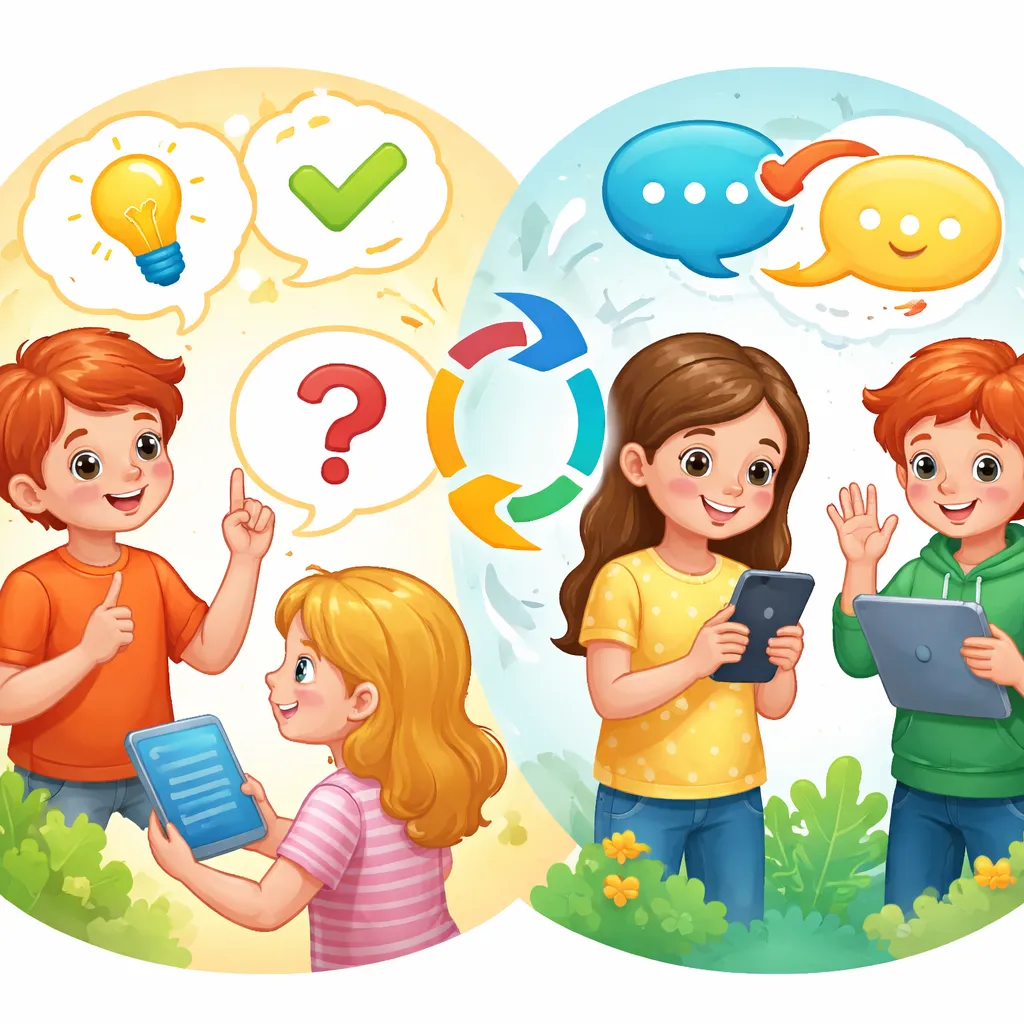

Hello, word explorer! Have you ever raised your hand in class? The teacher asks something. You give an answer. Or, you send a text to a friend. You wait for their reply. They both seem to mean a response. But are they the same? They are like two different types of return passes in a game. One is a direct throw to the basket. One is a gentle toss back. Let's find out! Today, we explore the word friends "answer" and "reply". Knowing their secret is a superpower. It makes your communication clear and confident. Let's start our responsive adventure!
First, let's be Response Detectives. Listen at home. Here are two sentences. "Can you answer the phone, please?" "I sent an email and got a quick reply." They both involve responding. A phone. An email. Do they sound the same? One feels more direct and complete. One feels more like a return message. Can you sense it? Great observation! Now, let's examine the response.
Adventure! Inside the World of Responses
Welcome to the world of responses! "Answer" and "reply" are two different return passes. Think of "answer" as a direct, powerful throw to the hoop. It aims to solve or complete something. Think of "reply" as a gentle, accurate toss back to a partner. It continues the exchange. Both are about responding. But they respond in different ways. Let's learn about each one.
The Direct Throw vs. The Gentle Toss Think about the word "answer". "Answer" feels like a direct, powerful throw. It is a response that solves a question, a problem, or a need. It is often complete and final. Answer a question. Answer the door. The answer to 2+2 is 4. It provides a solution. Now, think about "reply". "Reply" feels like a gentle, accurate toss back. It is a response to a message or a statement. It continues a conversation. Reply to a letter. Reply to a comment. He replied with a smile. "Answer" is the solving throw. "Reply" is the conversational toss. One solves. The other continues.
Solving a Need vs. Continuing a Chat Let's compare their purpose. "Answer" is often used for questions, tests, and calls. It provides what is needed. Can you answer this? The answer is on page five. It closes the loop. "Reply" is often used for messages, letters, and remarks. It is part of a two-way exchange. I replied to her text. He replied to my point. "Answer" can stand alone. "Reply" is part of a dialogue. One is more final. The other is more ongoing.
Their Special Word Partners and Grammar Rules Words have best friends. "Answer" loves to team up with words about questions and problems. Answer the phone. Answer a query. The correct answer. It can be a noun and a verb. "Reply" has its own special teams. It often needs "to" when used as a verb with an object. Reply to an email. In reply to your message. It is common in written communication. Note: We "answer" a question. We "reply to" a question. They are different.
Let's visit a school scene. The teacher asks, "What is the capital of France?" You raise your hand and answer, "Paris." This is a direct response to a question. Now, imagine you pass a note to a friend. They write back. They reply to your note. This is a response in a message exchange. Using "reply" for the teacher's question is possible, but "answer" is more common and direct. Using "answer" for the note is okay, but "reply" fits the informal, written response.
Now, let's go to the playground. A friend shouts, "What's the score?" You answer, "It's 3-2!" This gives the needed information. Later, you make a joke. Your friend replies with a laugh. This is a response to your remark. The word "answer" paints the factual response. The word "reply" paints the conversational reaction.
Our Little Discovery So, what did we find? "Answer" and "reply" are both about responding. But they are used in different contexts. "Answer" is often used for responding to questions, problems, or calls. It provides a solution or information. "Reply" is often used for responding to messages, comments, or statements in a conversation. It continues the exchange. You answer a test. You reply to an invitation. Knowing this helps you choose the perfect word.
Challenge! Become a Response Champion
Ready for a fun test? Let's try your new skills!
"The Best Choice" Challenge Let's imagine a nature scene. A bird makes a specific call. Another bird makes the same call. The second bird is... what? Answering or replying? The second bird is answering. It is responding to the call with a matching call. This is a direct response. Now, imagine two dolphins communicating with a series of clicks. One clicks, and the other clicks back. They are replying to each other in a conversation. "Answer" wins for the direct call-and-response. "Reply" is the champion for the ongoing chat.
"My Sentence Show" Your turn to create! Here is your scene: Working on a group project online. Can you make two sentences? Use "answer" in one. Use "reply" in the other. Try it! Here is an example: "I will answer the three questions on the shared document." This focuses on providing solutions. "Please reply to my chat message so I know you saw it." This focuses on responding to a message. Your sentences will show two types of responses!
"Eagle Eyes" Search Look at this sentence. Can you find the word that could be better? Let's check a home context. "I raised my hand to reply the teacher's math problem with the number 42." Hmm. A math problem requires a solution. The word "answer" is the correct choice for providing a solution to a problem. "I raised my hand to answer the teacher's math problem with the number 42." "Reply" would be for responding to something the teacher said, not for solving a problem. Did you spot it? Excellent word work!
Harvest and Action! Turn Knowledge Into Your Superpower
Great exploring! We started thinking "answer" and "reply" were the same. Now we know they are two different response styles. We can use the direct throw of "answer". We can use the gentle toss of "reply". You can now choose your response words with perfect accuracy. This is a great skill for school and friends.
What you can learn from this article: You can now feel that "answer" is often used for responding to questions, tests, or calls by providing information or a solution. You can feel that "reply" is often used for responding to messages, comments, or statements in a written or spoken exchange. You know that you "answer" a ringing phone, but you "reply to" a friend's text. You learned that "answer" can be more final, while "reply" is more conversational.
Life practice application: Try your new skill today! In class, be ready to answer questions. When you get a message, remember to reply to it. Listen to how people use these words. Tell a family member one answer you learned today. Send a reply to a friend. You are now a master of response words! Keep communicating clearly and kindly.