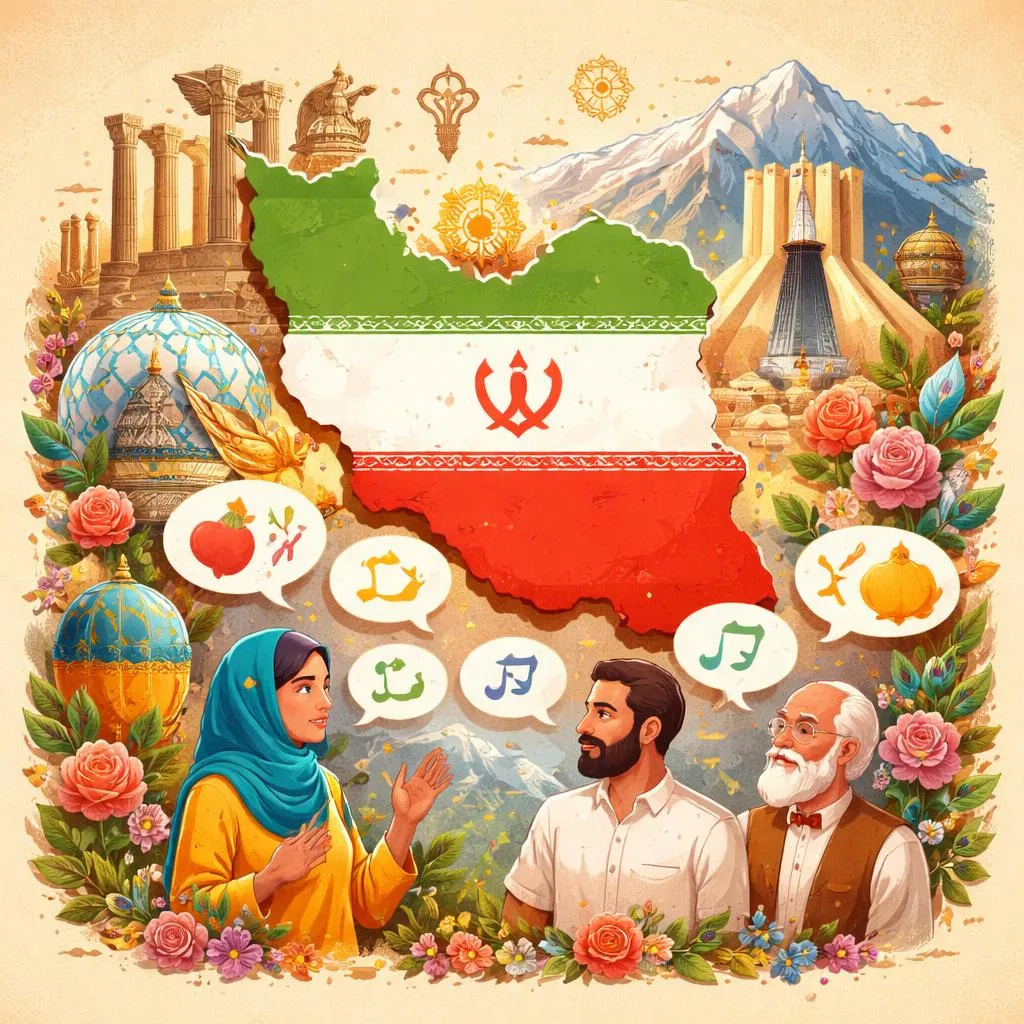

Iran is a linguistically rich country with many languages spoken across different regions. The most prominent language associated with Iran is Persian, also known as Farsi in English, but there are also many other languages from different linguistic families spoken within its borders. 
Persian (Farsi) — The Main Language of Iran
The primary language of Iran is Persian, locally called Farsi (though many scholars prefer the term “Persian” in English). It is the official language of Iran and is spoken by the majority of the population. Persian belongs to the Iranian branch of the Indo-Iranian family, itself a branch of the broader Indo-European language family. 
Persian has a rich literary and historical tradition dating back thousands of years. Ancient forms include Old Persian and Middle Persian, which evolved into modern Persian used today. 
Other Iranian Languages Spoken in Iran
Iran is home to a variety of other languages that are also part of the Iranian language family. Many of these languages share historical roots with Persian but remain distinct in grammar, pronunciation, or vocabulary. 
Kurdish – Spoken by Kurdish communities mainly in western Iran. It has multiple dialects and is widely used in Kurdish regions. 
Luri and Bakhtiari – Languages related to Persian spoken by the Lur and Bakhtiari peoples in southwestern Iran. 
Gilaki and Mazandarani – Caspian languages spoken near the Caspian Sea, each with its own distinct sound system. 
Balochi – Spoken in southeastern Iran, especially in the region known as Baluchistan. 
Talysh – A Northwestern Iranian language spoken in the north of Iran near the Caspian Sea. 
Laki – A Kurdish variety spoken in western Iran. 
There are also lesser-known Iranian language varieties such as Achomi and Bashkardi spoken in specific regions. 
Non-Iranian Languages Spoken in Iran
In addition to Iranian languages, several non-Iranian languages are spoken in Iran due to its ethnic diversity. 
Azerbaijani (Azeri) – A Turkic language spoken by a large minority in northwest Iran; it is similar to Turkish. 
Arabic – Spoken by small communities, especially in southwestern provinces near Iraq and the Persian Gulf. 
Turkmen – Another Turkic language used by Turkmen minorities. 
Other minority languages include Armenian, Assyrian Neo-Aramaic, and more, reflecting Iran’s cultural mosaic. 
How Languages Are Used in Iran
• Persian is the official language used in government, education, media, and literature. 
• Minority and regional languages are spoken at home and in local communities. 
• Arabic is also important for religious studies since it is the language of the Qur’an. 
Why This Matters
Understanding the languages of Iran helps appreciate its cultural and historical diversity. While Persian is the dominant and official language, the country truly contains a linguistic mosaic with many languages representing different ethnic and regional identities. 
The History of the Persian Language
The Persian language has a long and continuous history. It developed through several historical stages known as Old Persian, Middle Persian, and Modern Persian.
Old Persian was used during the time of the ancient Persian empires, including the Achaemenid Empire. Inscriptions from this period were written in cuneiform script and carved into stone.
Middle Persian developed later during the Sassanian Empire. During this time, the language changed in grammar and pronunciation, and a different writing system was used.
Modern Persian began to take shape after the Arab conquest of Persia in the 7th century. The Arabic script was adopted and adapted to write Persian. Several additional letters were added to represent Persian sounds that do not exist in Arabic.
Persian and Farsi
In English, the language is usually called Persian. Inside Iran, it is called Farsi. The word “Farsi” comes from “Pars,” the ancient name of a region in southern Iran.
In international contexts, “Persian” is often preferred because it connects the modern language with its historical tradition and classical literature.
Persian Beyond Iran
Persian is not spoken only in Iran. Closely related varieties are spoken in neighboring countries.
In Afghanistan, the language is called Dari.
In Tajikistan, it is called Tajik.
Dari and Tajik are mutually intelligible with Iranian Persian, although pronunciation, vocabulary, and script may differ. Tajik, for example, is written in the Cyrillic alphabet rather than the Arabic-based script.
These varieties show how one language can develop regional forms while remaining connected.
The Writing System
Modern Persian uses a modified version of the Arabic alphabet. It is written from right to left.
Four additional letters were added to the Arabic script to represent Persian sounds:
پ
چ
ژ
گ
These letters allow Persian to represent sounds that Arabic does not have.
Short vowels are usually not written in everyday text, which means readers rely on context and experience to understand pronunciation.
Persian Vocabulary
Persian vocabulary reflects its long history of contact with other cultures.
Many words come from Arabic due to historical and religious influence.
Some words have Turkish origins.
In modern times, French and English have also contributed loanwords.
Despite borrowing, Persian grammar remains structurally different from Arabic. Persian is an Indo-European language, while Arabic belongs to the Semitic language family.
Grammar Features
Persian grammar is relatively straightforward compared to many other languages.
Nouns do not have grammatical gender.
There are no articles like “a” or “the” in the same way as English.
Verb conjugation changes according to tense and person.
Word order is generally subject-object-verb.
For example, a literal word order might be:
“I book read.”
This differs from English word order.
Cultural Importance
Persian has a rich literary tradition. Famous poets such as Rumi and Hafez wrote influential works that are still widely read today.
Persian poetry is known for its depth, symbolism, and rhythm. It has influenced literature far beyond Iran’s borders.
The language has also played an important role in philosophy, science, and art throughout history.
Linguistic Diversity in Iran
Although Persian is the official language of Iran, many citizens grow up bilingual or multilingual.
Regional languages such as Kurdish, Balochi, Luri, and Gilaki are spoken in daily life in different provinces. Azerbaijani Turkish is also widely spoken in northwestern regions.
This diversity makes Iran one of the most linguistically varied countries in the region.
Why Understanding Iranian Languages Matters
Learning about languages from Iran helps clarify that “Iranian” refers to a branch of languages, not just one language.
Persian is the main official language, but it exists within a broader family of Iranian languages that share historical roots.
Studying these languages provides insight into history, migration, cultural exchange, and the development of writing systems across centuries.
Iran’s linguistic landscape reflects thousands of years of civilization, trade, literature, and cultural interaction.