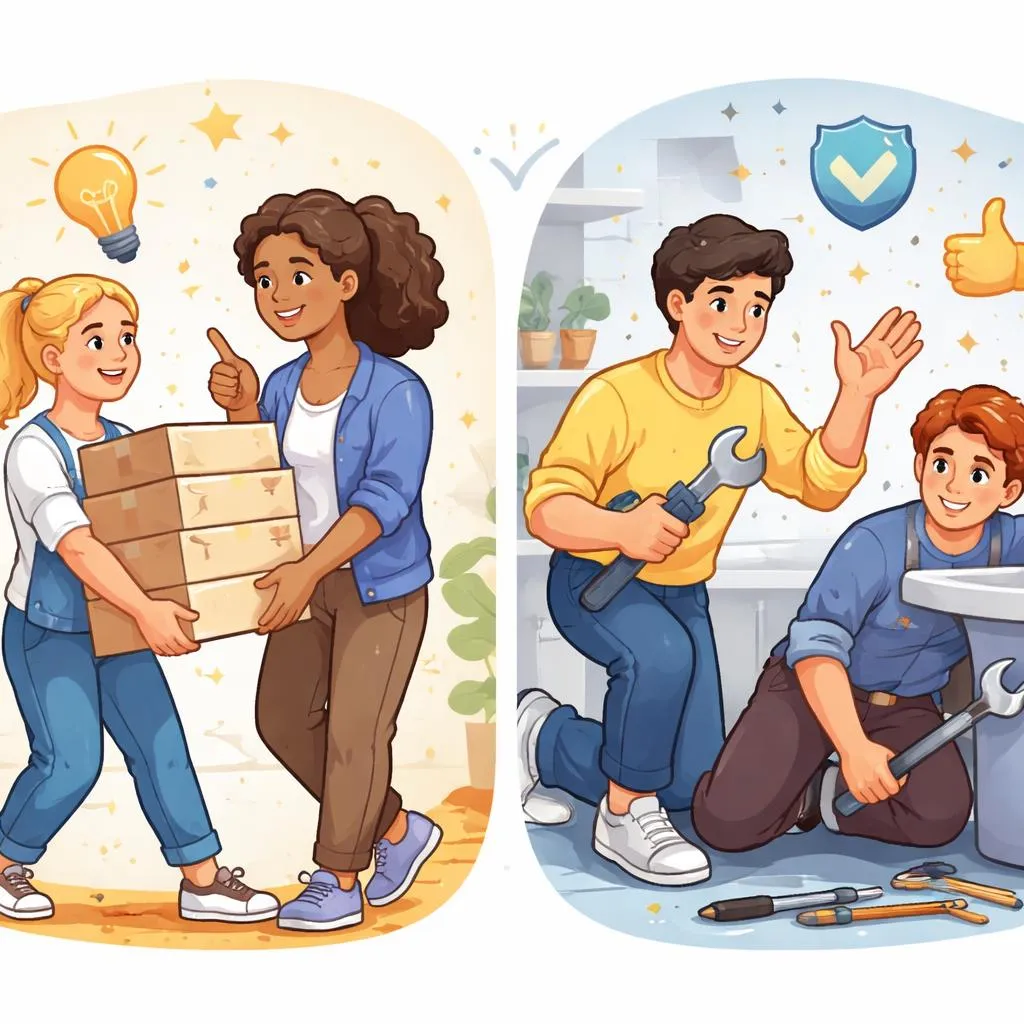

A child needs help. They worry about bothering you. "Is this too hard for you?" they ask. Two phrases answer the worry. "It's easy." "No trouble." Both mean "I can help. Do not worry."
But these phrases feel different. One talks about the task. One talks about the helper's feelings. Children hear both. Understanding the difference helps them feel safe asking for help.
This article helps families explore these reassuring phrases. Your child will learn when helpers say "it's easy" and when they say "no trouble."
What Do These Expressions Mean?
"It's easy" means "this task requires very little effort or skill from me." The phrase focuses on the difficulty of the task. It says "this is not hard for me to do."
For a child, think of this like tying a shoe. An adult says "it's easy." They mean "this is a simple task for me. I have done it thousands of times."
"No trouble" means "helping you does not cause me any inconvenience or burden." The phrase focuses on the helper's experience. It says "you are not bothering me."
For a child, think of this like helping find a lost toy. An adult says "no trouble." They mean "I do not mind looking. You are not a bother."
These two expressions seem similar because both reassure a worried child. Both say "I can help." Both remove guilt.
But one talks about the task's difficulty. One talks about the helper's feelings.
What's the Difference?
The main difference lies in what the phrase describes. "It's easy" describes the task. "No trouble" describes the helper's willingness.
One is about the job. One is about the helper.
"It's easy" sounds like a statement about the activity. The task requires low effort. The helper has the skill. The difficulty level is low.
"No trouble" sounds like a statement about the helper's attitude. The helper does not feel burdened. The help is given freely. The child is not a bother.
Another difference involves the child's worry. If the child worries about the task being hard, say "it's easy." If the child worries about being a bother, say "no trouble."
Also, "no trouble" is often used to respond to thanks. "Thank you for helping." "No trouble at all."
So remember: it's easy = the task requires little effort. no trouble = you are not a burden.
When Do We Use Each One?
Use "it's easy" when a child worries about the difficulty of the task. Use it when the child thinks something is too hard. Use it to build confidence.
For example, a child struggles with a zipper. They say "this is too hard." You say "it's easy for me. Let me show you." You address the difficulty.
Use "it's easy" for tasks that truly are simple for you. Buttoning a shirt. Opening a jar. Reading a sign.
Use "no trouble" when a child worries about bothering you. Use it when they say "sorry to ask." Use it after they thank you. Use it to remove guilt.
For example, a child asks for help in the middle of your work. They say "sorry to interrupt." You say "no trouble. I am happy to help." You address their worry about being a burden.
Use "no trouble" when the task might be hard, but you do not mind. Even if it takes effort, the child is not a bother.
Also use "no trouble" to respond to thanks. "Thank you for driving me." "No trouble. I enjoy our time in the car."
Remember: worry about task difficulty = "it's easy." Worry about being a burden = "no trouble."
Example Sentences for Kids
Here are simple sentences for "it's easy":
It's easy for me to reach the top shelf. Let me get that for you.
(This addresses a task that requires height.)
You think spelling this word is hard? It's easy once you know the rule.
(This addresses difficulty of a learning task.)
It's easy to fix this broken toy. I just need some glue.
(This addresses repair difficulty.)
Here are simple sentences for "no trouble":
No trouble at all. I was not busy anyway.
(This reassures a child who thinks they interrupted.)
You do not need to say sorry. Helping you is no trouble.
(This removes guilt about asking for help.)
Thank you for asking me. It is no trouble to explain it again.
(This responds to thanks while reassuring.)
Notice how "it's easy" talks about the task's difficulty. "No trouble" talks about the helper's willingness.
Common Mistakes to Avoid
Many people say "it's easy" when the child's worry is about being a burden. This misses the point. A child says "sorry to bother you." You say "it's easy."
Incorrect: Child worries about bothering. "It's easy."
Correct: "No trouble at all. You are never a bother."
The child's worry is about being a burden. Address that worry directly.
Another mistake: using "no trouble" for tasks that are actually hard. This can confuse a child. A task takes a long time. You say "no trouble." The child sees you struggling.
The child may stop believing you. Be honest. "This is a little hard, but helping you is no trouble." Truth builds trust.
A third mistake: forgetting that both phrases can dismiss a child's real difficulty. If a child finds something truly hard, saying "it's easy" can make them feel bad.
Instead say "it might be hard for you now, but it gets easier with practice." Validate the child's experience first. Then offer help.
Easy Memory Tips
Here is a fun trick for kids. Think of a feather and a smile.
"It's easy" = a feather. The task is light like a feather. It does not weigh much. It is easy to lift. The feather is about the task.
"No trouble" = a smile. A smile shows you are happy. Helping makes you smile. The child is not a trouble. The smile is about the helper's feeling.
Another memory tip: look at the words. "Easy" talks about the task. "Trouble" talks about bother. One is about the job. One is about the helper.
Draw a simple picture. Draw a feather next to "it's easy." Draw a smiling face next to "no trouble." The images help children feel the difference.
Also try this question: "Is the child worried about the task being hard or about being a bother?" If task hard, say "it's easy." If being a bother, say "no trouble."
Quick Practice Time
Try these easy exercises with your child. Fill in the blank with "it's easy" or "no trouble."
Your child struggles to open a jar. They hand it to you. You say "________________. I have strong hands."
Your child asks for help during your favorite TV show. They say "sorry to interrupt." You say "________________. The show can wait."
Your child says "this math problem looks impossible." You say "________________ once you learn the trick."
Your child thanks you for driving them to practice. You say "________________. I like watching you play."
Answers:
It's easy (task difficulty of opening a jar)
No trouble (child worries about interrupting)
It's easy (math problem difficulty)
No trouble (responding to thanks, showing willingness)
Now practice using both phrases at home. When your child worries about a task being hard, say "it's easy" and then show them how. When your child worries about being a bother, say "no trouble" with a warm smile. Your child will learn that some help is easy and all help is no trouble when given with love.
Wrap-up
Use "it's easy" to reassure a child that a task requires little effort or skill from the helper. Use "no trouble" to reassure a child that asking for help does not bother the helper at all. Both say "I can help," but one describes the task while one describes the heart.