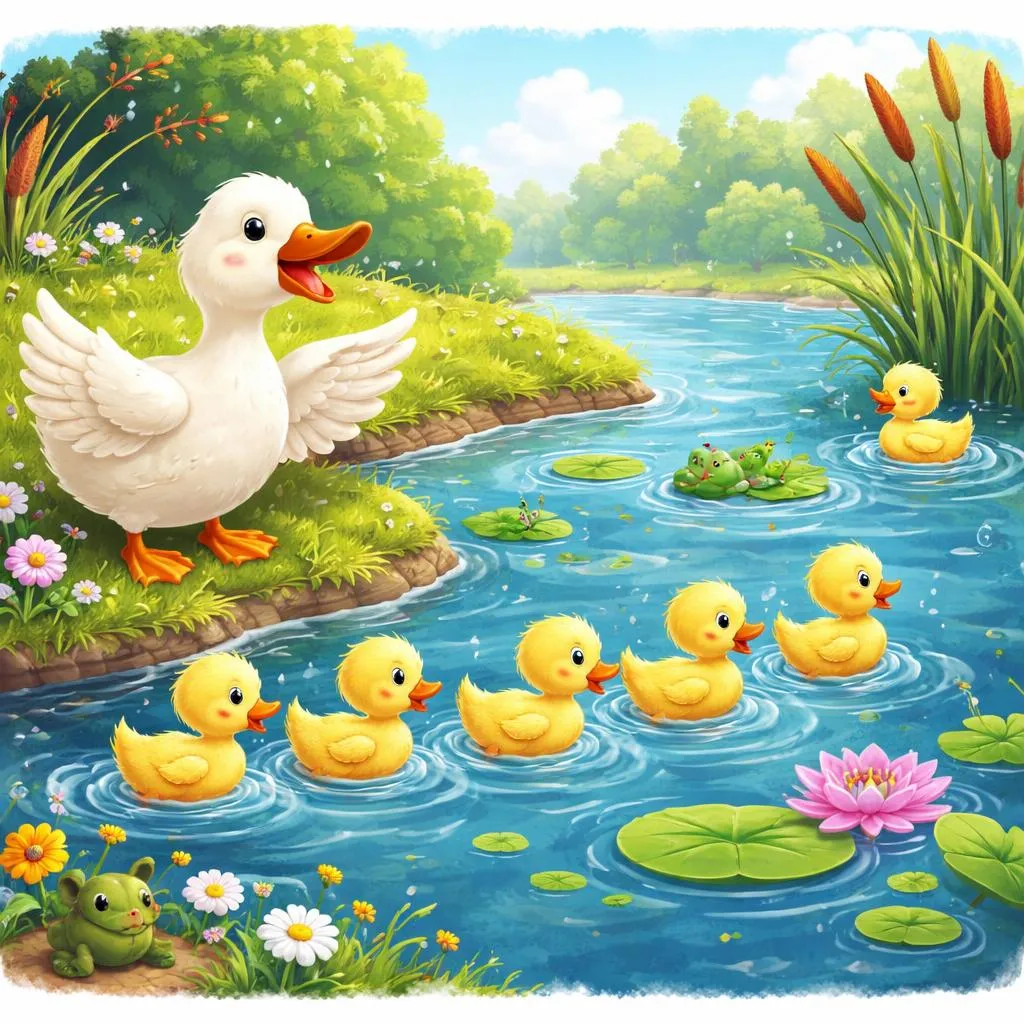

Some songs capture children's hearts and never let go. "Five Little Ducks" is one of these timeless treasures. It tells a simple story of ducks going out to play. One by one, they do not come back. Mother Duck calls for them. Finally, all five return. The lyrics to 5 little ducks teach counting backward, animal names, and family love. The song builds number skills, vocabulary, and emotional understanding all at once. Children learn that sometimes things come back after being away. Let us discover how to use this classic counting song in the young learners' classroom.
What Is the Five Little Ducks Rhyme?
"Five Little Ducks" is a traditional children's song. It has been sung for many generations. The song tells about five little ducks who go out to play. They wander away one by one. Mother Duck calls them back. Each time, fewer ducks return. Finally, all five come back home.
The song is cumulative and subtractive. Each verse removes one duck. This structure helps children learn counting backward. They see numbers decrease by one each time.
The song has a gentle, waddling rhythm. Children can act out the actions. They pretend to be ducks. They waddle and quack. This physical involvement makes the song memorable.
The song teaches several important concepts. Children practice counting from five down to one and back to five. They learn the concept of subtraction and addition. They develop listening skills. They build vocabulary about animals and family. All of this happens while having fun.
The Complete Lyrics to 5 Little Ducks
Here is the most common version of this classic song.
Five little ducks went out one day,
Over the hills and far away.
Mother Duck said, "Quack, quack, quack, quack,"
But only four little ducks came back.
Four little ducks went out one day,
Over the hills and far away.
Mother Duck said, "Quack, quack, quack, quack,"
But only three little ducks came back.
Three little ducks went out one day,
Over the hills and far away.
Mother Duck said, "Quack, quack, quack, quack,"
But only two little ducks came back.
Two little ducks went out one day,
Over the hills and far away.
Mother Duck said, "Quack, quack, quack, quack,"
But only one little duck came back.
One little duck went out one day,
Over the hills and far away.
Mother Duck said, "Quack, quack, quack, quack,"
But no little ducks came back.
Sad Mother Duck went out one day,
Over the hills and far away.
Mother Duck said, "Quack, quack, quack, quack,"
And all five little ducks came back.
This simple story has a happy ending. All the ducks return to their mother.
Vocabulary Learning from the Song
The song introduces rich vocabulary about ducks, numbers, and actions. Children learn these words in a memorable musical context.
Duck: A bird that lives near water. Ducks have webbed feet and flat bills. They say "quack."
Little: Small in size. The ducks are little compared to their mother.
Went out: Left the home or place. The ducks went out to explore.
One day: On a particular day. This phrase starts the story.
Over the hills: Across the hills, far away. This shows the ducks traveled far.
Far away: A long distance from here. The ducks went to a distant place.
Mother Duck: The mother of the little ducks. She cares for them.
Said: Spoke. Mother Duck says "quack" to call her children.
Quack: The sound a duck makes. Mother Duck uses this sound to call her babies.
Came back: Returned. The ducks come back to their mother.
Sad: Feeling unhappy. Mother Duck is sad when her babies don't return.
All: Every one. All five ducks come back at the end.
Use these words in other contexts. Talk about ducks if you see them at a pond. Practice the "quack" sound. Discuss feelings like sadness and happiness.
Phonics Points in the Song
The song offers excellent phonics practice. The rhyming and repetition highlight specific sounds.
The "ack" sound:
Quack and back rhyme. This word family includes black, pack, sack, and track. Children can generate more words with this pattern.
The "ay" sound:
Day and away rhyme. This word family includes play, say, lay, and stay. The long "a" sound is common in English.
The "uck" sound:
Duck contains this sound. This word family includes luck, truck, stuck, and cluck. Children feel the "uck" in their mouths.
The "ill" sound:
Hills contains this sound. This word family includes bill, fill, hill, and sill. The short "i" sound appears in many words.
The "ad" sound:
Sad contains this sound. This word family includes bad, dad, had, and mad. Children hear the short "a" sound.
Syllable counting:
Clap the syllables in key words. Lit-tle has two claps. Ducks has one. Moth-er has two. This builds phonemic awareness.
Initial sounds:
Duck starts with D. Mother starts with M. Hills starts with H. Quack starts with Q, a less common letter. Practice saying the first sound of each word.
Rhyming words:
The song is full of rhymes. Day and away. Quack and back. Recognizing rhymes is a key reading skill.
Grammar Patterns in the Lyrics
The song demonstrates several grammar patterns. Children absorb these through repetition.
Number words:
Five, four, three, two, one, no, all. The song teaches counting forward and backward. Children learn that "no" means zero in this context.
Past tense verbs:
Went, said, came. The song uses past tense to tell the story. Went and came are irregular. Children hear these common irregular forms.
Prepositional phrases:
Over the hills, far away. These phrases tell where the ducks went. Children learn common prepositions.
Subject-verb agreement:
"Five little ducks went" uses plural. "One little duck went" uses singular. Children see agreement in action.
Adjectives before nouns:
Little ducks, sad mother. The adjective comes before the noun. Children internalize this word order.
Direct speech:
Mother Duck said, "Quack, quack, quack, quack." Children learn how to show someone speaking.
Conjunctions:
"And" connects the final verse. "But" shows contrast in earlier verses. "But only four little ducks came back" shows that something unexpected happened.
The song provides rich language input. Children do not need to analyze the grammar. They absorb it through joyful repetition.
Learning Activities with the Song
Songs become powerful teaching tools when we add activities. Here are ideas for using the lyrics to 5 little ducks in the classroom.
Duck Puppets: Create simple duck puppets from yellow paper or socks. Make five little ducks and one mother duck. Children use them to act out the song. Each time a duck doesn't return, they put one puppet away.
Duck Pond Dramatic Play: Set up a blue blanket or paper for the pond. Add five little duck toys. Children act out the song, moving the ducks "over the hills and far away" and bringing them back.
Counting Backwards Practice: Use the song to practice counting backwards from five. Hold up five fingers as you sing. Put one finger down each time a duck doesn't return.
Duck Mask Craft: Make simple duck masks from paper plates. Add yellow paint and a orange paper bill. Children wear them while singing and acting out the song.
Mother Duck Role Play: One child plays Mother Duck. Others are the little ducks. Mother Duck calls "quack, quack" and the little ducks waddle back. This builds social skills and fun.
Duck Number Line: Create a number line with duck pictures. Five ducks, then four, then three, then two, then one. Children point to the numbers as they sing.
Feelings Discussion: Talk about how Mother Duck feels when her babies don't return. Discuss how the little ducks feel when they come back to a happy mother. This builds emotional vocabulary.
Printable Materials for Classroom Use
Having printable resources makes lesson planning easier. Here are materials to prepare for this song.
Lyric Poster: Create a large poster with the full lyrics. Add simple illustrations of ducks going over hills. Display it during singing time. Children can follow along.
Duck Counting Cards: Create cards with numbers one through five. On each card, show that many ducks. Children arrange them in order and sing the corresponding verse.
Duck Puppet Templates: Provide templates for making duck puppets. Children color, cut out, and attach to craft sticks. Use them during the song.
Duck Pond Scene: Create a printable scene with hills and a pond. Children cut out duck pictures and move them as they sing. One by one, the ducks go over the hills.
Coloring Pages: Design coloring pages showing the ducks and mother duck. Children color while listening to the song. Add the number words for tracing.
Number Tracing Pages: Create pages for tracing numbers five through one. Include the number word. Children trace and then draw that many ducks.
Word Cards: Make flashcards for key words. Duck, mother, little, hills, far, away, quack, back. Use pictures on one side and words on the other.
Educational Games for Deeper Learning
Games make learning joyful. Here are games centered around the lyrics to 5 little ducks.
Duck Hide and Seek: Hide five little duck pictures around the room. Children search for them. As they find each duck, they sing the corresponding verse. "Four little ducks went out one day..."
Duck Counting Game: Place five duck toys in a row. Children close their eyes. Remove one duck. They open their eyes and say how many ducks are left. This builds subtraction skills.
Duck Memory Match: Create pairs of duck cards with different numbers of ducks. Children play memory match, finding ducks with the same number.
Mother Duck Says: Play a variation of Simon Says. "Mother Duck says waddle." "Mother Duck says quack." "Fly away" (if Mother Duck didn't say it, children shouldn't move).
Duck Pond Hop: Place number cards around the room. Children hop from number to number in order from five to one. They say each number as they land.
Duck Subtraction Stories: Use the duck puppets to tell subtraction stories. "Five ducks were on the pond. One flew away. How many are left?" Children act out and answer.
Duck Addition at the End: After all ducks return, practice addition. "No ducks were home. Then one came back. Then another. How many now?" This leads to the happy ending.
Connecting to Math Concepts
The song naturally leads to math learning. Here are ways to extend math connections.
Counting backwards: Practice counting backwards from other numbers. Ten, nine, eight. Three, two, one. Blast off! This builds number sense.
Subtraction as taking away: The song shows subtraction in action. Start with five, take away one, get four. Use objects to demonstrate this concept.
One less: Each verse has one less duck. Discuss what "one less" means. If you have four and take one, you have three.
Zero concept: The song has a verse with no ducks. Discuss what zero means. It means none. Nothing left.
Addition at the end: All five ducks return. This shows addition. Zero plus five equals five. Children see numbers increasing.
Number recognition: Write the numbers as you sing. Children see the symbols for five, four, three, two, one, zero.
Counting objects: Give children five small objects. As you sing, they remove one each time. They see the quantity decreasing.
Connecting to Science Learning
The song also connects to science concepts about animals and nature.
Duck habitats: Ducks live near water. They need ponds, rivers, or lakes. Discuss where ducks live and what they need.
What ducks eat: Ducks eat plants, insects, and small fish. They dip their heads underwater to find food.
Duck families: Mother ducks care for their babies. Ducklings stay close to their mother for protection. Discuss animal families.
Feathers and floating: Ducks have waterproof feathers. They float on water. Discuss how feathers keep ducks dry.
Migration: Some ducks fly to warmer places in winter. This connects to "over the hills and far away."
Duck sounds: Ducks quack. Male and female ducks make different sounds. Listen to recordings of real duck sounds.
Connecting to Emotional Learning
The song offers opportunities to discuss feelings.
Mother Duck's feelings: How does Mother Duck feel when her babies don't return? Sad, worried, lonely. Discuss these feelings.
The ducklings' feelings: Why might the ducklings not come back? Are they having fun exploring? Did they get lost? Discuss possibilities.
The happy ending: How does Mother Duck feel when they all return? Happy, relieved, joyful. Celebrate this happy moment.
Separation and reunion: Many children experience separation from parents. The song shows that loved ones come back. This can be comforting.
Helping others: Mother Duck goes to find her babies. She doesn't give up. Discuss how we help people we love.
The lyrics to 5 little ducks carry generations of childhood joy. Children learn to count backward from five. They hear rhyming words and rhythmic patterns. They act out waddling ducks and quacking mothers. They feel sad when the ducks don't return and happy when they come back. The simple story of a duck family becomes a vehicle for rich learning. Through this song, children develop number sense, vocabulary, and emotional understanding. They build memory and coordination. And they do it all while having fun.