
What Is This Animal?
A sea lion is a marine mammal with a streamlined body and visible ears. It has long front flippers that help it swim fast. On land, sea lions can walk. They turn their back flippers forward. This allows them to move with more ease than seals.
Sea lions are related to seals and walruses. They belong to the group called eared seals. Their small external ears are easy to see. They have thick fur and a layer of blubber for warmth. Their bodies are built for speed in water.
These animals live along coastlines. They are found in the Pacific Ocean, from Alaska to Australia. They gather on beaches, rocks, and docks. They form large groups called colonies. Sea lions are social and noisy. They bark loudly to communicate.
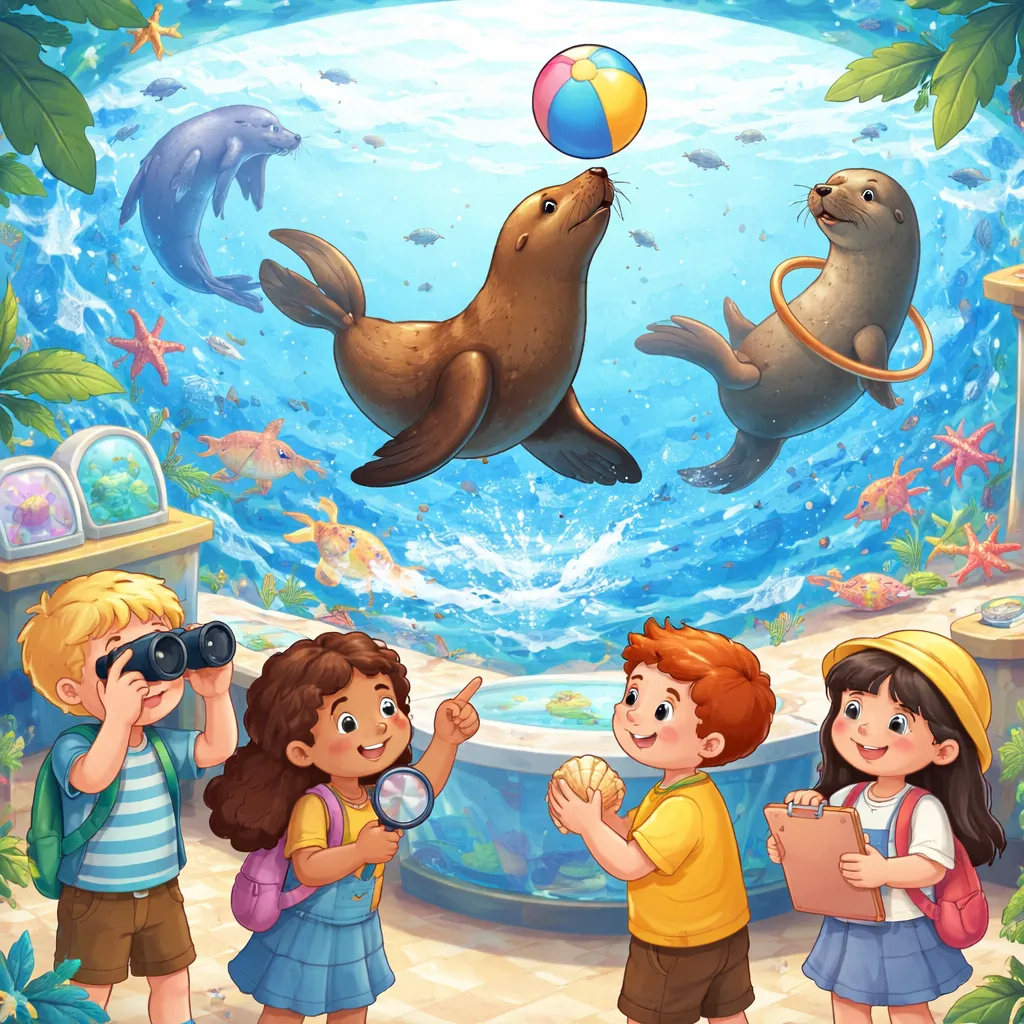
For children, sea lions are entertaining. They balance balls, clap their flippers, and leap from water. Their playful nature makes them favorites at zoos and aquariums. Learning about sea lions teaches children about marine life, social behavior, and adaptation.
English Learning About This Animal
Let us learn the English words sea lion. We say it like this: /siː ˈlaɪən/. Sea sounds like “see.” Lion sounds like “lie-un.” Put them together: sea lion. Say it three times. Sea lion. Sea lion. Sea lion.
Now let us learn words about a sea lion’s body. The flippers are long front limbs for swimming and walking. The ears are small external flaps. The whiskers are stiff hairs called vibrissae. The blubber is the thick fat layer under the skin. The fur is short and dense. The bark is the loud call sea lions make.
There is a wise saying about sea lions. Naturalists observe, “The sea lion barks like a dog but swims like a fish.” This highlights their dual nature. Another saying is, “A sea lion’s grace in water matches its clumsiness on land.” This reminds us that everyone has strengths and challenges.
These English words help children understand sea lion anatomy. When they say flippers, they learn how sea lions move. When they say bark, they know the sound. Parents can practice these words while watching sea lions at an aquarium. Point to the parts. Say the words together.
Animal Facts and Science Knowledge
Sea lions belong to the family Otariidae. They are eared seals. There are several sea lion species. The California sea lion is the most familiar. Steller sea lions are much larger. Males can weigh over 2,000 pounds. Females are smaller.
Sea lions live along coastlines. They prefer rocky shores, sandy beaches, and man-made docks. They spend time in water hunting. They come onto land to rest, breed, and raise young. They are found in the Pacific Ocean from Alaska to South America and across to Australia.
Sea lions are carnivores. They eat fish, squid, and octopus. They hunt in water. They can dive deep to find food. They use their whiskers to detect movement. They swallow small fish whole. They tear larger prey with their teeth.
Sea lions have special abilities. They can swim up to twenty-five miles per hour. They can dive for up to twenty minutes. They can turn their back flippers forward to walk on land. Their front flippers are powerful for swimming. They have excellent vision both in and out of water.
Sea lions are very social. They live in large colonies. During breeding season, males establish territories. They bark loudly to warn other males. Females give birth to one pup each year. Pups can swim within hours of birth. Mothers recognize their pups by smell and sound.
How to Interact With This Animal Safely
Sea lions are wild animals. They are not pets. In the wild, keep a safe distance. Do not approach sea lions on beaches or rocks. They may bite if threatened. They can move faster on land than they appear. Stay at least fifty yards away.
Teach children not to feed wild sea lions. Feeding changes their natural behavior. It can make them dependent on people. It can also make them aggressive. Wild sea lions need to hunt for themselves.
If you see a sea lion pup alone, do not touch it. The mother is likely nearby hunting. She will return. Human scent may cause her to abandon the pup. Call a wildlife rescue if the pup seems injured or alone for a long time.
In zoos and aquariums, sea lions are trained. Follow all rules. Do not tap on glass. Do not throw objects into their pool. Enjoy the shows and exhibits. Watch how they swim and interact. This is a safe way to see sea lions up close.
Sea lions sometimes gather on docks and boats. Do not approach them. They are resting. Give them space. If a sea lion is in an area where people need to pass, wait or go another way. Respect their need for rest.
What Can We Learn From This Animal
Sea lions teach us about playfulness. They leap, chase, and balance. Children learn that play is important for learning and joy. Playing helps us stay active and happy.
Sea lions teach us about family. Mothers care for their pups. Colonies work together. Children learn that families and communities support each other. Helping family, sharing, and staying together make us strong.
Sea lions teach us about adaptation. They are graceful in water and clumsy on land. Yet they thrive. Children learn that everyone has strengths and weaknesses. Playing to our strengths and accepting challenges is part of life.
Sea lions teach us about communication. They bark, posture, and use sounds. Children learn that communicating clearly helps us connect. Using words, listening, and showing feelings help us share with others.
Fun Learning Activities
Let us make learning about sea lion fun. One activity is the sea lion balance game. Ask your child to balance a soft ball on their nose like a sea lion. Clap flippers together. Bark like a sea lion. Say “sea lion balances” and “sea lion claps.”
Another activity is drawing a sea lion. Look at pictures of sea lions. Notice the external ears, long front flippers, and whiskers. Draw a sea lion on a rock. Add the flippers and ears. Label the parts. Say the words aloud.
Create a story about a sea lion pup. Ask your child what the pup does. Does it swim with mother? Does it bark at other pups? Does it learn to catch fish? Write a few sentences together. Let your child draw pictures. Read the story aloud.
Make a sea lion craft. Use a small paper cup for the body. Add paper flippers. Add a paper head with ears. Add yarn whiskers. Paint or color the sea lion brown. Move the craft sea lion. Practice saying “sea lion swims” and “sea lion barks.”
Learn about eared seals versus true seals. Compare sea lions to harbor seals. Notice the ears, flippers, and movement on land. Talk about how each animal is adapted to its environment. Use words like “pinniped,” “colony,” and “adaptation.”
Visit an aquarium if possible. Watch sea lion shows. Notice how they swim. Listen to their barks. Count how many are in the pool. Use words like “trainer,” “behavior,” and “marine mammal.”
These simple activities bring learning to life. Children build English vocabulary while playing. They learn science through understanding adaptation. They develop respect through learning about wild animals. Learning about sea lion becomes a journey to the coast. Each moment spent together strengthens language, curiosity, and a growing appreciation for the playful, barking mammals that balance on rocks and swim with grace, teaching us that life is a mix of work and play.