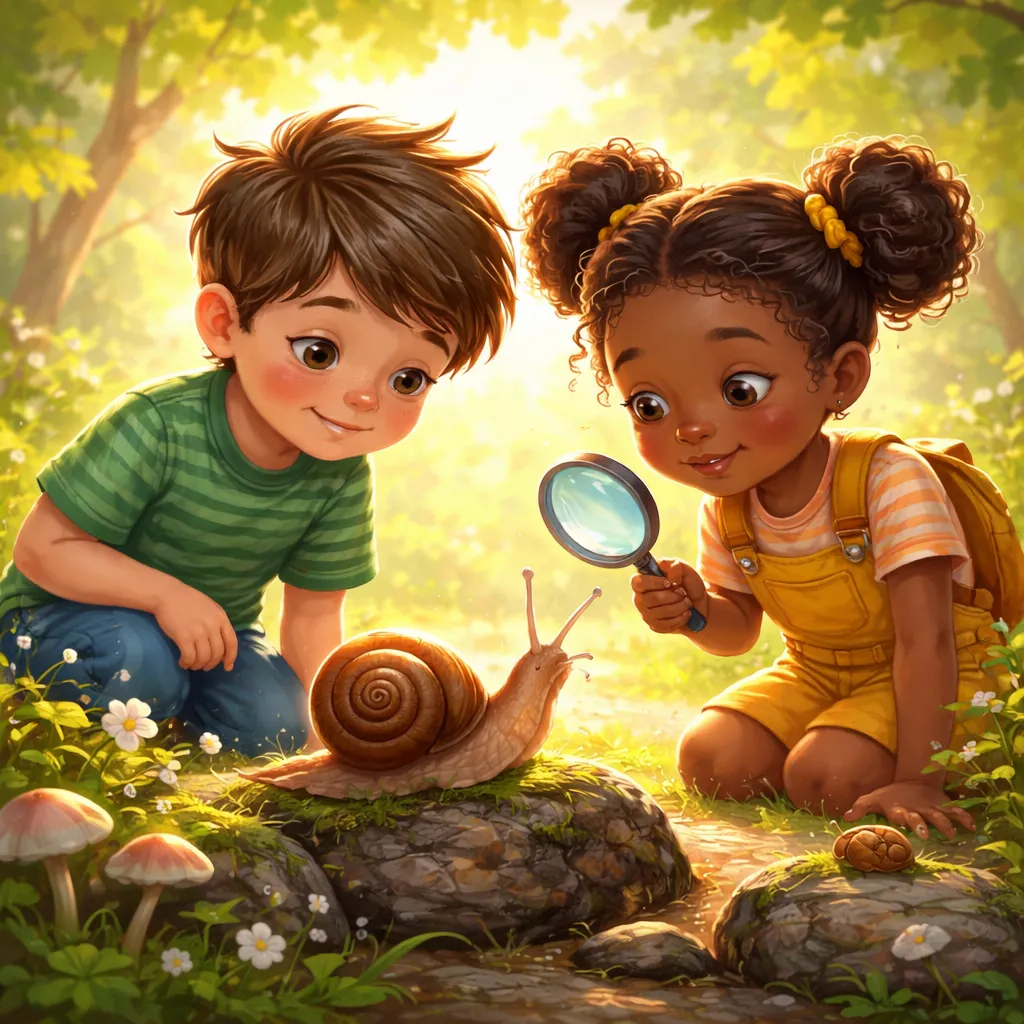

What Is This Animal?
A snail is a small creature with a soft body and a hard shell on its back. It carries its home wherever it goes. The shell protects the snail from danger and dry weather. Snails move slowly. They leave a trail of shiny slime behind them.
Snails belong to a group called mollusks. This group also includes clams and octopuses. Most snails live on land. Some live in fresh water. Others live in the ocean. Land snails have a muscular foot on their underside. This foot moves in waves to push the snail forward.
These creatures like damp places. You find them in gardens, under leaves, and on wet walls. They come out after rain. They hide during hot, dry days. Snails are most active at night or early morning.
For children, snails are gentle and fascinating. Their slow movement lets children watch closely. Their shells come in many colors and patterns. They show us that moving slowly can be a wonderful way to explore the world.
English Learning About This Animal
Let us learn the English word snail. We say it like this: /sneɪl/. The sn sound starts with the tongue on the roof of the mouth. The ai sounds like “ay” in “say.” The l is soft. Say it together: snail. Say it three times. Snail. Snail. Snail.
Now let us learn words about a snail’s body. The shell is the hard spiral home on the back. The foot is the muscular underside that moves the snail. The tentacles are the two pairs of feelers on the head. The long tentacles hold the eyes. The short tentacles sense smell and touch. The mantle is the part of the body that makes the shell.
There is a famous saying about snails. It comes from the story of the tortoise and the hare. People say, “Slow and steady wins the race.” This reminds us that moving slowly with persistence leads to success. Another gentle proverb is, “The snail carries its home with it.” This means we can find comfort within ourselves wherever we go.
These English words help children understand snail anatomy. When they say tentacles, they learn about the special feelers. When they say foot, they understand how the snail moves. Parents can practice these words while watching a snail in the garden. Point to the parts. Say the words together.
Animal Facts and Science Knowledge
Snails belong to the class Gastropoda. This name means “stomach foot.” Snails are mollusks. They have soft bodies. Most snails have a single shell that spirals. The shell grows with the snail. If the shell breaks, the snail cannot repair it. The shell is part of the snail’s body.
Snails live in many habitats. Land snails live in gardens, forests, and meadows. They need damp places. Their bodies dry out easily. They hide under leaves, logs, and rocks during dry weather. Some snails live in deserts. They seal themselves inside their shells until rain comes.
Snails eat plants, algae, and decaying matter. They use a special tongue called a radula. The radula has thousands of tiny teeth. It works like a file. The snail scrapes food into its mouth. Some snails eat other snails. Most land snails are herbivores. They eat leaves, fruits, and flowers.
Snails have special abilities. They produce slime from their foot. The slime helps them glide over rough surfaces. It protects their soft body. The slime also helps them stick to walls and leaves. Snails can sleep for up to three years in dry weather. They seal their shell opening with dried slime.
Snails are hermaphrodites. Each snail has both male and female parts. Two snails mate. Both can lay eggs. Snails lay eggs in damp soil. The eggs are small and round. Baby snails hatch with tiny shells. Their shells grow as they eat and grow.
How to Interact With This Animal Safely
Snails are gentle wild creatures. They are safe to hold and observe. If you find a snail outside, let your child watch it. Notice how it moves. Look at the spiral shell. Watch the tentacles extend and retract. Then leave the snail where you found it.
If your child wants to hold a snail, show them how. Wet your hands first. Dry hands can stick to the snail’s soft body. Let the snail crawl onto your palm. Feel the gentle movement. Watch the foot ripple. Then place the snail back on a leaf or damp soil.
Teach children to be gentle. Snails have soft bodies. Their shells can break if dropped. Do not pull the snail off surfaces. Let it release on its own. Wash hands after touching snails. Their slime is harmless but may leave a residue.
Never take a snail far from where you found it. Snails know their home area. They need the right plants and moisture. If your family wants to observe a snail for a day, place it in a small container with damp soil and fresh leaves. Add air holes. Watch it for one day. Then release it where you found it.
Teach children to protect snail homes. Leave damp leaves and logs in the garden. Do not use chemicals on plants. Snails help break down dead leaves. They are part of a healthy garden. When we care for their homes, we enjoy their gentle presence.
What Can We Learn From This Animal
Snails teach us about patience. They move slowly. They do not rush. Children learn that taking time is okay. Walking slowly, eating slowly, and thinking before speaking are all valuable. Patience helps us notice small wonders.
Snails teach us to carry our home with us. Their shell is always there. Children learn that comfort comes from within. A sense of safety, a loving family, and kind thoughts are like a shell. We carry them wherever we go.
Snails teach us about persistence. They keep moving even when the path is long. Children learn that small steps lead to big results. Learning a new skill, finishing a project, or growing a garden takes many small steps. Each step matters.
Snails teach us to rest when needed. Snails sleep for long periods in dry weather. They know when to stop and wait. Children learn that rest is important. Sleep, quiet time, and taking breaks help us recharge. Rest makes us stronger for the next adventure.
Fun Learning Activities
Let us make learning about snail fun. One activity is the snail crawl game. Ask your child to move slowly on hands and knees. Make a wavy motion like a snail’s foot. Leave a pretend slime trail with yarn or ribbon. Say “snail crawls slowly” and “snail leaves a trail.”
Another activity is drawing a snail. Look at a snail’s spiral shell. Draw the spiral pattern. Add the tentacles and eyes. Label the parts. Say the words aloud. Count how many circles make the shell spiral.
Create a story about a snail’s journey. Ask your child where the snail goes. Does it crawl up a leaf? Does it hide under a log? Does it meet another snail? Write a few sentences together. Let your child draw pictures. Read the story aloud.
Make a snail from craft materials. Use a paper plate for the shell. Decorate it with spiral patterns. Add a body from construction paper. Attach pipe cleaner tentacles with small paper eyes. Move the craft snail slowly. Practice saying “snail glides” and “snail rests.”
Observe a real snail after rain. Go outside together. Look for snails on leaves or walls. Watch one for five minutes. Notice how far it moves. Count its tentacles. Draw what you see in a nature journal. Use words like “foot,” “shell,” and “tentacles.”
These simple activities bring learning to life. Children build English vocabulary while playing. They learn science through observation. They connect with nature in gentle ways. Learning about snail becomes a lesson in slowness and wonder. Each moment spent together strengthens language, curiosity, and a lasting appreciation for the small, shelled travelers that remind us to move gently and carry our home with pride.