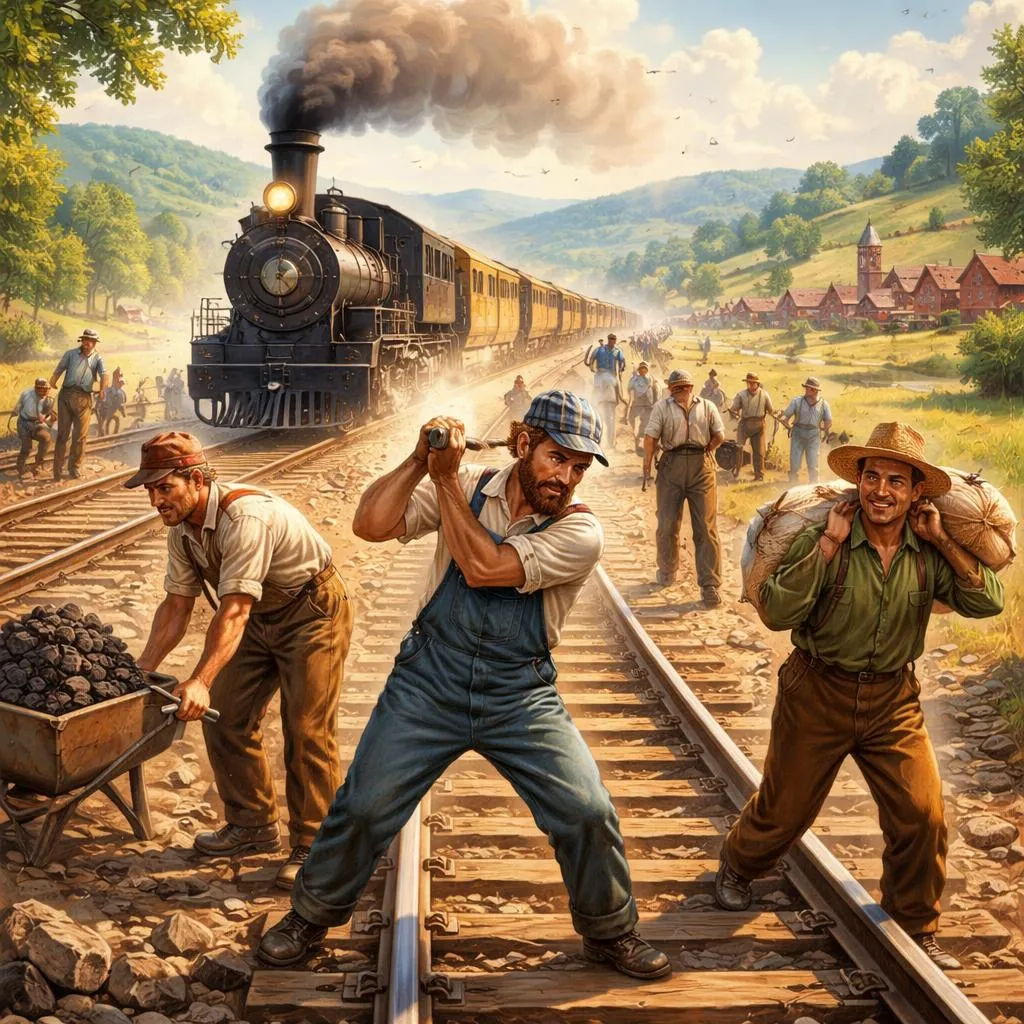

Hello, young learners! Welcome to our music classroom. Today we travel back in time. We explore the i was working on the railroad lyrics. This song is an old American folk tune.
The song tells about a person working on the railroad. They work all day long. They hear the whistle blowing. They think about their life and work. The music has a strong, steady rhythm like a train.
Let us climb aboard the learning train. Let us discover the words and meaning of this classic song. All aboard for English learning.
What is the Rhyme?
The i was working on the railroad lyrics come from America. People sang this song over one hundred years ago. It is a folk song, which means regular people created it and passed it down.
The song describes life working on the railroad. Building and running trains was hard work. Workers spent long days outside. They laid tracks and fixed trains. The song captures this experience.
The tune is lively and easy to remember. Children enjoy singing it. The words repeat in ways that make learning fun. The song also has playful verses about a girl named Dinah.
Some people think the song started with workers building railroads. Others think it began as a minstrel song. Either way, it became popular across America and remains well-known today.
The Lyrics of Nursery Rhymes
Let us read the i was working on the railroad lyrics together. We will say them slowly and clearly.
I've been working on the railroad,
All the live-long day.
I've been working on the railroad,
Just to pass the time away.
Can't you hear the whistle blowing,
Rise up so early in the morn?
Can't you hear the captain shouting,
"Dinah, blow your horn!"
Dinah, won't you blow,
Dinah, won't you blow,
Dinah, won't you blow your horn?
Dinah, won't you blow,
Dinah, won't you blow,
Dinah, won't you blow your horn?
Someone's in the kitchen with Dinah,
Someone's in the kitchen I know.
Someone's in the kitchen with Dinah,
Strumming on the old banjo.
And singing, fee, fie, fiddly-eye-o,
Fee, fie, fiddly-eye-o.
Fee, fie, fiddly-eye-o,
Strumming on the old banjo.
These verses tell a little story. First, the worker describes railroad work. Then someone calls for Dinah to blow the horn. Then we find someone in the kitchen with Dinah, playing music.
Vocabulary Learning
The i was working on the railroad lyrics teach us many useful words. Let us look at each important word.
Working: This means doing a job or task. The person is doing their job on the railroad. Working takes effort and time.
Railroad: This is the track that trains run on. Railroads have metal rails and wooden ties. Trains carry people and goods along railroads.
Live-long day: This means the entire day from morning to night. Live-long is an old way to say whole or entire. The worker works all day.
Whistle: This is a device that makes a loud sound. Trains have whistles to warn people. The whistle blows to signal the train is coming.
Captain: On a railroad, the captain might be the boss or leader. The captain gives orders to workers. The captain tells Dinah to blow the horn.
Dinah: This is a woman's name in the song. Dinah might be a cook or someone who works on the railroad. People call to her throughout the song.
Horn: A horn is an instrument that makes sound. On trains, horns warn people. Dinah has a horn to blow for some reason.
Kitchen: This is a room where food is prepared. Someone is in the kitchen with Dinah, maybe helping cook or just visiting.
Banjo: This is a musical instrument with strings. It has a round body and a long neck. People strum banjos to make music.
Strumming: This means playing a stringed instrument by brushing the strings. Strumming creates rhythm and melody.
Phonics Points
Now let us practice some sounds from the i was working on the railroad lyrics. Phonics helps us read and say words correctly.
Listen to the beginning of "working." It starts with the "w" sound. Round your lips a little. Say "w-w-w." Now say "working." Feel your lips move.
Listen to the "r" sound in "railroad" and "rail." Curl your tongue back a little. Say "r-r-r." Now say "rail." Now say "railroad." Feel the vibration.
Listen to the "wh" sound in "whistle." Put your lips forward. Blow air out. Say "wh-wh-wh." Now say "whistle." This sound asks for air movement.
Listen to the "ch" sound in "kitchen." Say "ch-ch-ch." It is like saying "t" then "sh" quickly. Now say "kitchen." Feel your tongue move.
Listen to the "j" sound in "banjo." Say "j-j-j." It is the same sound as at the beginning of "jump." Now say "ban-jo." Feel the vibration.
Grammar Patterns
The i was working on the railroad lyrics teach us some useful grammar. Grammar is how we put words together in sentences.
We see the past continuous tense. "I was working" shows an action happening over time in the past. The worker did this for a long period. This tense uses was/were plus -ing.
We see questions in the song. "Can't you hear the whistle blowing?" asks if someone hears the sound. "Dinah, won't you blow your horn?" is a polite request.
We see contractions. "I've" is short for I have. "Can't" is short for cannot. "Won't" is short for will not. Contractions make speech flow more smoothly.
We see commands or requests. "Blow your horn" tells Dinah what to do. The word "won't" makes it a polite question, but the meaning is a request.
We see the present tense in the kitchen verse. "Someone's in the kitchen" means right now, someone is there. The apostrophe -s is short for is.
Learning Activities
Let us do some fun activities with the i was working on the railroad lyrics. These help us remember the words and enjoy the music.
Activity 1: Train Rhythm
Create a train rhythm by patting knees. Pat, pat, pat, pat in a steady beat. This sounds like a train moving. Sing the song while keeping the train rhythm. This connects music to movement.
Activity 2: Whistle Sounds
Practice making whistle sounds with voices. Make a high-pitched "wooo wooo" sound like a train. Do this when the song mentions the whistle. This adds sound effects to singing.
Activity 3: Kitchen Play
Act out the kitchen scene. One child is Dinah. Another is in the kitchen with them. Pretend to cook or play a banjo. Use paper plates and bowls for props.
Activity 4: Banjo Craft
Make simple banjos from paper plates and rubber bands. Put rubber bands around a paper plate. Strum them gently. They make sounds like a banjo. Play along with the song.
Printable Materials
We can make printable materials for the i was working on the railroad lyrics. These are sheets to print at home or in class.
Lyric Sheet
Print all the words of the song on one page. Use large, clear letters. Add drawings of trains, tracks, and a banjo. Children follow along while singing.
Coloring Page
Draw a simple train on tracks. Add a worker nearby. Children color the picture. Below, write the words "train" and "worker" for tracing.
Train Number Match
Draw several train cars with numbers on them. 1, 2, 3, 4, 5. On another sheet, draw the same number of tracks next to each number. Children match the trains to the correct track groups.
Word Cards
Print cards with words from the song. Railroad, working, whistle, captain, Dinah, kitchen, banjo, strumming. On the back, draw simple pictures. Practice matching words to pictures.
Story Sequencing Sheet
Print pictures showing the song's scenes. Worker on railroad. Whistle blowing. Captain shouting. Someone in kitchen with Dinah. Playing banjo. Children arrange in order.
Educational Games
Games make learning with the i was working on the railroad lyrics even more fun. Here are some games to play.
Game 1: Train Freeze
Play the song. Children move around like trains. They can chug with arms like wheels. When the music stops, everyone freezes like a train. The last to freeze sits down.
Game 2: Whistle Stop Game
One child is the captain. Others are workers. The captain says "Blow your horn!" and points to a worker. That worker makes a whistle sound. The captain guesses who made the sound.
Game 3: Kitchen Memory
Place items from a kitchen on a tray. Spoon, cup, plate, bowl, napkin. Let children look for one minute. Cover and remove one. Uncover and ask what is missing. This builds memory.
Game 4: Banjo Strum Relay
Divide into teams. Give each team a paper plate banjo. Place a finish line. First person strums the banjo and runs to the line and back. Next person goes. First team finished wins.
Game 5: What Word Is Missing?
Write the lyrics on the board with some words missing. I've been working on the ____. All the live-long ____. Children guess the missing words. This builds memory and reading skills.
Game 6: Train Car Counting
Make train cars from paper. Write numbers on them. Line them up in order. Count together. Then remove one. Ask which number is missing. This combines math with the train theme.
Game 7: Captain Says
Play like Simon Says with a captain. Captain says chug like a train. Captain says blow your whistle. Captain says strum the banjo. Children follow only if "Captain says" comes first.
Game 8: Rhyming Word Match
Find words from the song that rhyme. Day and away rhyme. Morn and horn rhyme. Blow and know rhyme. I-o and banjo sort of rhyme. Make cards and find rhyming pairs.
Game 9: Train Track Drawing
Give children paper and crayons. They draw train tracks going across the page. They add a train on the tracks. They can add workers nearby. Label the parts.
Game 10: Pass the Whistle
Sit in a circle with a small whistle or a whistle sound maker. Play the song softly. Pass the whistle around. Stop the music suddenly. The child holding the whistle must say a line from the song.
Game 11: Dinah's Kitchen Game
Set up a pretend kitchen area. Have toy food and pots. Children take turns being Dinah and the person in the kitchen. They act out cooking while others sing.
Game 12: Train Sound Guessing
Play recordings of different train sounds. Whistle blowing, wheels on tracks, bell ringing, engine starting. Children guess each sound. This builds listening skills.
Game 13: Work Action Game
Call out different work actions from the song and from railroad work. Lay tracks - pretend to put down heavy rails. Shovel coal - make shoveling motions. Blow whistle - make whistle sound. Wave flag - wave hand.
Game 14: Story Drawing
Children draw their favorite part of the song. It could be working on the railroad, the whistle blowing, or the kitchen scene. Share drawings and explain why that part is favorite.
Game 15: Train Line-up
Children line up like train cars. Hold onto the waist of the person in front. Chug around the room while singing the song. The engine leads the way. The caboose is at the end.
Game 16: Memory Chain
Start a memory chain using the song. First person says "I've been working on the railroad." Next says "I've been working on the railroad, all the live-long day." Next adds another line. Continue as long as possible.
Game 17: Instrument Match
Show pictures of different instruments. Banjo, guitar, violin, drum, trumpet. Children find the banjo. Talk about how a banjo sounds different from other instruments.
Game 18: Worker Hat Craft
Make simple worker hats from paper. Use brown or blue paper. Fold into hat shapes. Add a pretend lantern or tool. Wear the hats while singing the song.
The i was working on the railroad lyrics take us back to another time. We learn about hard work and train travel. We meet Dinah in the kitchen. We hear the whistle blowing.
Every time children sing this song, they practice new words. Railroad, whistle, captain, banjo, strumming. They learn about past tense and questions. They feel the steady rhythm like a train.
Keep singing and learning. Keep imagining life on the old railroads. English comes alive through songs like this one. All aboard for more learning adventures, everyone