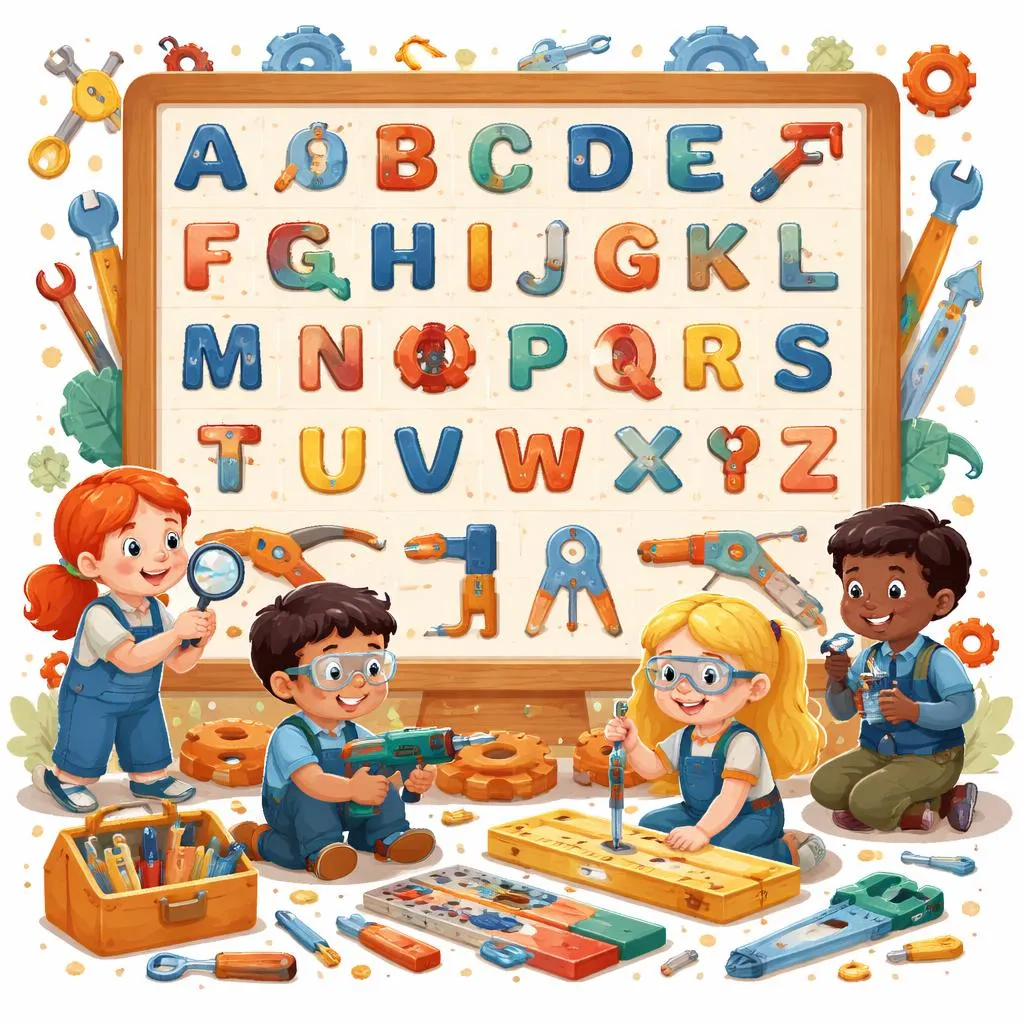

Hello, wonderful educators! Today we are exploring a practical and engaging vocabulary topic. We will focus on "tools start with" different letters of the alphabet. Tools are objects we use to fix, build, create, and repair things. Learning tool names builds practical vocabulary. It connects to real-world activities. We will examine what tools are. We will explore tools for each letter. We will share teaching strategies. We will provide engaging classroom activities. This guide will help you teach tool vocabulary effectively. Let's begin this handy learning journey together.
What Are Tools?
Tools are objects that help us do work. They make tasks easier and faster. People use tools for many different jobs. Carpenters use tools to build houses. Mechanics use tools to fix cars. Artists use tools to create paintings. Cooks use tools to prepare food.
Tools have been used by humans for thousands of years. Early humans used simple stone tools. Today we have complex electric tools. But the purpose remains the same. Tools extend our abilities and help us accomplish tasks.
Learning tool names helps children understand the world around them. They see adults using tools at home and in the community. Knowing the names gives children language to ask questions and learn more.
Tool vocabulary also connects to action words. Each tool has a purpose and a verb associated with it. Hammer and pound. Saw and cut. Screwdriver and turn. This builds richer language connections.
Meaning and Explanation of Tools
Let us explore the meaning behind different tools. Each tool has a specific function and design.
Tools can be simple or complex. A simple tool like a hammer has one main purpose. A complex tool like a drill can have multiple functions. Understanding this helps children categorize.
Tools are designed for specific materials. Some tools work on wood. Some work on metal. Some work on fabric. Matching tools to materials builds practical knowledge.
Safety is important with tools. Many tools have sharp edges or move quickly. Teaching tool names includes teaching respect for their proper use. This builds responsibility.
Tools exist in every part of life. Kitchen tools help us cook. Gardening tools help us plant. Office tools help us write. Bathroom tools help us clean. This shows the variety in daily life.
Tools Start with Each Letter of the Alphabet
Let us explore tools that begin with each letter. This alphabetical approach helps with letter learning too.
A: Axe, Awl, Auger, Adjustable wrench, Anvil. These tools help with cutting, punching holes, and metalwork.
B: Hammer, Brace, Bit, Bolt cutter, Broom, Brush. The B in hammer is silent but the word starts with H. Actually hammer starts with H. For B we have Brace and Bit.
C: Chisel, Clamp, Crowbar, Cutter, Compass, Crescent wrench. These help with shaping, holding, and prying.
D: Drill, Driver, Dolly, Drawknife, Dremel tool. These help with making holes and moving heavy items.
E: Edger, Electric saw, Exacto knife, Extractor. These help with finishing edges and precision cutting.
F: File, Flashlight, Fork, Funnel, Framing square. These help with smoothing, lighting, and measuring.
G: Glue gun, Grease gun, Grinder, Gutter tool, Gouge. These help with attaching, lubricating, and shaping.
H: Hammer, Hand saw, Hacksaw, Hatchet, Hoe, Level. Hammer and level are common household tools.
I: Iron, Inclinometer, Impact driver, Ink knife. These help with pressing, measuring angles, and printing.
J: Jack, Jigsaw, Jointer, Jig, Jackhammer. These help with lifting, cutting curves, and woodworking.
K: Knife, Keyhole saw, Kneeler, Knife sharpener. These help with cutting and maintenance.
L: Level, Ladder, Lathe, Lever, Locking pliers, Laser level. These help with measuring, reaching, and turning.
M: Mallet, Measuring tape, Microscope, Mortar, Mulcher. These help with striking, measuring, and viewing small things.
N: Nail gun, Nail set, Needle, Needle-nose pliers, Nut driver. These help with fastening and delicate work.
O: Oil can, Oscillating tool, Oxy-acetylene torch, Offset screwdriver. These help with lubrication and cutting.
P: Pliers, Plane, Putty knife, Paint roller, Pry bar, Punch. These help with gripping, smoothing, and spreading.
Q: Quick clamp, Quenching tank, Quadrant. These help with holding and cooling metal.
R: Ruler, Rasp, Ratchet, Rivet gun, Router, Wrench. Ratchet and wrench are common in toolboxes.
S: Saw, Screwdriver, Sander, Scissors, Sledgehammer, Spade. These are very common tools.
T: Tape measure, Trowel, Torch, Tongs, Tweezers, Tire iron. These help with measuring, gardening, and gripping.
U: Utility knife, Upholstery tool, Undercoat tool, U-clamp. These help with cutting and fabric work.
V: Vise, Vice grip, Vacuum, Voltage tester, Veneer saw. These help with holding and electrical work.
W: Wrench, Wire cutter, Wedge, Wheelbarrow, Wood chisel, Work light. These are essential tools.
X: X-acto knife, X-ray tool, Xylophone mallet. X-acto knife is very common for crafts.
Y: Yacht tool, Yarning tool, Yoke. These are more specialized tools.
Z: Zax, Zigzag ruler, Zinc scraper. Zax is a roofing tool.
Daily Life Examples with Tools
We can weave tool names into everyday conversations. This makes learning natural and continuous.
During classroom repairs, point out tools being used. "The janitor is using a hammer to fix the desk." "The teacher needs a screwdriver to tighten the door handle."
During art projects, name the tools. "We will use scissors to cut paper." "Please pass the glue stick." "Use the ruler to draw straight lines."
During outdoor play, notice gardening tools. "The gardener uses a shovel to dig holes." "The rake helps gather leaves." "The hose waters the plants."
During cooking activities, name kitchen tools. "We need a whisk to mix the eggs." "Use the peeler to remove apple skin." "The rolling pin flattens the dough."
During dramatic play, provide tool sets. Children use toy tools and name them naturally. "I need a hammer to fix this chair." "Pass me the screwdriver please."
Printable Flashcards for Tools
Flashcards provide excellent visual support for vocabulary lessons. Here are some ideas for creating them.
Tool Picture Cards: Create cards with clear pictures of tools on one side. Write the tool name on the other side. Include a variety from different categories.
Tool Alphabet Cards: Create cards for each letter showing a tool that starts with that letter. A for Axe. B for Brace. C for Chisel. Display these around the room.
Tool and Purpose Cards: Create cards showing the tool on one side. On the other side, show what it does. Hammer drives nails. Saw cuts wood. This builds function understanding.
Tool Matching Cards: Create two sets of tool cards. Students play memory match by finding pairs. They name the tool when they make a match.
Tool Category Cards: Create category headers. Cutting tools. Fastening tools. Measuring tools. Students sort tool cards into the correct categories.
Learning Activities or Games for Tools
Games make vocabulary practice fun and memorable. Here are many engaging ideas.
Activity 1: Tool Scavenger Hunt
Hide pictures of tools around the room. Give students a list of tool names to find. They search and check off each tool. This builds observation and reading skills.
Activity 2: What's This Tool?
Hold up a tool or picture. Ask students to name it. Then ask what it does. "This is a hammer. What do we do with a hammer?" Students answer, "We pound nails with a hammer."
Activity 3: Tool Sorting
Provide a collection of tool pictures. Have students sort them by function. Cutting tools together. Measuring tools together. Fastening tools together. This builds categorization.
Activity 4: Tool Charades
Act out using a tool without speaking. Pretend to hammer. Pretend to saw. Pretend to measure. Students guess the tool. This builds observation and vocabulary.
Activity 5: Tool Bingo
Create bingo cards with tool pictures. Call out tool names or descriptions. Students cover matching tools. First to cover a row wins.
Activity 6: I Spy a Tool
Say, "I spy with my little eye, a tool that cuts wood." Students guess the saw. "I spy a tool that drives nails." Students guess the hammer.
Activity 7: Tool Alphabet Challenge
Go through the alphabet naming a tool for each letter. See how many the class can name together. Keep a running list on the board.
Activity 8: Tool and Job Matching
Create cards with different jobs. Fixing a leaky pipe. Building a birdhouse. Painting a wall. Students choose the right tools for each job. This builds practical reasoning.
Activity 9: Tool Store Role Play
Set up a pretend tool store. Students take turns being shopkeepers and customers. Customers ask for specific tools. Shopkeepers find them and tell the price. This builds conversational skills.
Activity 10: Tool Safety Discussion
Talk about how to use tools safely. What tools should children not use without adults? Why are some tools dangerous? This builds safety awareness.
Activity 11: Tool Riddles
Create simple riddles about tools. "I have a head and a handle. I pound nails. What am I?" Students guess the hammer. This builds listening and reasoning.
Activity 12: Tool Drawing
Give each student a tool name. They draw that tool without writing the word. Display drawings and guess which tool each one shows.
Activity 13: Tool Memory Game
Place several tool pictures on a tray. Students study them. Cover the tray. Students name as many tools as they remember. This builds memory and vocabulary.
Activity 14: Tool Song Creation
Create a simple song about tools using a familiar tune. "This is the way we use a hammer, use a hammer, use a hammer. This is the way we use a hammer, when we build a house." Add verses for other tools.
Activity 15: Tool Invention Challenge
Ask students to invent a new tool. What would it do? What would it look like? What would it be called? Students draw and describe their invention. This builds creativity.
Activity 16: Tool Category Race
Call out a category. "Name three cutting tools!" Students race to name saw, scissors, knife. "Name three measuring tools!" Ruler, tape measure, level. This builds quick thinking.
Activity 17: Tool Show and Tell
Ask students to bring a safe tool from home with permission. A plastic hammer. A child-safe scissors. A wooden spoon. They show the tool and tell what it does.
Activity 18: Tool Puzzle
Create simple puzzles with tool pictures cut into pieces. Students assemble the puzzles and name the tool. This builds fine motor skills and vocabulary.
Activity 19: Tool Questions Game
One student thinks of a tool. Others ask yes or no questions to guess. "Is it used for cutting?" "Is it electric?" "Do you hold it in your hand?" This builds questioning skills.
Activity 20: Tool Collage
Provide magazines and catalogs with tool pictures. Students cut out tools and create a collage. They label each tool or name them to the class.
We have explored the wonderful world of tools together. Learning what "tools start with" each letter builds vocabulary in a structured way. Children learn to name the objects people use to build, fix, and create. This knowledge connects to real-world activities. It builds practical understanding. We looked at what tools are. We explored tools for each alphabet letter. We found examples in daily life. We created printable flashcards for practice. We shared engaging games and activities. This integrated approach makes learning natural and meaningful. Use these strategies in your classroom. Adapt them to your students' needs. Watch as your learners gain vocabulary and understanding. They will see the world with new eyes. Every hammer, saw, and screwdriver will have a name and purpose. Their own ability to describe and ask questions will grow stronger with each tool they learn.