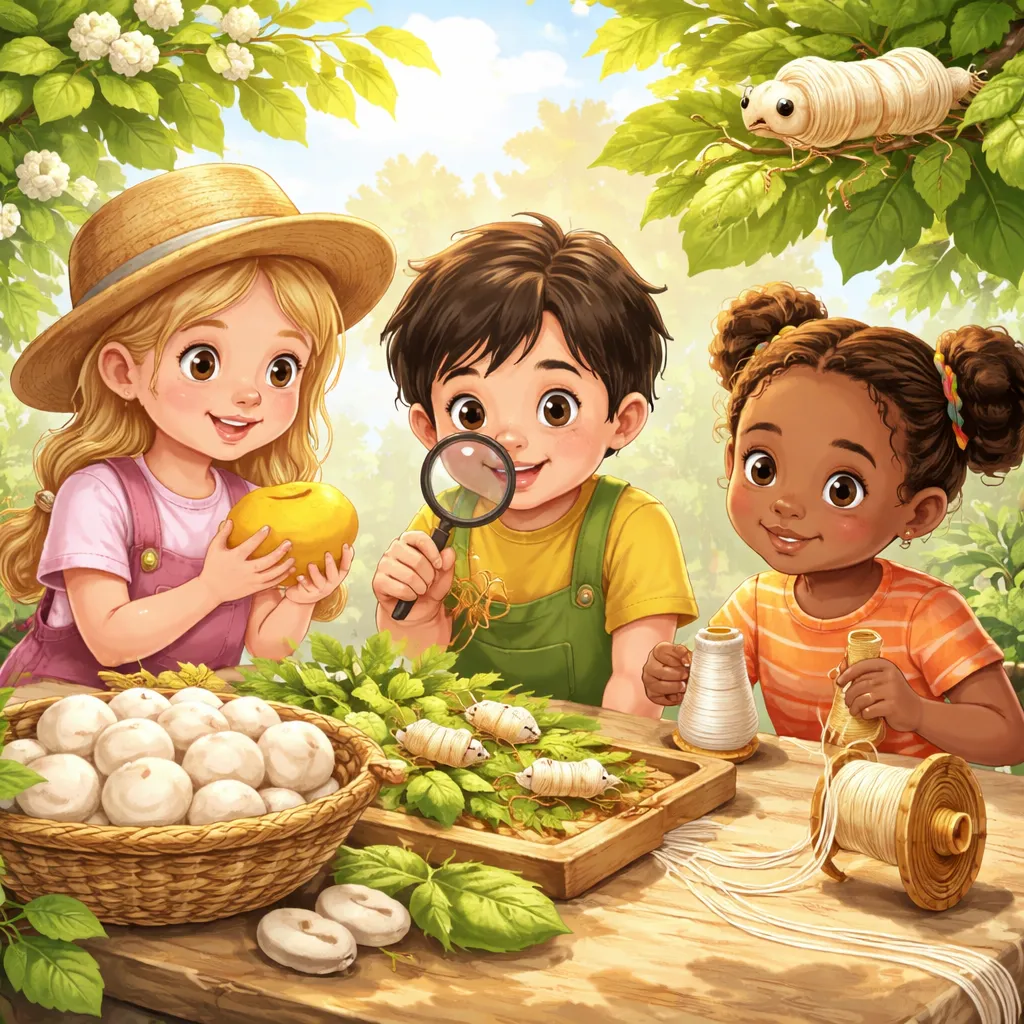

What Is This Animal?
A silkworm is the caterpillar of a moth called the silkmoth. It is not a worm at all. It is an insect larva. Silkworms have soft, pale bodies. They eat constantly. They grow very fast. They are known for spinning silk cocoons.
Silkworms have been raised by people for thousands of years. They are domesticated insects. They no longer live in the wild. People keep them for the silk they produce. Silk is a strong, shiny fiber. It comes from the cocoon of the silkworm.
These caterpillars eat only mulberry leaves. They eat fresh leaves every day. They grow from tiny eggs to full-sized caterpillars in about one month. When ready, they spin a cocoon. Inside the cocoon, they transform into moths.
For children, silkworms are wonderful to observe. They are gentle and safe to hold. Their life cycle is easy to watch. Learning about silkworms teaches children about where fabric comes from and the amazing process of transformation.
English Learning About This Animal
Let us learn the English word silkworm. We say it like this: /ˈsɪlkwɜːrm/. The word has two parts. Silk sounds like “silk.” Worm sounds like “wurm.” Put them together: silkworm. Say it three times. Silkworm. Silkworm. Silkworm.
Now let us learn words about a silkworm’s body. The head holds the mandibles for chewing leaves. The thorax has three pairs of true legs. The abdomen has prolegs for gripping. The spinneret is on the head. It produces silk thread. The cocoon is the silk case the silkworm spins.
There is a famous Chinese saying about silkworms. It comes from a poem: “The silkworm spins silk until it dies.” This means giving fully to one’s work. Another saying is, “Patience spins silk.” This reminds us that careful, steady work creates beautiful things.
These English words help children understand silkworm anatomy. When they say spinneret, they learn where silk comes from. When they say cocoon, they know the silk case. Parents can practice these words while watching silkworms. Point to the parts. Say the words together.
Animal Facts and Science Knowledge
Silkworms belong to the moth species Bombyx mori. They are domesticated insects. They cannot survive in the wild. They depend on humans for food and care. Silkworms have been raised in China for over five thousand years. The secret of silk traveled along the Silk Road to other lands.
Silkworms live indoors under human care. They are kept in trays with fresh mulberry leaves. They need clean, dry conditions. They are sensitive to smells and loud noises. Their whole life cycle takes about two months.
Silkworms eat only mulberry leaves. They eat day and night. A silkworm grows from a tiny hatchling to a large caterpillar in about four weeks. It increases its size ten thousand times. It sheds its skin four times as it grows.
Silkworms have special abilities. They produce silk from two glands in their head. The silk comes out as a liquid. It hardens when it touches air. The silkworm moves its head in a figure-eight pattern to spin the cocoon. One cocoon yields a single thread up to one mile long.
When ready to pupate, the silkworm spins a cocoon around itself. The cocoon takes two to three days to complete. Inside, the caterpillar transforms into a pupa. Then it becomes a moth. The moth emerges by dissolving the cocoon with a liquid. If left to emerge, the silk thread breaks. For silk production, cocoons are heated to stop the moth from emerging.
How to Interact With This Animal Safely
Silkworms are safe to handle. They do not bite or sting. They are gentle and slow. Children can hold them gently in their hands. Wash hands before and after handling. Silkworms are sensitive to dirt and oils.
If your family wants to raise silkworms, start with eggs or small caterpillars. You need a steady supply of mulberry leaves. Silkworms eat constantly. They need fresh leaves every day. Keep them in a clean box with air holes. Remove old leaves and droppings daily.
Teach children to be gentle. Silkworms have soft bodies. Their legs grip surfaces. Let them crawl on hands. Do not squeeze them. Watch them eat. Watch them grow. Caring for silkworms teaches responsibility.
When silkworms spin cocoons, do not disturb them. They need quiet. They will attach to twigs or paper. After they finish cocoons, you can observe them. If you want silk thread, you must stop the moth from emerging. This is a serious decision. Some families let the moths emerge to complete the cycle.
If moths emerge, they cannot fly. They are too heavy. They will mate and lay eggs. The eggs will hatch in about two weeks. Then the cycle begins again. This is a wonderful way to watch complete metamorphosis.
What Can We Learn From This Animal
Silkworms teach us about patience. They eat and grow for weeks. They spin silk slowly. Children learn that good things take time. Learning a skill, finishing a project, or growing up all require patience.
Silkworms teach us about transformation. They change from caterpillar to moth inside the cocoon. Children learn that change can happen in hidden ways. Growing and learning happen inside us too. We emerge changed.
Silkworms teach us about giving. They spin their silk and give it to humans. Children learn that giving is valuable. Sharing our work, our time, and our kindness makes the world better.
Silkworms teach us about care. They need fresh leaves every day. They need a clean home. Children learn that caring for others takes attention. Watering plants, feeding pets, and helping family are all acts of care.
Fun Learning Activities
Let us make learning about silkworm fun. One activity is the silkworm crawl game. Ask your child to move slowly on hands and knees. Move the body in a wavy motion. Stop to pretend to eat leaves. Say “silkworm eats” and “silkworm grows.”
Another activity is raising silkworms. Get silkworm eggs or small caterpillars. Find a mulberry tree. Watch them grow each day. Draw their size. Count how many leaves they eat. Observe the spinning of cocoons. This long project teaches patience and observation.
Draw a silkworm and label its parts. Draw the head, true legs, prolegs, and spinneret. Draw a cocoon beside it. Write the words next to each part. Say them aloud. For younger children, draw the silkworm first. Let them point to the parts as you say the words.
Create a story about a silkworm’s life. Ask your child what the silkworm does. Does it hatch from an egg? Does it eat leaves? Does it spin a cocoon? Write a few sentences together. Let your child draw pictures. Read the story aloud.
Make a silk thread craft. If you have a cocoon, boil it gently. Unwind the silk thread carefully. Wind it onto a piece of cardboard. Feel how strong and shiny it is. Talk about how silk becomes fabric.
Learn about the history of silk. Read about the Silk Road. Talk about how silk traveled from China to other lands. Use words like “trade,” “fabric,” and “ancient.” This connects the insect to human history.
These simple activities bring learning to life. Children build English vocabulary while playing. They learn science through direct observation. They learn responsibility through caring for living things. Learning about silkworm becomes a journey of patience, transformation, and the beautiful thread that connects tiny caterpillars to the robes of emperors and the scarves we wear today. Each moment spent together strengthens language, curiosity, and a lasting appreciation for the small, white caterpillars that spin treasure from their mouths.