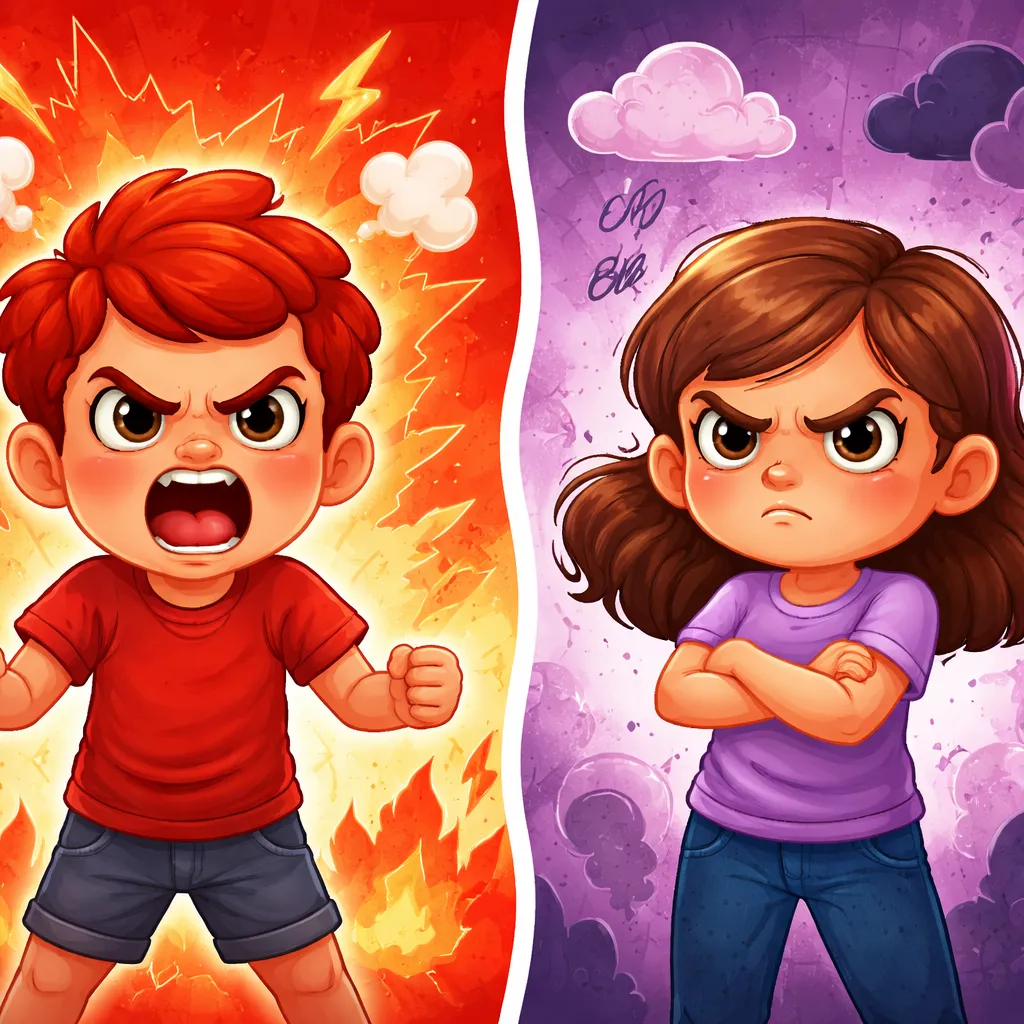

Hey there, emotion explorer! Have you ever felt really, really upset? Maybe someone broke your toy. Maybe a game was unfair. How do you talk about that feeling? Do you say you are angry? Or do you say you are mad? People use both words. They seem like twins, right? But are they exactly the same? Not quite! Knowing the small difference is a superpower. It helps you describe your feelings just right. Let's go on a word adventure today. We will unlock the secrets of "angry" and "mad".
First, let's be word scientists. Put on your lab coat! We will observe at home. Listen to these sentences. "My dad was angry about the messy kitchen." "My little brother was mad when I took his cookie." Both talk about a strong, upset feeling. But do they sound exactly the same? Maybe one feels a little more formal. Maybe one feels a little more sudden. What do you think? Great observation! Now, let's look much closer with our word microscope.
Adventure! Inside the World of Big Feelings
Welcome to the world of big feelings! Today, we explore two fiery emotions. Think of "angry" and "mad" as two types of fire. One is a hot, steady volcano. One is a quick, sparking firework. Let's learn about each one.
The Steady Volcano vs. The Sparking Firework Think about the word "angry". "Angry" feels like a rumbling volcano. The feeling builds up slowly. It is hot and serious. You feel angry about something unfair. You feel angry when someone is mean. It is a strong, deep feeling. It can last a while. Now, think about "mad". "Mad" feels more like a sudden firework. It sparks quickly! It is a burst of feeling. You are mad that you lost the game. You are mad that you spilled your juice. "Angry" is the hot lava underground. "Mad" is the bright, loud pop! Both are hot feelings. But one builds up. The other bursts out.
The Loud Voice vs. The Shouting Voice Let's listen to their volume. "Angry" is a loud, firm voice. It shows controlled but strong emotion. A teacher is angry about the noise. A parent is angry about a bad choice. The feeling is clear and serious. "Mad" is a shouting, yelling voice. It feels more out of control. It is often stronger in sound. A kid is mad and stomps his feet. You are so mad you could scream! "Mad" can sound more intense. "Angry" is a serious, hot feeling. "Mad" is a wild, hot feeling. One is a loud talk. The other is a yell.
Their Favorite Word Friends Words have best friends. "Angry" often likes to explain why. It works with "about" or "at" or "with". She is angry about the broken promise. He is angry at the referee. You can also say, "He has an angry face." "Mad" is a bit different. It loves the word "at". You are mad at your friend. I was so mad at myself! "Mad" also loves the word "that". I'm mad that I forgot my book. A common phrase is "drive someone mad". This means to really annoy someone. "Angry" is often for serious reasons. "Mad" can be for serious or silly reasons.
Let's visit a school scene. Imagine a student cheats on a test. The teacher finds out. The teacher feels very angry. This is a serious, disappointed feeling. The teacher's anger is deep and controlled. Now, imagine you are playing tag. Your friend tags you too hard. You yell, "Hey!" You feel mad for a moment. It is a quick, hot burst of feeling. Using "mad" for the cheating feels too quick. Using "angry" for the tag feels too serious. Each word paints a different picture.
Now, let's go to the playground. Your friend keeps changing the rules of the game. You feel frustrated. You say, "I'm getting angry." This shows your building frustration. Later, someone pushes you off the swing. You shout, "I'm so mad!" This shows your instant, hot reaction. The word "angry" paints the slow-building heat. The word "mad" paints the sudden spark.
Our Little Discovery So, what did we find in our lab? "Angry" and "mad" are both hot feelings. But they burn differently. "Angry" is often a deeper, hotter, more serious feeling. It builds up like a volcano. "Mad" is often a quicker, louder, more sudden feeling. It bursts like a firework. "Angry" often explains the reason carefully. "Mad" often points directly at the cause. Knowing this lets you choose the perfect word-fire.
Challenge! Become an Emotion Word Expert
Ready for a challenge? Let's test your new knowledge!
"The Best Choice" Challenge Let's imagine a nature scene. A bear is sleeping in its cave. Some loud campers wake it up. The bear is not just annoyed. It is deeply, seriously upset. The bear is... what? Is it angry or mad? The bear is angry. This is a deep, rumbling, serious feeling. Now, imagine a little squirrel. It is trying to bury a nut. A bird keeps stealing it. The squirrel chatters loudly. It stamps its feet. The squirrel is mad! This is a quick, frustrated burst of feeling. "Angry" wins for the deep, serious bear. "Mad" is the champion for the chattering squirrel.
"My Sentence Show" Your turn to create! Here is your scene: Dinner time with family. Can you make two sentences? Use "angry" in one. Use "mad" in the other. Try it! Here is an example: "My mom was angry about the fight we had." This shows a serious, deep upset. "My sister was mad that I took the last meatball." This shows a quick, hot reaction to a small thing. Your sentences will show different kinds of heat!
"Eagle Eyes" Search Look at this sentence. Can you find the word that could be better? Let's check a home context. "The loud noise from the party next door made my dad absolutely mad all night." Hmm. The phrase "all night" suggests a long-lasting feeling. The word "mad" often describes a quicker burst. The word "angry" might fit this lasting, serious feeling better. "The noise... made my dad absolutely angry all night." Did you spot it? You are a fantastic word detective!
Harvest and Action! Turn Knowledge Into Your Superpower
Awesome job! We started thinking "angry" and "mad" were twins. Now we know they are close cousins. We can feel the rumbling volcano of "angry". We can hear the popping firework of "mad". You can now describe your fiery feelings perfectly. This is a powerful tool for talking about emotions.
What you can learn from this article: You can now feel that "angry" is often a deeper, hotter, more serious feeling that builds up. You can feel that "mad" is often a quicker, louder, more sudden burst of feeling. You know that saying "I am angry about something" often explains a serious reason. Saying "I am mad at someone" often points to a quick reaction. You learned to match the word to the type of "heat" you feel inside.
Life practice application: Try your new skill this week. The next time you feel upset, stop for a second. Are you feeling a slow, hot "angry" like a volcano? Or a quick, sparking "mad" like a firework? Tell a grown-up which one it is. Watch a superhero movie. Listen for the words "angry" and "mad". When does the villain make the hero "angry"? When does the hero get "mad"? This makes you a super listener. Keep exploring your feelings with the perfect words. You are an amazing emotion expert!