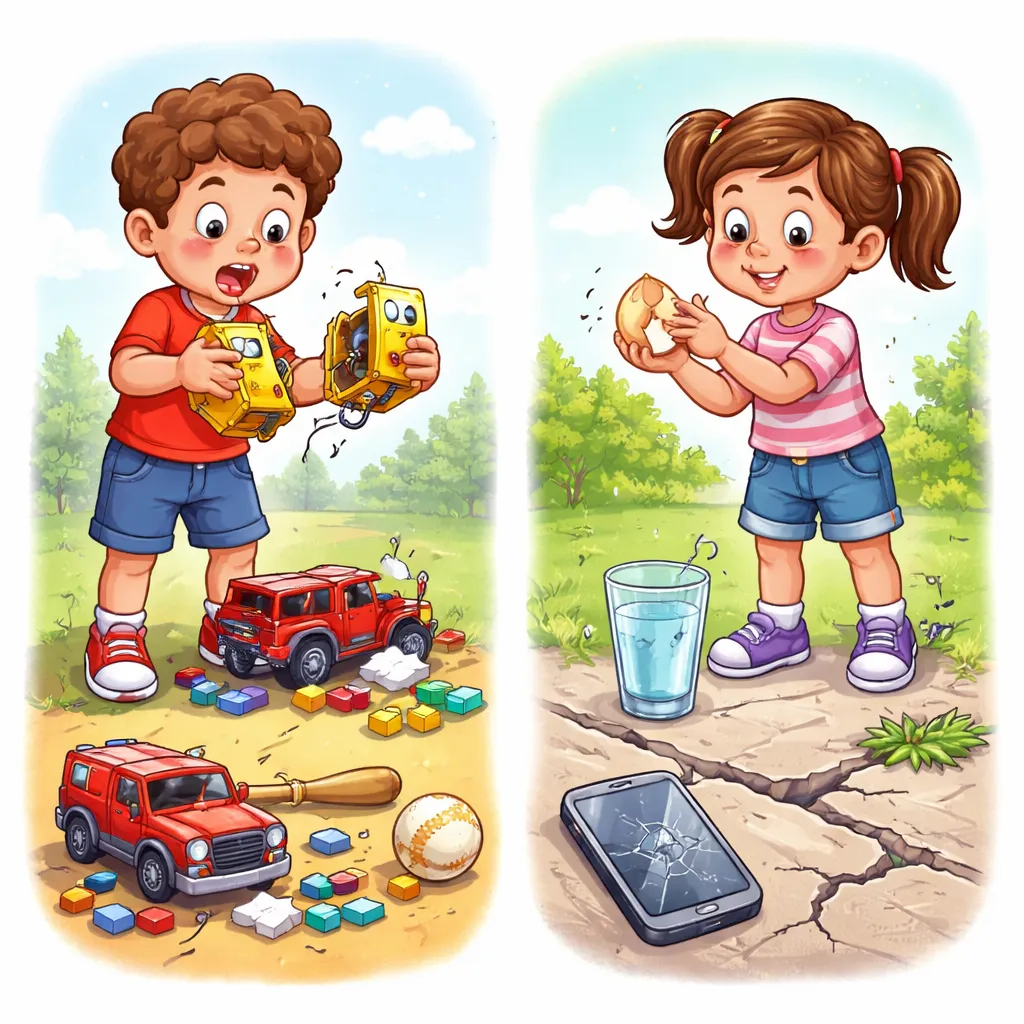

Hello, word explorer! Have you ever dropped a glass? Or seen a line on an old wall? How do you talk about that? Did the glass break? Or did the wall crack? They both seem to mean something is damaged. But are they the same? They are like two different levels of damage. One is a shattered vase, in many pieces. One is a line on an eggshell, the egg is still whole. Let's find out! Today, we explore the word friends "break" and "crack". Knowing their secret is a superpower. It makes you a careful and clear observer. Let's start our detective adventure!
First, let's be Damage Detectives. Listen at home. Here are two sentences. "Oh no, I might break this fragile ornament if I drop it!" "Be careful not to crack the phone screen when you put it in your pocket." They both talk about damage. An ornament. A phone screen. Do they sound the same? One feels like complete destruction. One feels like a partial, thin line. Can you sense it? Great observation! Now, let's look at the damage.
Adventure! Inside the World of Damage
Welcome to the world of damage! "Break" and "crack" are two different accidents. Think of "break" as a shattered vase. It is in many pieces, completely separated. Think of "crack" as a line on an eggshell. The shell is still in one piece, but with a thin split. Both are about harm. But they describe different levels. Let's learn about each accident.
The Shattered Vase vs. The Cracked Eggshell Think about the word "break". "Break" feels like a shattered vase. It is the general, strong word. It means to separate into pieces, to make something not work, or to destroy its wholeness. The object is often in two or more parts. I break a pencil. The machine broke. He broke the record. It is a complete failure. Now, think about "crack". "Crack" feels like a line on an eggshell. It is a more specific word. It means to break without dividing into separate parts, causing a thin line or opening. You can see through it. The ice cracked. Her voice cracked. "Break" is the shattered vase. "Crack" is the cracked eggshell. One is complete. The other is partial.
Complete Separation vs. A Thin Split Let's compare the result. "Break" means the object is often in pieces or not functioning. The damage is total. You can break a bone, break a promise, or break for lunch. "Crack" means the object is usually still in one piece, but with a visible line or split. The damage is on the surface. You crack a window, crack a code, or crack a nut. "Break" is for the whole thing. "Crack" is for the surface. One is a crash. The other is a snap.
Their Special Word Partners and Common Uses Words have best friends. "Break" loves to team up in many common, complete phrases. Break the ice. Break even. Break a leg. It is about a full change. "Crack" has its own special teams about opening and sound. Crack a joke. Crack of dawn. Crack and pop. Note: We say "break the law". We don't say "crack the law". They are different.
Let's visit a school scene. You are running in the hall. You trip and fall. You might break your arm bone. This is a serious, complete damage. In science class, you do an experiment with an ice cube. You press it. A thin line appears. The ice cube cracked. It is still one piece, but damaged. Using "crack" for the broken arm is wrong because a bone break is severe. Using "break" for the ice cube is okay, but "crack" better describes the thin line.
Now, let's go to the playground. You throw a ball too hard. It hits a window and the window breaks into pieces. This is total destruction. You step on a twig. It cracks with a snapping sound. The twig is now in two pieces? Wait, that's a break. Actually, a twig that snaps in two is broken. A crack might be a split along its length without fully separating. Let's adjust: You step on a thick branch. It doesn't snap, but a thin line appears along the wood. The branch cracked. The word "break" paints the window shattering. The word "crack" paints the branch getting a split.
Our Little Discovery So, what did we find? "Break" and "crack" are both about damage. But they are very different. "Break" means to separate into pieces or stop working. The damage is complete. "Crack" means to get a thin split or line, usually without falling apart. The object is often still in one piece. You break a toy. You crack an egg. Knowing this helps you describe accidents with perfect accuracy.
Challenge! Become a Damage Word Champion
Ready for a careful test? Let's try your new skills!
"The Best Choice" Challenge Let's imagine a nature scene. A large tree branch is covered in ice during a storm. The ice is too heavy. The branch snaps and falls to the ground. The branch breaks. This is a complete separation. Now, look at a dry, mud-covered ground in summer. The hot sun makes thin lines appear on the surface. The ground cracks. This is a network of thin splits, but the ground is still there. "Break" wins for the fallen branch. "Crack" is the champion for the dry, split ground.
"My Sentence Show" Your turn to create! Here is your scene: Helping to set the dinner table. Can you make two sentences? Use "break" in one. Use "crack" in the other. Try it! Here is an example: "I hope I don't break a plate when I unload the dishwasher." This is about complete destruction. "I noticed a tiny crack in the edge of this glass cup; we shouldn't use it." This is about a thin, partial split. Your sentences will show two levels of damage!
"Eagle Eyes" Search Look at this sentence. Can you find the word that could be better? Let's check a home context. "I cracked my favorite mug when I dropped it on the floor; now it's in five pieces." Hmm. The mug is in five separate pieces. This is complete separation. The word "broke" is the correct choice for this total damage. "I broke my favorite mug when I dropped it on the floor; now it's in five pieces." "Cracked" would mean it had a line but was still in one piece. Did you spot it? Excellent and careful word work!
Harvest and Action! Turn Knowledge Into Your Superpower
Great exploring! We started thinking "break" and "crack" were the same. Now we know they are two different accidents. We can see the shattered vase of "break". We can see the cracked eggshell of "crack". You can now talk about damage with perfect accuracy. This is a great skill for safety and science.
What you can learn from this article: You can now feel that "break" means to separate into pieces or to stop working completely, like breaking a window or breaking a pencil. You can feel that "crack" means to get a thin split or line without completely falling apart, like cracking an eggshell or cracking the ground. You know that a dropped plate will "break", but a stepped-on nut might "crack". You learned to match the word to the damage: "break" for complete separation, "crack" for a partial split.
Life practice application: Try your new skill today! Look around your home. Do you see anything that is broken? Do you see anything that is cracked? Tell an adult if you find something cracked or broken. Be a safety inspector. You are now a master of damage words! Keep observing and describing your world carefully.