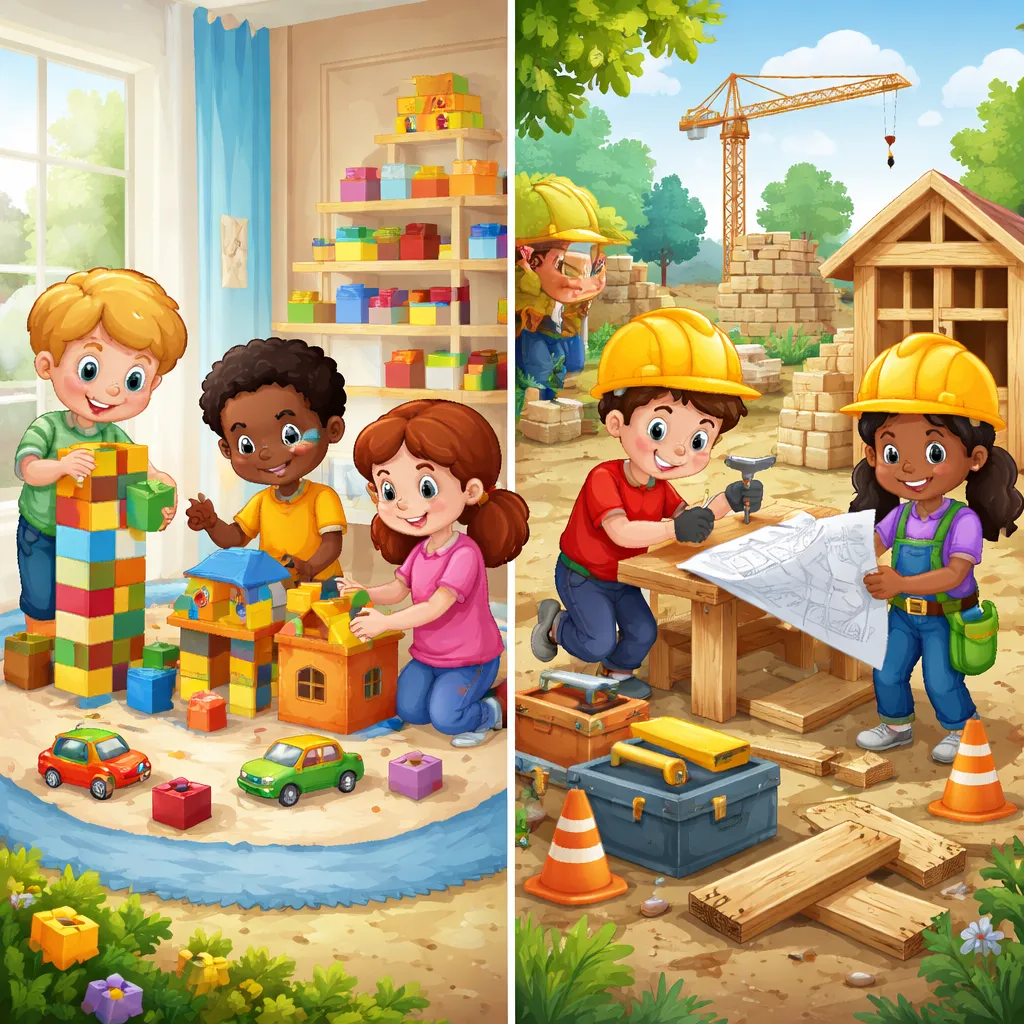

Hello, word explorer! Have you ever made a tower from blocks? Or seen workers put up a new house? How do you talk about that? Do you build a tower? Or do you construct a house? They both seem to mean putting parts together. But are they the same? They are like two different sets of instructions. One is a simple recipe. One is a complex blueprint. Let's find out! Today, we explore the word friends "build" and "construct". Knowing their secret is a superpower. It helps you talk about projects big and small. Let's start our engineering adventure!
First, let's be Builder Detectives. Listen at home. Here are two sentences. "My brother and I will build a fort from couch cushions." "A company will construct a new bridge across the river." They both talk about making something. A fort. A bridge. Do they sound the same? One feels more playful and simple. One feels more official and complex. Can you sense it? Great observation! Now, let's look at the blueprints.
Adventure! Inside the World of Putting Things Together
Welcome to the world of putting things together! "Build" and "construct" are two different instruction manuals. Think of "build" as a friendly, simple recipe. It is for all kinds of projects, real and imaginary. Think of "construct" as a detailed, technical blueprint. It is for serious, often large, physical structures. Both are about assembly. But they assemble in different contexts. Let's learn about each one.
The Simple Recipe vs. The Technical Blueprint Think about the word "build". "Build" feels like a simple, friendly recipe. It is the everyday, common word. It means to put parts together to form something whole. You can build a model. You can build a business. You can build trust. It is used for physical things, ideas, and feelings. Now, think about "construct". "Construct" feels like a detailed, technical blueprint. It is a more formal word. It usually means to build a physical structure, like a building, road, or machine, often with planning and skill. Workers construct a skyscraper. Engineers construct a dam. "Build" is the simple recipe. "Construct" is the technical blueprint. One is general. The other is specific and skilled.
The General Action vs. The Skilled Process Let's compare their use. "Build" is a very flexible, general verb. It is used in daily life, play, and metaphor. Let's build a sandcastle. He is building his strength. We need to build a team. "Construct" is more specific. It often describes a careful, planned process of building something large and tangible. It is common in official or technical contexts. They will construct a new wing on the hospital. Birds construct nests. "Build" is for the playroom. "Construct" is for the construction site. One is casual. The other is formal and precise.
Their Special Word Partners and Common Contexts Words have best friends. "Build" loves to team up with a wide range of words. Build up. Build on. Build a life. It is used in many common phrases. "Construct" has its own special teams. It often pairs with words about engineering, architecture, and theory. Construct a building. Construct an argument. Construct a sentence. Note: We say "body build" (physique). We say "social construct" (an idea). They are different.
Let's visit a school scene. In the block corner, you build a tall, wobbly tower for fun. This is a playful, hands-on activity. Now, in a technology class, you follow a diagram to construct a simple robot from a kit. This involves following precise, technical steps. Using "construct" for the block tower is too formal. Using "build" for the robot kit is fine, but "construct" fits the technical, planned nature of the project.
Now, let's go to the playground. You build a small dam in a muddy puddle. This is simple, imaginative play. Later, you watch city workers construct a new climbing frame. They use tools, machines, and plans. The word "build" paints the playful dam. The word "construct" paints the official playground project.
Our Little Discovery So, what did we find? "Build" and "construct" both mean to form something by assembling parts. But they are used in different situations. "Build" is the common, general word for making anything, from objects to ideas. "Construct" is a more formal word, usually for building physical structures with planning and skill. You build a Lego castle. Engineers construct a real castle. Knowing this helps you choose the right word for your project.
Challenge! Become a Builder Word Champion
Ready for a fun test? Let's try your new skills!
"The Best Choice" Challenge Let's imagine a nature scene. A child makes a small hut from fallen branches. The child is going to build a hideout. This is a simple, creative act. Now, consider a colony of termites. They work together in an organized way to make a huge, complex mound. The termites construct a giant mound. This suggests a complex, organized process. "Build" wins for the child's creative hut. "Construct" is the champion for the termites' organized engineering.
"My Sentence Show" Your turn to create! Here is your scene: A weekend project with a parent. Can you make two sentences? Use "build" in one. Use "construct" in the other. Try it! Here is an example: "My dad and I will build a birdhouse from a pre-made kit." This is a general, hands-on project. "The city will construct a new sidewalk on our street this summer." This is a formal, planned public project. Your sentences will show two levels of projects!
"Eagle Eyes" Search Look at this sentence. Can you find the word that could be better? Let's check a home context. "We need to construct a better schedule for our homework time so we're not rushing." Hmm. A schedule is a plan, not a physical structure. The word "build" is a better fit for creating an intangible plan or system. "We need to build a better schedule for our homework time..." is more natural. "Construct" is usually for physical things or very formal arguments. Did you spot it? Excellent word work!
Harvest and Action! Turn Knowledge Into Your Superpower
Great exploring! We started thinking "build" and "construct" were the same. Now we know they are two different instruction manuals. We can follow the simple recipe of "build". We can follow the technical blueprint of "construct". You can now describe your projects and the world around you with perfect accuracy. This is a great skill for future engineers and storytellers!
What you can learn from this article: You can now feel that "build" is the common, everyday word for putting things together, whether it's a physical object, an idea, or a relationship. You can feel that "construct" is a more formal word, usually for building physical structures like buildings and bridges, often with planning and engineering. You know that you "build" a model plane, but a company might "construct" a real airport. You learned to match the word to the project: "build" for general making, "construct" for skilled, physical structures.
Life practice application: Try your new skill today! Look at something you made. Did you build it? Look at a big project in your town. Are workers constructing it? Tell a family member about something you want to build. Read about a famous structure and how they constructed it. You are now a master of builder words! Keep planning and creating amazing things.