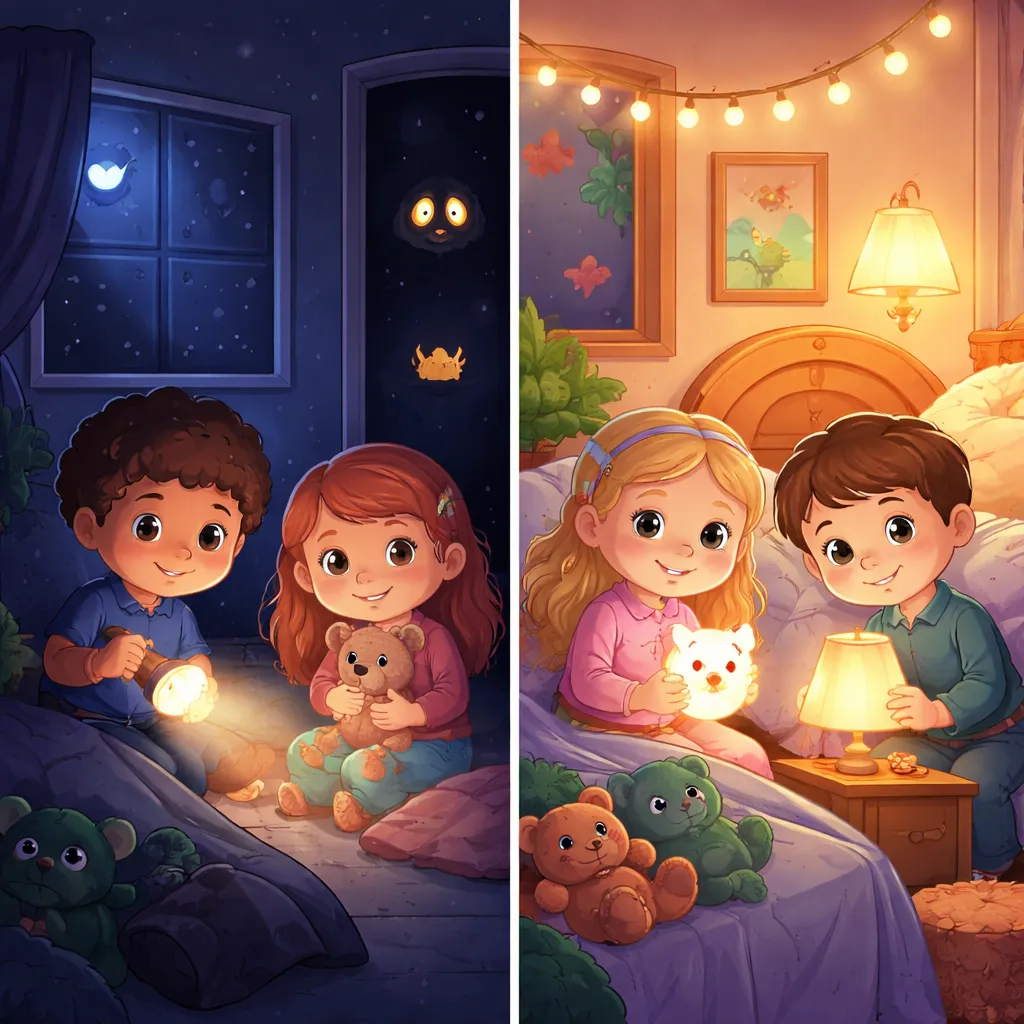

Hello, word explorer! Have you ever been in a room with no lights? Or tried to read under a small nightlight? How do you describe that? Is the room dark? Or is the light dim? They both seem to mean "not bright". But are they the same? They are like two different kinds of shadow. One is a deep, black shadow. One is a soft, gray shadow. Let's find out! Today, we explore the word friends "dark" and "dim". Knowing their secret is a superpower. It helps you paint perfect pictures of light and shadow. Let's start our adventure!
First, let's be Light Detectives. Listen at home. Here are two sentences. "My closet is completely dark with the door closed." "The dim lamp in the living room created a cozy mood." They both talk about low light. A closet. A lamp. Do they sound the same? One feels like no light at all. One feels like a little bit of light. Can you sense it? Great observation! Now, let's look closer with our word light meter.
Adventure! Into the World of Low Light
Welcome to the world of low light! "Dark" and "dim" are two different brushes. They paint different shades of shadow. Think of "dark" as a pot of black paint. It covers everything completely. Think of "dim" as a brush with gray paint. It leaves a soft, hazy layer. Both are about less light. But they are different amounts. Let's learn about each one.
The Black Paint vs. The Gray Haze Think about the word "dark". "Dark" feels like a pot of black paint. It means there is very little or no light. It is the opposite of light. A dark night. A dark cave. It can also describe colors. A dark blue shirt. It is a strong, full absence of light. Now, think about "dim". "Dim" feels like a soft, gray haze. It means there is some light, but it is weak and not bright. A dim light bulb. A dim memory (unclear). "Dark" is the black paint. "Dim" is the gray haze. One is absence. The other is weakness.
The Loud Silence vs. The Soft Whisper Let's listen to their volume. "Dark" is like a loud silence. It is a strong, complete state. It is the maximum level of "not bright". The power went out, and the house was dark. "Dim" is like a soft whisper. It is a low, gentle level of light. You can still see a little. The stars were dim in the cloudy sky. "Dark" is the off switch. "Dim" is the low setting. One is all or nothing. The other is a little bit.
Their Special Word Partners and Common Uses Words have best friends. "Dark" loves to team up with words about absence and mystery. Dark room. Dark secret. The dark (as a noun). It is used in many common phrases. "Dim" has its own special teams. It often pairs with words about low light and vague things. Dim light. Dim hope. Dim memory. Also, "dim" can be a verb meaning to make less bright. Dim the lights. Note: We say "pitch dark" (very dark). We say "dimly lit" (poorly lit). They are different teams.
Let's visit a school scene. During a solar eclipse, the sky becomes strangely dark in the middle of the day. This describes the near absence of sunlight. Now, imagine your classroom has old overhead lights. One bulb is flickering weakly. That corner of the room is dim. This describes the area with weak light. Using "dim" for the eclipse is an understatement. Using "dark" for the flickering bulb is too strong. Each word fits a different level.
Now, let's go to the playground. You crawl into a tunnel slide. Inside, it is dark. You cannot see your hand. Later, as the sun sets, the whole playground becomes dim. You can still see, but colors are softer. The word "dark" paints the inside of the tunnel. The word "dim" paints the soft evening light.
Our Little Discovery So, what did we find? "Dark" and "dim" are both about low light. But they are different levels. "Dark" means there is very little or no light. It is a strong word for absence. "Dim" means there is some light, but it is weak, soft, or not clear. It is a gentler word for low levels. A room with the lights off is dark. A room with a small nightlight is dim. Knowing this helps you describe shadows and light perfectly.
Challenge! Become a Shadow Word Champion
Ready for a fun test? Let's try your new skills!
"The Best Choice" Challenge Let's imagine a nature scene. A bat lives in a deep, underground cave. No sunlight reaches its resting spot. That part of the cave is completely... what? Dark or dim? The cave is dark. There is no light at all. Now, imagine a foggy morning in the forest. The sun is up, but the fog makes the light soft and gray. The forest is dim. The light is weak and hazy. "Dark" wins for the sunless cave. "Dim" is the champion for the foggy forest.
"My Sentence Show" Your turn to create! Here is your scene: A camping trip at night. Can you make two sentences? Use "dark" in one. Use "dim" in the other. Try it! Here is an example: "The woods were very dark after we put out the campfire." This means almost no light. "We used a dim flashlight to find our way to the tent." This means the flashlight had a weak beam. Your sentences will show two levels of light!
"Eagle Eyes" Search Look at this sentence. Can you find the word that could be better? Let's check a home context. "I turned off the big light, so the room was only dim, and I couldn't see anything at all." Hmm. If you "couldn't see anything at all," that suggests no light. The word "dark" is a better fit for no visibility. "I turned off the big light, so the room was dark, and I couldn't see anything at all." "Dim" implies you can still see a little. Did you spot it? Excellent word work!
Harvest and Action! Turn Knowledge Into Your Superpower
Great exploring! We started thinking "dark" and "dim" were the same. Now we know they are two different shades of shadow. We can feel the black paint of "dark". We can see the gray haze of "dim". You can now describe light levels with perfect accuracy. This is a great skill for stories and daily life.
What you can learn from this article: You can now feel that "dark" means there is very little or no light, like inside a closed box. You can feel that "dim" means there is some light, but it is weak and soft, like a candle in a big room. You know that a movie theater is "dark" before the film starts, but a nightlight makes a room "dim". You learned to match the word to the amount of light: "dark" for none, "dim" for a little.
Life practice application: Try your new skill tonight! When you go to bed, is your room dark or dim? Look at a streetlamp from far away. Does it look bright or dim? Tell a family member about a dark place you know. Describe a dim light you like. Listen to how people use these words. You are now a master of light and shadow words! Keep exploring the wonderful world of language.