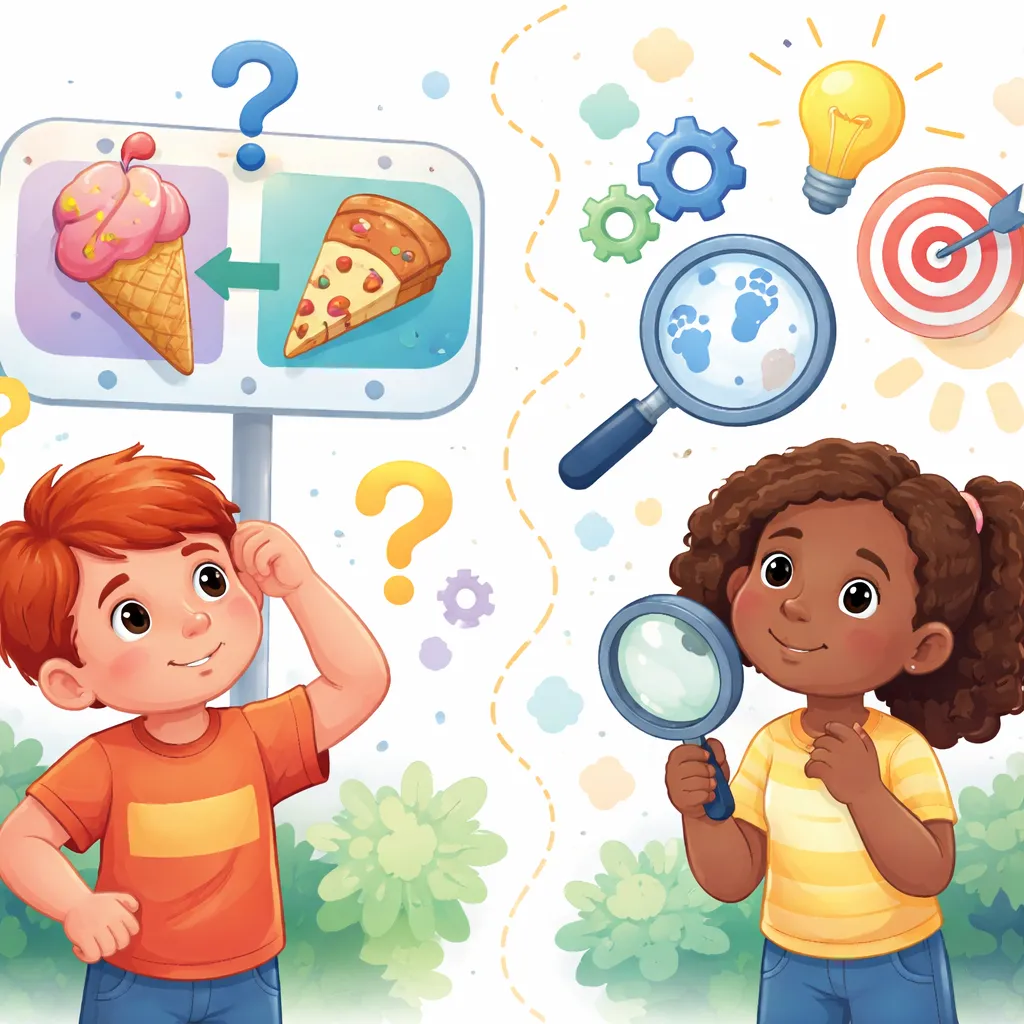

Hello, decision-maker! Have you ever had to pick a movie with friends? Or tried to figure out a puzzle's solution? How do you talk about that? Do you decide on a movie together? Or do you determine the right answer? They both seem to mean making a choice or finding an answer. But are they the same? They are like two different paths to a conclusion. One is a fork in the road where you pick a direction. One is a detective solving a mystery to find the only truth. Let's find out! Today, we explore the word friends "decide" and "determine". Knowing their secret is a superpower. It makes you a confident chooser and a sharp thinker. Let's start our thinking adventure!
First, let's be Thought Detectives. Listen at home. Here are two sentences. "We need to decide what to have for dinner tonight—pizza or pasta?" "The mechanic will run tests to determine what is wrong with the car's engine." They both talk about reaching a conclusion. Dinner. A car problem. Do they sound the same? One feels like making a choice between options. One feels like finding out the facts to reach a single answer. Can you sense it? Great observation! Now, let's look at the paths.
Adventure! Into the World of Reaching Conclusions
Welcome to the world of conclusions! "Decide" and "determine" are two different conclusion-makers. Think of "decide" as a fork in the road. You look at two or more paths and pick one to follow. It's about your choice. Think of "determine" as a detective solving a case. The detective gathers clues until the truth is clear. It's about discovering the facts. Both end with a conclusion. But they get there in different ways. Let's learn about each maker.
The Fork in the Road vs. The Detective on a Case Think about the word "decide". "Decide" feels like a fork in the road. It is the common, everyday word. It means to make a choice or judgment after thinking. The focus is on selecting between options. I decide to go. Let's decide the winner. The judge will decide. It is about making up your mind. Now, think about "determine". "Determine" feels like a detective on a case. It is a more formal, investigative word. It means to find out the facts or truth about something, or to officially set or control something. The test will determine your level. We must determine the cause. The rules determine the game. "Decide" is the fork. "Determine" is the detective. One is about choice. The other is about discovery or control.
Making a Choice vs. Finding Out the Facts Let's compare their process. "Decide" is about using your will or judgment to pick something. The answer comes from you. You can decide what to wear, decide to be brave, or decide a game is over. "Determine" is about using evidence or rules to find an answer. The answer comes from the facts. A scientist determines the result. Your hard work determines your grade. The date is determined by the calendar. "Decide" is subjective. "Determine" is objective. One is a preference. The other is a fact.
Their Special Word Partners and Common Contexts Words have best friends. "Decide" loves to team up with choices and plans. Decide on. Decide to go. Decide for yourself. It is about personal judgment. "Determine" teams up with causes, facts, and rules. Determine the outcome. Determine by experiment. Determine the price. Note: We say "decide what to do". We say "determine what happened". They are different.
Let's visit a school scene. Your class is voting for a field trip location. You will decide between the museum and the zoo. This is a choice between options. In science class, you do an experiment. The data you collect will determine if your hypothesis is correct. This is about using facts to find the answer. Using "determine" for the field trip is too strong because it's a vote, not a factual discovery. Using "decide" for the experiment is okay, but "determine" is the precise scientific word.
Now, let's go to the playground. You and your friends can't agree on a game. You take a vote to decide. This is a group choice. You are building a tall tower with blocks. The strength of the base will determine how high it can go. The word "decide" paints the group's vote. The word "determine" paints the cause-and-effect rule of physics.
Our Little Discovery So, what did we find? "Decide" and "determine" both lead to a conclusion. But they do it differently. "Decide" means to make a choice or judgment about something. It comes from your own mind or a group's agreement. "Determine" means to find out the facts or truth about something, or to officially control or set something. It comes from evidence, rules, or authority. You decide what game to play. The rules determine who wins. Knowing this helps you talk about choices and facts perfectly.
Challenge! Become a Conclusion Word Champion
Ready for a thoughtful test? Let's try your new skills!
"The Best Choice" Challenge Let's imagine a nature scene. A flock of birds is getting ready to fly south. They seem to wait for a signal. Then, the lead bird decides it is time to go, and the flock follows. This is a choice or judgment made by the leader. A young plant starts to grow. The amount of sunlight and water it gets will determine how tall and strong it becomes. This is a fact controlled by the environment. "Decide" wins for the bird's leadership choice. "Determine" is the champion for the plant's growth factors.
"My Sentence Show" Your turn to create! Here is your scene: Planning a weekend with your family. Can you make two sentences? Use "decide" in one. Use "determine" in the other. Try it! Here is an example: "We will decide on Saturday morning whether to go hiking or visit the pool." This is about making a choice between options. "The weather forecast will determine which activity we actually get to do." This is about the facts (the weather) controlling the outcome. Your sentences will show choice vs. control!
"Eagle Eyes" Search Look at this sentence. Can you find the word that could be better? Let's check a home context. "We used a calculator to decide the total cost of our groceries at the store." Hmm. A calculator is used to find out a factual number, not to make a choice. The word "determine" is the correct choice for calculating or finding out a fact. "We used a calculator to determine the total cost of our groceries at the store." "Decide" would be used if you were choosing whether to buy something or not. Did you spot it? Excellent word work!
Harvest and Action! Turn Knowledge Into Your Superpower
Great exploring! We started thinking "decide" and "determine" were the same. Now we know they are two different conclusion-makers. We can take the fork in the road with "decide". We can solve the mystery with "determine". You can now talk about your choices and discoveries with perfect accuracy. This is a great skill for school projects and family plans.
What you can learn from this article: You can now feel that "decide" is about making a choice or judgment, often between different options, like deciding what to eat, what to wear, or what game to play. You can feel that "determine" is about finding out the facts, the cause, or the truth of something, or about rules that control an outcome, like determining the answer to a math problem, determining why something broke, or determining the winner by the score. You know that a team captain might decide the strategy, but the final score determines the winner. You learned to match the word to the process: "decide" for making a choice, "determine" for finding facts or setting rules.
Life practice application: Try your new skill today! When you make a plan, you decide. When you figure out why something happened, you determine the cause. Tell a family member one thing you will decide today and one fact you would like to determine. You are now a master of conclusion words! Keep making great choices and discovering cool facts.