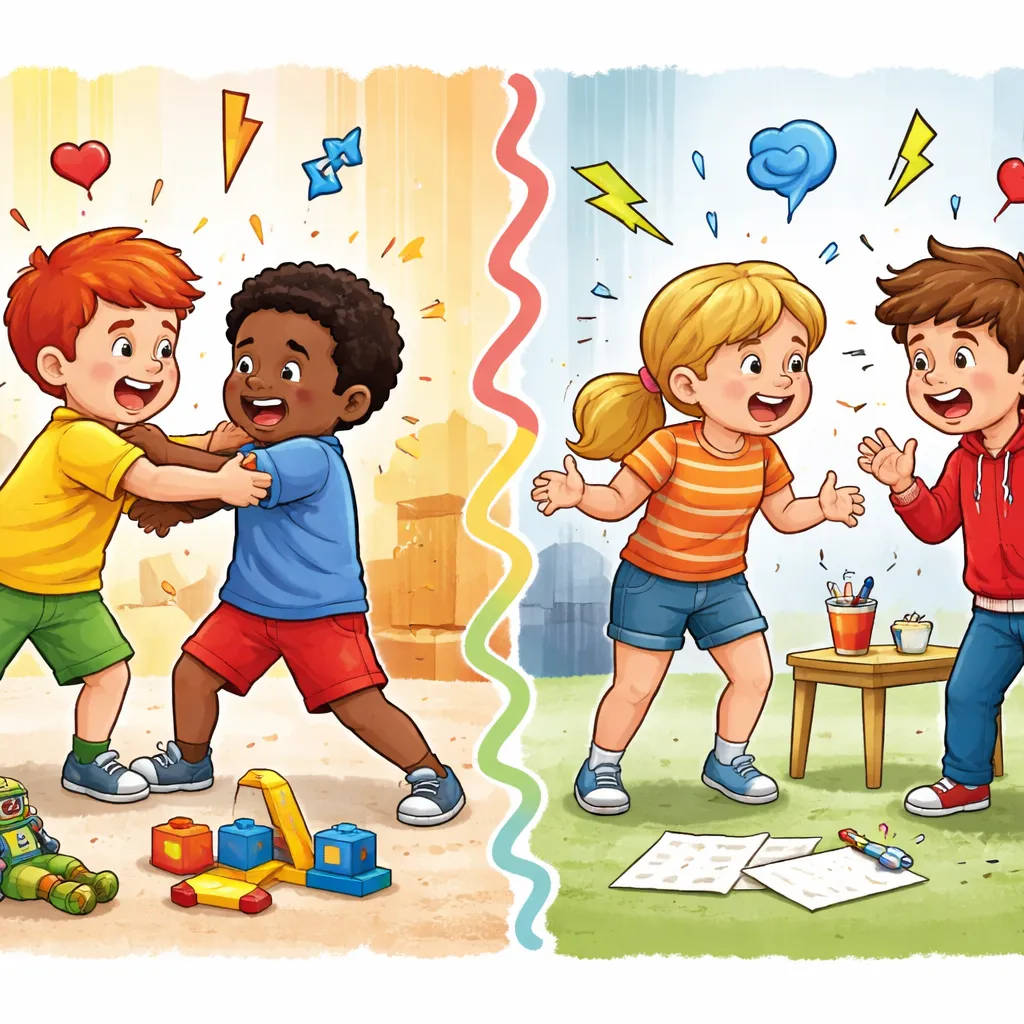

Hello, word explorer! Have you ever disagreed with a friend? Or seen a loud, physical struggle? How do you talk about that? Do you argue about which game to play? Or do you see two people fight? They both seem to mean a big disagreement. But are they the same? They are like two different kinds of storms. One is a loud thunderstorm of words. One is a wild hurricane with pushing and shoving. Let's find out! Today, we explore the word friends "fight" and "argue". Knowing their secret is a superpower. It makes you a peacemaker. Let's start our careful adventure!
First, let's be Peace Detectives. Listen at home. Here are two sentences. "My brother and I sometimes argue about who gets to use the computer first." "It's wrong to use your hands to fight with someone when you are angry." They both talk about conflict. Computer time. Using hands. Do they sound the same? One feels like a loud talk. One feels like physical hitting. Can you sense it? Great observation! Now, let's look at the conflict.
Adventure! Inside the World of Conflict
Welcome to the world of conflict! "Fight" and "argue" are two different storms. Think of "fight" as a wild hurricane. It is intense and can be physical. Think of "argue" as a loud thunderstorm. It is noisy with words and ideas. Both are about strong disagreement. But they disagree in different ways. Let's learn about each storm.
The Wild Hurricane vs. The Loud Thunderstorm Think about the word "fight". "Fight" feels like a wild hurricane. It is a strong, general word. It means to use force or to struggle against someone or something. It can be physical or a serious effort. Soldiers fight in a war. I will fight for my rights. He fights a cold. It can mean physical conflict. Now, think about "argue". "Argue" feels like a loud thunderstorm. It is a more specific word. It means to give reasons for or against something, often angrily. It is about words, not fists. They argue about politics. I argue my point. "Fight" is the hurricane. "Argue" is the thunderstorm. One can be physical. The other is verbal.
Physical Struggle vs. Verbal Disagreement Let's compare their action. "Fight" can involve physical force. Two people can fight with fists. It can also mean to try very hard against something. You fight a fire. You fight sleep. "Argue" is always about using words. It is a debate or a quarrel. You argue a case in court. You argue with a friend. "Fight" can be hands. "Argue" is only words. One is a battle. The other is a debate.
Their Special Word Partners and Common Uses Words have best friends. "Fight" loves to team up with struggles and efforts. Fight back. Fight off. Fight the urge. It is about struggle. "Argue" has its own special teams about reasoning and debate. Argue the point. Argue against. He is argumentative. Note: We say "fight a battle". We say "argue a point". They are different.
Let's visit a school scene. Two students have a big disagreement on the playground. They start shouting at each other. They are arguing. This is a war of words. If they start pushing each other, then they start to fight. This is a physical struggle. Using "fight" for the shouting is not precise. Using "argue" for the pushing is wrong because arguing is only verbal.
Now, let's go to the playground. You and a friend argue about the rules of a new game. You talk loudly, giving your reasons. This is a verbal disagreement. You see two squirrels chasing each other up a tree. They might be fighting over territory or food. This suggests a physical struggle. The word "argue" paints the loud talk about rules. The word "fight" paints the physical chase between animals.
Our Little Discovery So, what did we find? "Fight" and "argue" are both about conflict. But they are very different. "Fight" is a general word for a struggle. It can be physical, like hitting, or it can mean to try hard against something. "Argue" is a specific word. It means to have a verbal disagreement, to give reasons for your opinion, often in an angry way. You argue with words. You might fight with your body. Knowing this helps you describe conflicts clearly and choose peace.
Challenge! Become a Peace Word Champion
Ready for a thoughtful test? Let's try your new skills!
"The Best Choice" Challenge Let's imagine a nature scene. Two male rams want to be the leader. They back up and run at each other, crashing their horns together. They are fighting. This is a physical battle for power. Now, listen to a group of crows in a tree. They are making loud, screeching calls at each other. It sounds like they are arguing. This is a noisy, sound-based disagreement. "Fight" wins for the rams' physical clash. "Argue" is the champion for the crows' loud, vocal dispute.
"My Sentence Show" Your turn to create! Here is your scene: Working on a group project with classmates. Can you make two sentences? Use "fight" in one. Use "argue" in the other. Try it! Here is an example: "Our group must fight to finish this project before the deadline." This means to struggle or work very hard against time. "We should discuss ideas calmly, not argue about who has the best one." This means to avoid a heated verbal disagreement. Your sentences will show two kinds of struggle!
"Eagle Eyes" Search Look at this sentence. Can you find the word that could be better? Let's check a home context. "My sister and I were fighting about which movie to watch, so we made a list of pros and cons for each one." Hmm. The sentence describes a debate using a list of reasons. This is a verbal exchange of ideas. The word "arguing" is a more accurate and common choice for this. "My sister and I were arguing about which movie to watch, so we made a list of pros and cons for each one." "Fighting" suggests something more serious or physical. Did you spot it? Excellent and peaceful word work!
Harvest and Action! Turn Knowledge Into Your Superpower
Great exploring! We started thinking "fight" and "argue" were the same. Now we know they are two different storms. We can recognize the thunderstorm of "argue". We can see the hurricane of "fight". You can now talk about disagreements with perfect accuracy. This is a great skill for solving problems peacefully.
What you can learn from this article: You can now feel that "fight" is a general word for a struggle, which can be a physical battle or a strong effort against something, like fighting an illness or fighting for a turn. You can feel that "argue" is a specific word for having a disagreement using words, where people give reasons for their opinions, often in an angry or heated way. You know that it's better to argue your point with words than to fight with your hands. You learned to match the word to the conflict: "fight" for physical struggles or big efforts, "argue" for verbal disagreements.
Life practice application: Try your new skill today! If you disagree with someone, use your words. You can have a discussion, not a fight. Tell a friend, "Let's talk, not fight." Listen to people. Are they arguing or fighting? You are now a master of peace words! Choose your words carefully and be a great communicator.